| @@ -1,6 +1,20 @@ |
| ### Statement |
| ### Statement |
| |
| |
| $1.3.13^*.$ From a hose lying on the ground, water shoots at an angle of $45^\circ$ to the horizon with an initial velocity of $10~\mathrm{\frac{m}{s}}$. The cross-sectional area of the hose opening is $5~\text{sm}^2$ . Determine the mass of the jet in the air. |
| $1.3.13^*.$ The projectile flew out of the gun and hit a point with horizontal coordinate $x$ and vertical coordinate $y$. The initial velocity of the projectile is $v$. |
| |
| |
| |
| Find: |
| |
| |
| |
| a) the tangent of the angle $\varphi$ formed by the gun barrel with the horizon; |
| |
| |
| |
| b) the boundary of the area of possible hits of the projectile; |
| |
| |
| |
| c) the lowest initial velocity of the projectile at which it can hit the point with coordinates $(x, y)$. |
| |
| |
| |
| For the solution, use the trigonometric identity |
| |
| \[ |
| |
| \frac{1}{\cos^{2}\varphi} = \tan^{2}\varphi + 1. |
| |
| \] |
| |
| |
| |
| |
| ### Solution |
| ### Solution |
| |
| |
| a) We will use the formula for the flight path obtained in [1.3.6](../1.3.6): | | a) We will use the formula for the flight path obtained in [1.3.6](../1.3.6): |
| | | |
| $$ | | $$ |
| y(x) = x \tan\varphi-\frac{gx^2}{2v^2\cos^2 \varphi} | | y(x) = x \tan\varphi-\frac{gx^2}{2v^2\cos^2 \varphi} |
| $$ | | $$ |
| | | |
| Let's use the hint, | | Let's use the hint, |
| | | |
| $$ | | $$ |
| y(x) = x \tan\varphi-\frac{gx^2}{2v^2}(1+\tan^2 \varphi)\tag{1} | | y(x) = x \tan\varphi-\frac{gx^2}{2v^2}(1+\tan^2 \varphi)\tag{1} |
| $$ | | $$ |
| | | |
| Where do we express the angle $ \varphi$: | | Where do we express the angle $ \varphi$: |
| | | |
| $$ | | $$ |
| \tan\varphi=\frac{v^2\pm\sqrt{v^4-2gv^2y-g^2x^2}}{gx} | | \tan\varphi=\frac{v^2\pm\sqrt{v^4-2gv^2y-g^2x^2}}{gx} |
| $$ | | $$ |
| | | |
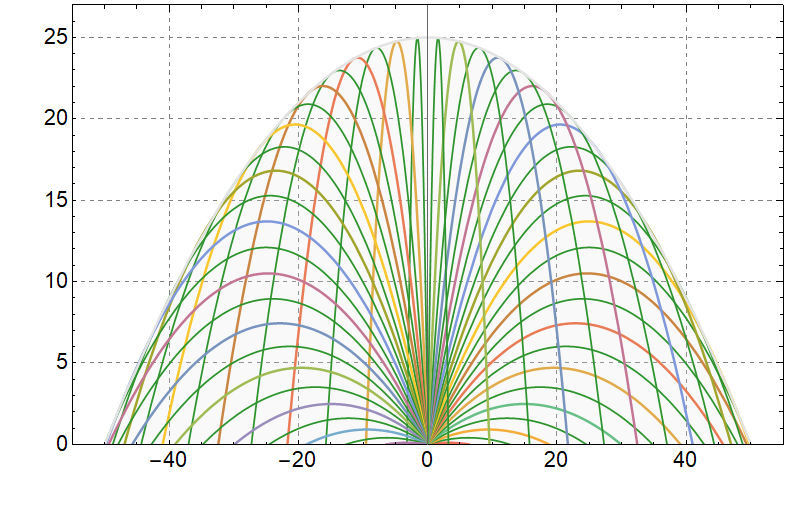
| b) Let's depict a set of trajectories, changing the angle $\varphi$ from $-\frac{\pi}{2}$ to $\frac{\pi}{2}$: | | b) Let's depict a set of trajectories, changing the angle $\varphi$ from $-\frac{\pi}{2}$ to $\frac{\pi}{2}$: |
| | | |
|  | |  |
| | | |
| Having analyzed the domain of definition of the function $(1)$, we emphasize that the expression under the root is not negative | | Having analyzed the domain of definition of the function $(1)$, we emphasize that the expression under the root is not negative |
| | | |
| $$ | | $$ |
| v^4-2gv^2y-g^2x^2 \geq 0 | | v^4-2gv^2y-g^2x^2 \geq 0 |
| $$ | | $$ |
| | | |
| $$ | | $$ |
| y \leq \frac{v^2}{2g}-\frac{gx^2}{2v^2} | | y \leq \frac{v^2}{2g}-\frac{gx^2}{2v^2} |
| $$ | | $$ |
| | | |
| c) From $(1)$, we get: | | c) From $(1)$, we get: |
| | | |
| $$ | | $$ |
| v_{x}v_{y}x-\frac{1}{2}gx^{2}=v_{x}^{2}y | | v_{x}v_{y}x-\frac{1}{2}gx^{2}=v_{x}^{2}y |
| $$ | | $$ |
| | | |
| We will use the formula for horizontal and vertical coordinates obtained in [1.3.6](../1.3.6): | | We will use the formula for horizontal and vertical coordinates obtained in [1.3.6](../1.3.6): |
| | | |
| $$ | | $$ |
| y(t) = vt \cdot \sin{\varphi} - \frac{gt^2}{2} | | y(t) = vt \cdot \sin{\varphi} - \frac{gt^2}{2} |
| $$ | | $$ |
| | | |
| $$ | | $$ |
| x(t) = vt \cdot \cos{\varphi} | | x(t) = vt \cdot \cos{\varphi} |
| $$ | | $$ |
| | | |
| Let $\xi =\cos{\varphi}$, | | Let $\xi =\cos{\varphi}$, |
| | | |
| $$ | | $$ |
| v_y = v \xi | | v_y = v \xi |
| $$ | | $$ |
| | | |
| $$ | | $$ |
| v_x = v \sqrt{1-\xi^2} | | v_x = v \sqrt{1-\xi^2} |
| $$ | | $$ |
| | | |
| Getting a function | | Getting a function |
| | | |
| $$ | | $$ |
| v(\xi )=\frac{\sqrt{g}x}{\sqrt{2 \xi\sqrt{1-\xi^{2}}x-\xi^{2}y}} \tag{2} | | v(\xi )=\frac{\sqrt{g}x}{\sqrt{2 \xi\sqrt{1-\xi^{2}}x-\xi^{2}y}} \tag{2} |
| $$ | | $$ |
| | | |
| The maximum of the radical value corresponds to the minimum of the function (2) | | The maximum of the radical value corresponds to the minimum of the function (2) |
| | | |
| $$ | | $$ |
| \frac{\sqrt{x^{2}+y^{2}-y}}{2} \rightarrow \max | | \frac{\sqrt{x^{2}+y^{2}-y}}{2} \rightarrow \max |
| $$ | | $$ |
| | | |
| Minimum of function $(2)$ | | Minimum of function $(2)$ |
| | | |
| $$ | | $$ |
| \fbox{$v^{2}=\frac{gx}{\sqrt{1+(\frac{y}{x})^{2}}-\frac{y}{x}}$} | | \fbox{$v^{2}=\frac{gx}{\sqrt{1+(\frac{y}{x})^{2}}-\frac{y}{x}}$} |
| $$ | | $$ |
| | | |
| #### Answer | | #### Answer |
| | | |
| $$ | | $$ |
| \tan\varphi=\frac{v^2\pm\sqrt{v^4-2gv^2y-g^2x^2}}{gx}. | | \tan\varphi=\frac{v^2\pm\sqrt{v^4-2gv^2y-g^2x^2}}{gx}. |
| $$ | | $$ |
| | | |
| $$ | | $$ |
| y=\frac{v^2}{2g}-\frac{gx^2}{2v^2} | | y=\frac{v^2}{2g}-\frac{gx^2}{2v^2} |
| $$ | | $$ |
| | | |
| $$ | | $$ |
| v_{\text{min}}=\sqrt{g(y+\sqrt{x^2+y^2})} | | v_{\text{min}}=\sqrt{g(y+\sqrt{x^2+y^2})} |
| $$ | | $$ |