Statement
3.1.13. [Insert the problem statement]
Solution
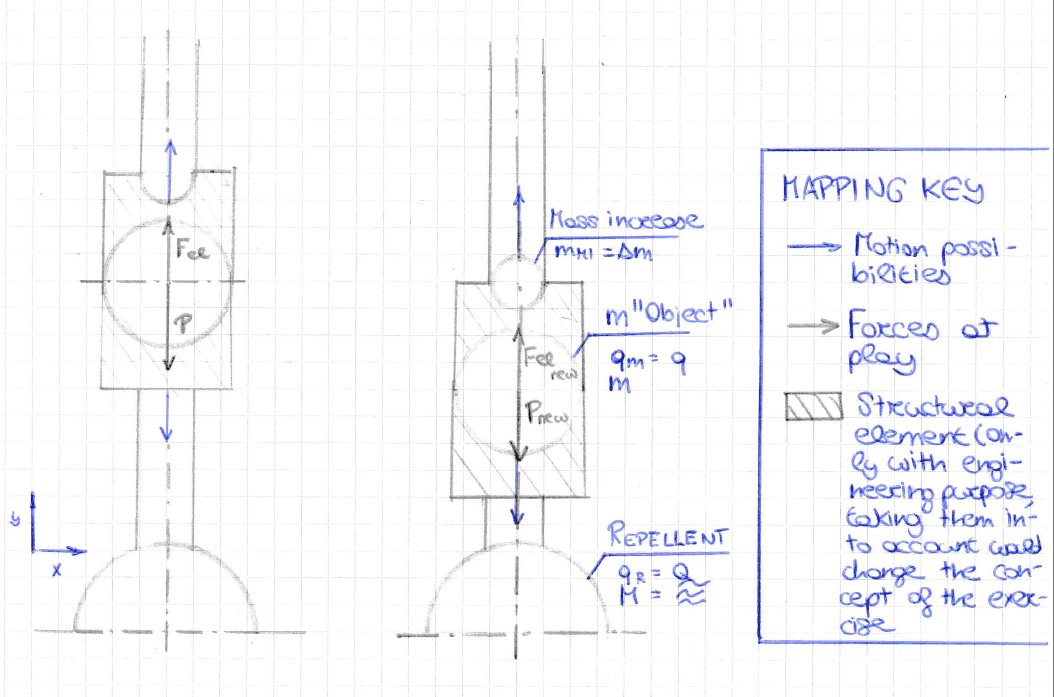
According to Problems~3.1.12 and~3.1.13, we consider the following configuration.
A small charged body of mass
This modification alters the equilibrium distance. Initially, the balance of forces gives
from which
After adding the mass
leading to
The simplest way to solve the problem is by using the principle of conservation of mechanical energy, since the system is conservative:
Thus,
\begin{equation}
E_{\text{el}}(r) + E_{\text{grav}}(r)
E_{\text{el}}(r') + E_{\text{grav}}(r') + E_{\text{kin}}.
\end{equation}
Expanding each term, we obtain
\begin{equation}
(m+\Delta m) g r + \frac{k Q q}{r}
(m+\Delta m) g r' + \frac{k Q q}{r'} + \frac{1}{2}(m+\Delta m) v^2.
\end{equation}
Substituting the expression
the equation becomes
\begin{equation}
(m+\Delta m) g r + \frac{k Q q}{r}
(m+\Delta m) g \sqrt{\frac{k Q q}{(m + \Delta m) g}}
+
\frac{k Q q}{\sqrt{\frac{k Q q}{(m + \Delta m) g}}}
+
\frac{1}{2}(m+\Delta m) v^2.
\end{equation}
Solving for the velocity, the maximum speed is found to be
\begin{equation}
v_{\max}
\sqrt{
2 g R
\left(
1 + \frac{m}{m+\Delta m}
- 2 \sqrt{\frac{m}{m+\Delta m}}
\right)
}.
\end{equation}
This result can also be justified by analyzing the motion itself. Since no dissipative forces (such as air resistance) are present, the system is conservative, and the motion is therefore simple harmonic motion (SHM).
For SHM, the velocity is given by
where
The amplitude corresponds to the difference between the original equilibrium position and the new one:
\begin{equation}
A = r - r'
= \sqrt{\frac{k Q q}{m g}}
\sqrt{\frac{k Q q}{(m + \Delta m) g}}.
\end{equation}
Substituting this expression into the SHM formulas yields an equivalent result to that obtained via energy conservation. Although this approach is equally valid, it requires a Taylor expansion, which unnecessarily complicates the analysis.
Answer
[Insert a concise answer or boxed result]