$1.1.1.$ Figure$^{*)}$ shows a "blurred photograph" of a jet airplane in flight. The length of the airplane is $30 \text{ m}$, the length of its nose is $10 \text{ m}$. Determine from this "photograph" the speed of the airplane. The shutter exposure time is $0.1 \text{ s}$. The shape of the airplane is shown in the figure with a dashed line.
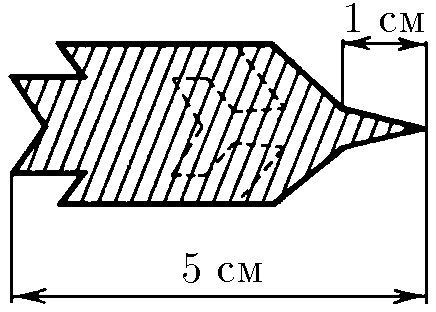
To find the velocity of the airplane it is necessary to determine the vector of its displacement for the time $T$, during which the shutter of the camera is open. Let us select the initial point $1$ in the photograph and determine the distance it will move during the time $T$. The length of the airplane must be subtracted from the total length of the photograph. Taking into account the scale, the modulus of displacement will be
$$
l=50-30 = 20 \text{ m}
$$
For the $0.1 \text{ s}$ aiplane covered a distance of $20\text{ m}$, which corresponds to velocity of
$$
\boxed{v = \frac{l}{T} = 200\text{ m/s}}
$$
#### O'zbekcha
$1.1.1.$ Rasmda*) uchayotgan reaktiv samolyotning
harakatdan ”siljigan” rasmi keltirilgan. Samolyot uzunligi $30 \text{ m}$
burun qismining uzunligi $10 \text{ m}$. Mazkur ”siljigan” rasmga
ko’ra samolyot tezligini aniqlang ($m/s$). Rasmga olishda fotoapparat ekspozitsiya vaqti $0.1 \text{ s}$. Samolyot shakli rasmda
shtrixlab ko’rsatilgan

Samolyotning tezligini aniqlash uchun kamera yopqichi ochiq bo‘lgan $T$ vaqt davomida uning siljish vektorini aniqlash zarur. Fotosuratda boshlang‘ich $1$ - nuqtani tanlaymiz va ushbu nuqta $T$ vaqt ichida qancha masofaga siljishini aniqlaymiz. Fotosuratdagi umumiy uzunlikdan samolyotning uzunligini ayirish kerak. Masshtabni hisobga olgan holda, siljishning moduli quyidagicha bo‘ladi:
$$
l=50-30 = 20 \text{ m}
$$
$0.1 \text{ s}$ davomida samalyot $20\text{ m}$ masofani o'tadi, bu orqali tezlikni topsak:
$$
\boxed{v = \frac{l}{T} = 200\text{ m/s}}
$$
ещё строк без изменений 8
### Statement
### Statement
$1.1.1.$ Figure$^{*)}$ shows a "blurred photograph" of a jet airplane in flight. The length of the airplane is $30 \text{ m}$, the length of its nose is $10 \text{ m}$. Determine from this "photograph" the speed of the airplane. The shutter exposure time is $0.1 \text{ s}$. The shape of the airplane is shown in the figure with a dashed line.
$1.1.1.$ Figure$^{*)}$ shows a "blurred photograph" of a jet airplane in flight. The length of the airplane is $30 \text{ m}$, the length of its nose is $10 \text{ m}$. Determine from this "photograph" the speed of the airplane. The shutter exposure time is $0.1 \text{ s}$. The shape of the airplane is shown in the figure with a dashed line.


To find the velocity of the airplane it is necessary to determine the vector of its displacement for the time $T$, during which the shutter of the camera is open. Let us select the initial point $1$ in the photograph and determine the distance it will move during the time $T$. The length of the airplane must be subtracted from the total length of the photograph. Taking into account the scale, the modulus of displacement will be
To find the velocity of the airplane it is necessary to determine the vector of its displacement for the time $T$, during which the shutter of the camera is open. Let us select the initial point $1$ in the photograph and determine the distance it will move during the time $T$. The length of the airplane must be subtracted from the total length of the photograph. Taking into account the scale, the modulus of displacement will be
$$
$$
l=50-30 = 20 \text{ m}
l=50-30 = 20 \text{ m}
$$
$$
For the $0.1 \text{ s}$ aiplane covered a distance of $20\text{ m}$, which corresponds to velocity of
For the $0.1 \text{ s}$ aiplane covered a distance of $20\text{ m}$, which corresponds to velocity of
$$
$$
\boxed{v = \frac{l}{T} = 200\text{ m/s}}
\boxed{v = \frac{l}{T} = 200\text{ m/s}}
$$
$$
#### O'zbekcha
#### O'zbekcha
$1.1.1.$ Rasmda*) uchayotgan reaktiv samolyotning
$1.1.1.$ Rasmda*) uchayotgan reaktiv samolyotning
harakatdan ”siljigan” rasmi keltirilgan. Samolyot uzunligi $30 \text{ m}$
harakatdan ”siljigan” rasmi keltirilgan. Samolyot uzunligi $30 \text{ m}$
burun qismining uzunligi $10 \text{ m}$. Mazkur ”siljigan” rasmga
burun qismining uzunligi $10 \text{ m}$. Mazkur ”siljigan” rasmga
ko’ra samolyot tezligini aniqlang ($m/s$). Rasmga olishda fotoapparat ekspozitsiya vaqti $0.1 \text{ s}$. Samolyot shakli rasmda
ko’ra samolyot tezligini aniqlang ($m/s$). Rasmga olishda fotoapparat ekspozitsiya vaqti $0.1 \text{ s}$. Samolyot shakli rasmda
shtrixlab ko’rsatilgan
shtrixlab ko’rsatilgan


Samolyotning tezligini aniqlash uchun kamera yopqichi ochiq bo‘lgan $T$ vaqt davomida uning siljish vektorini aniqlash zarur. Fotosuratda boshlang‘ich $1$ - nuqtani tanlaymiz va ushbu nuqta $T$ vaqt ichida qancha masofaga siljishini aniqlaymiz. Fotosuratdagi umumiy uzunlikdan samolyotning uzunligini ayirish kerak. Masshtabni hisobga olgan holda, siljishning moduli quyidagicha bo‘ladi:
Samolyotning tezligini aniqlash uchun kamera yopqichi ochiq bo‘lgan $T$ vaqt davomida uning siljish vektorini aniqlash zarur. Fotosuratda boshlang‘ich $1$ - nuqtani tanlaymiz va ushbu nuqta $T$ vaqt ichida qancha masofaga siljishini aniqlaymiz. Fotosuratdagi umumiy uzunlikdan samolyotning uzunligini ayirish kerak. Masshtabni hisobga olgan holda, siljishning moduli quyidagicha bo‘ladi:
$$
$$
l=50-30 = 20 \text{ m}
l=50-30 = 20 \text{ m}
$$
$$
$0.1 \text{ s}$ davomida samalyot $20\text{ m}$ masofani o'tadi, bu orqali tezlikni topsak:
$0.1 \text{ s}$ davomida samalyot $20\text{ m}$ masofani o'tadi, bu orqali tezlikni topsak: