| @@ -1,69 +1,51 @@ |
| | − | ### Statement |
| | + | ### Statement |
| | | |
| | − | \\\\\\\$6.2.12.\\\\\\\$ In a uniformly charged infinite plate, a spherical cavity was cut out as shown in the figure. Plate's thickness is \\\\\\\$h\\\\\\\$ and its bulk charge density is \\\\\\\$\\\\\\\\rho\\\\\\\$. What is the electric field strength at point \\\\\\\$A\\\\\\\$? At point \\\\\\\$B\\\\\\\$? Find the dependence of the electric field strength along the line \\\\\\\$OA\\\\\\\$ on the distance to the point \\\\\\\$O\\\\\\\$. |
| | + | **6.2.12.** In a uniformly charged infinite plate, a spherical cavity was cut out as shown in the figure. The plate's thickness is $h$ and its bulk charge density is $\rho$. |
| | | |
| | − | 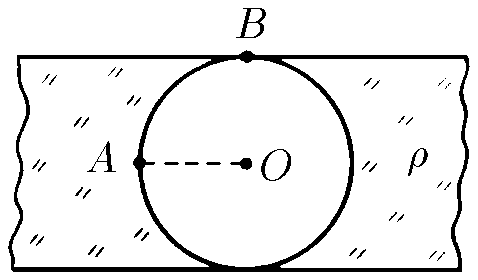 |
| | + | 1. What is the electric field strength at point $A$ (the center of the cavity)? |
| | + | 2. What is the electric field strength at point $B$ (on the surface of the plate directly above the center)? |
| | + | 3. Find the dependence of the electric field strength along the line $OA$ on the distance $r$ from the center $O$. |
| | | |
| | + | --- |
| | + | |
| | | ### Solution |
| | | |
| | − | The idea for solving this problem is to consider superposition principle: as cavity is uncharged, we can suppose that it exists a superposition of a plate (with charge density \\\\\\\$\\\\\\\\rho\\\\\\\$) and a sphere with charge density \\\\\\\$-\\\\\\\\rho\\\\\\\$. So, if we analyze the field in \\\\\\\$A\\\\\\\$ without cavity, we have two plates of thickness \\\\\\\$\\\\\\\\frac{h}{2}\\\\\\\$, one over \\\\\\\$A\\\\\\\$ and the other one under A, both with charge density \\\\\\\$\\\\\\\\rho\\\\\\\$, then field in \\\\\\\$A\\\\\\\$ is null. While for \\\\\\\$A\\\\\\\$ in the sphere's surface, applying Gauss's Law, |
| | + | The key to solving this problem is the **principle of superposition**. We can treat the cavity as a combination of a solid, uniformly charged plate (density $+\rho$) and a sphere of the same size with an opposite charge density ($-\rho$). |
| | | |
| | − | \\\\\\\$\\\\\\\$ |
| | − | -E_A\\\\\\\\cdot 4\\\\\\\\pi\\\\\\\\left(\\\\\\\\frac{h}{2}\\\\\\\\right)^2 = -\\\\\\\\frac{q_{enc}}{\\\\\\\\varepsilon_0} |
| | − | \\\\\\\$\\\\\\\$ |
| | + | #### Field at Point A |
| | + | In a solid infinite plate of thickness $h$, the electric field at the exact center (point $A$) is zero due to symmetry. Therefore, the field at $A$ is generated solely by the "negative" sphere. |
| | | |
| | − | as \\\\\\\$V = \\\\\\\\frac{4}{3}\\\\\\\\pi\\\\\\\\left(\\\\\\\\frac{h}{2}\\\\\\\\right)^3\\\\\\\$, so \\\\\\\$6\\\\\\\\frac{V}{h} = 4\\\\\\\\pi\\\\\\\\left(\\\\\\\\frac{h}{2}\\\\\\\\right)^2\\\\\\\$, and taking in account that \\\\\\\$\\\\\\\\rho = \\\\\\\\frac{q_{enc}}{V}\\\\\\\$ |
| | + | Using Gauss’s Law for the sphere at its surface ($r = h/2$): |
| | + | $$E_A \cdot 4\pi \left(\frac{h}{2}\right)^2 = \frac{Q_{enc}}{\varepsilon_0}$$ |
| | | |
| | − | #### Answer 1 |
| | + | Given $V = \frac{4}{3}\pi\left(\frac{h}{2}\right)^3$ and $Q_{enc} = \rho \cdot V$: |
| | + | $$E_A \cdot 4\pi \left(\frac{h}{2}\right)^2 = \frac{\rho \cdot \frac{4}{3}\pi\left(\frac{h}{2}\right)^3}{\varepsilon_0}$$ |
| | | |
| | − | \\\\\\\$\\\\\\\$ |
| | − | E_A = \\\\\\\\frac{\\\\\\\\rho h}{6\\\\\\\\varepsilon_0} |
| | − | \\\\\\\$\\\\\\\$ |
| | + | **Answer 1:** |
| | + | $$E_A = \frac{\rho h}{6\varepsilon_0}$$ |
| | | |
| | − | For point \\\\\\\$B\\\\\\\$, the way is similar: in this case the plate without cavity generates certain field in \\\\\\\$B\\\\\\\$, located on its surface. From Gauss's Law |
| | + | --- |
| | | |
| | − | \\\\\\\$\\\\\\\$ |
| | − | E_p\\\\\\\\cdot S = \\\\\\\\frac{q_t}{\\\\\\\\varepsilon_0} |
| | − | \\\\\\\$\\\\\\\$ |
| | + | #### Field at Point B |
| | + | Point $B$ is on the surface of the plate. |
| | + | 1. **Field from the solid plate ($E_p$):** By Gauss’s Law, the total field emerging from both sides of a plate is $\frac{\rho h}{\varepsilon_0}$. For just one side (at point $B$): |
| | + | $$E_{plate} = \frac{\rho h}{2\varepsilon_0}$$ |
| | + | 2. **Field from the "negative" sphere ($E_s$):** Point $B$ is on the surface of the sphere ($r = h/2$). As calculated in Part 1, the field from the sphere at its surface is: |
| | + | $$E_{sphere} = \frac{\rho h}{6\varepsilon_0}$$ |
| | | |
| | − | as \\\\\\\$S = \\\\\\\\frac{V}{h}\\\\\\\$, and \\\\\\\$\\\\\\\\rho = \\\\\\\\frac{q_t}{V}\\\\\\\$ |
| | + | The vectors point in opposite directions at $B$, so we subtract them: |
| | + | $$E_B = E_{plate} - E_{sphere} = \frac{\rho h}{2\varepsilon_0} - \frac{\rho h}{6\varepsilon_0}$$ |
| | | |
| | − | \\\\\\\$\\\\\\\$ |
| | − | E_p = \\\\\\\\frac{\\\\\\\\rho h}{\\\\\\\\varepsilon_0} |
| | − | \\\\\\\$\\\\\\\$ |
| | + | **Answer 2:** |
| | + | $$E_B = \frac{\rho h}{3\varepsilon_0}$$ |
| | | |
| | − | but, for one of the side of plate, field is \\\\\\\$E_B' = \\\\\\\\frac{E_p}{2} = \\\\\\\\frac{\\\\\\\\rho h}{2\\\\\\\\varepsilon_0}\\\\\\\$ Now, overlapping with field generated by sphere, |
| | + | --- |
| | | |
| | − | \\\\\\\$\\\\\\\$ |
| | − | E_B = E_B' - E_c |
| | − | \\\\\\\$\\\\\\\$ |
| | + | #### Field along line OA |
| | + | Since line $OA$ is at the center of the infinite plate, the plate's own contribution to the field is zero at every point along this line. Thus, the field depends only on the charged sphere. |
| | | |
| | − | where \\\\\\\$E_c = E_A\\\\\\\$, |
| | + | For any point at a distance $r$ inside the cavity ($0 \leq r \leq h/2$), we apply Gauss's Law to the sphere: |
| | + | $$E(r) \cdot 4\pi r^2 = \frac{\rho \cdot \frac{4}{3}\pi r^3}{\varepsilon_0}$$ |
| | | |
| | − | #### Answer 2 |
| | − | |
| | − | \\\\\\\$\\\\\\\$ |
| | − | E_B = \\\\\\\\frac{\\\\\\\\rho h}{3\\\\\\\\varepsilon_0} |
| | − | \\\\\\\$\\\\\\\$ |
| | − | |
| | − | As \\\\\\\$A\\\\\\\$ is on line \\\\\\\$OA\\\\\\\$, all points over that line "feel" only the electric field generated by sphere. From Gauss's Law |
| | − | |
| | − | \\\\\\\$\\\\\\\$ |
| | − | -E(r) \\\\\\\\cdot 4\\\\\\\\pi r^2 = -\\\\\\\\frac{q_{enc}}{\\\\\\\\varepsilon_0} |
| | − | \\\\\\\$\\\\\\\$ |
| | − | |
| | − | as \\\\\\\$V = \\\\\\\\frac{4}{3}\\\\\\\\pi r^3\\\\\\\$, so \\\\\\\$3\\\\\\\\frac{V}{r} = 4\\\\\\\\pi r^2\\\\\\\$, and \\\\\\\$\\\\\\\\rho = \\\\\\\\frac{q_{enc}}{V}\\\\\\\$ |
| | − | |
| | − | #### Answer 3 |
| | − | |
| | − | \\\\\\\$\\\\\\\$ |
| | − | E(r) = \\\\\\\\frac{\\\\\\\\rho r}{3\\\\\\\\varepsilon_0} |
| | − | \\\\\\\$\\\\\\\$ |
| | − | |
| | − | for \\\\\\\$0\\\\\\\\leq r \\\\\\\\leq \\\\\\\\frac{h}{2}\\\\\\\$. |
| | − | |
| | − | |
| | − | |
| | − | |
| | − | |
| | − | |
| | + | **Answer 3:** |
| | + | $$E(r) = \frac{\rho r}{3\varepsilon_0}$$ |