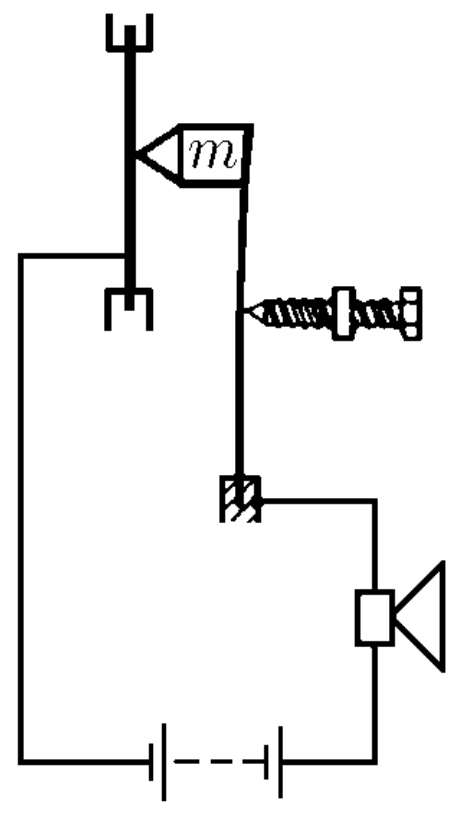
3.3.31. To measure small amplitudes of oscillations of a diaphragm making harmonic vibrations of high frequency $\omega$, a ”hammer” connected in an electrical circuit with a diaphragm and a telephone is used. The hammer of mass $m$ is pressed against the diaphragm with a force that is adjusted by a micrometer screw. When the contact of the hammer with the diaphragm is interrupted, the current in the circuit is interrupted and a rattling can be heard in the telephone. Determine the amplitude of the vibrations if the rattling begins when the force with which the hammer presses the diaphragm reaches the value $F$.
For problem $3.3.31$
Solution
This promlem is analogous to the previous one ($3.3.30$; if anything, look at the solution of the mentioned problem in russian). We can write for the hammer (projection onto the axis of oscillations)
$$F-N=ma,$$
where $N$ is the normal reaction force of the diaphragm, $a$ is the acceleration of the hammer.
The diaphragm perform harmonic oscillations, thus
$$a=\omega^2A\sin\omega t,$$
where $A$ is the oscillation amplitude of the diaphragm, $t$ is time period.
From the previous equations we can obtain
$$N=F-m\omega^2A\sin\omega t.$$
If the value of $F$ is larger than $m\omega^2A$, then $N>0$ and there will be no the rattling (since $-1\leqslant\sin\omega t\leqslant1$). The rattling begins, when