Новое решение

en/14.1.3.md
+76 −0
| @@ -0,0 +1,76 @@ | |||
| + | ### Statement | ||
| + | |||
| + | $14.1.3.$ [Insert the problem statement] | ||
| + | |||
| + | ### Solution | ||
| + | |||
| + |  | ||
| + | |||
| + | \documentclass[12pt,a4paper]{article} | ||
| + | \usepackage[english]{babel} | ||
| + | \usepackage{float} | ||
| + | \usepackage{wrapfig} | ||
| + | \usepackage{lmodern} | ||
| + | \usepackage[T1]{fontenc} | ||
| + | \usepackage[utf8]{inputenc} | ||
| + | \usepackage{microtype} | ||
| + | \usepackage{graphicx} | ||
| + | \usepackage{booktabs} | ||
| + | \usepackage{amsmath,amssymb} | ||
| + | \usepackage{hyperref} | ||
| + | \usepackage{csquotes} | ||
| + | \usepackage{geometry} | ||
| + | \usepackage{fancyhdr} | ||
| + | \usepackage{subcaption} | ||
| + | \usepackage{tikz} | ||
| + | \usepackage{array} | ||
| + | \usepackage{pgfplots} | ||
| + | \usepackage{wrapfig} | ||
| + | \usepackage{subcaption} | ||
| + | |||
| + | |||
| + | \begin{document} | ||
| + | |||
| + | \begin{center} | ||
| + | \Large \textbf{Statement} | ||
| + | \end{center} | ||
| + | |||
| + | At what angle to the horizon is a luminous object seen moving horizontally at | ||
| + | a speed $\beta c$ at the moment when it is above the observer? | ||
| + | |||
| + | \begin{center} | ||
| + | \Large \textbf{Solution} | ||
| + | \end{center} | ||
| + | |||
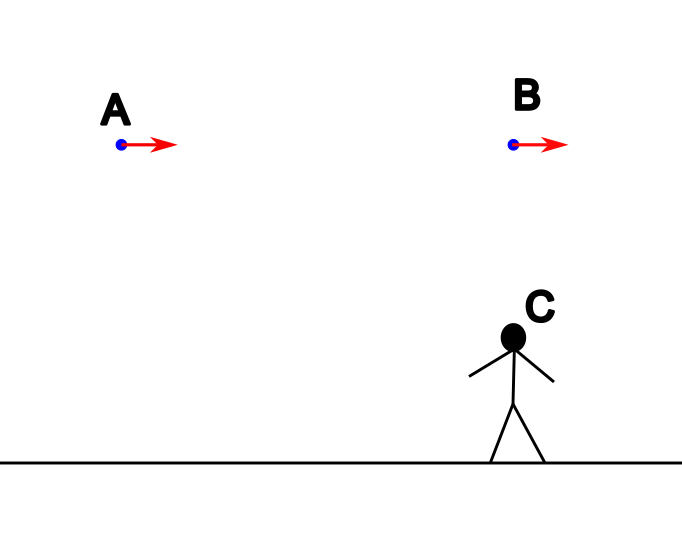
| + | The key idea of this problem is that light has a finite velocity $c$. To understand the solution, you may use the figure below: | ||
| + | |||
| + | \begin{figure}[H] | ||
| + | \centering | ||
| + | \includegraphics[width=0.5\linewidth]{14.1.3_Observer.png} | ||
| + | \caption{The point $C$ is at the observer's head. The red vectors are the velocity vectors of the object at each position.} | ||
| + | \end{figure} | ||
| + | |||
| + | The light needs a time $t_1 = \frac{\overline{AC}}{c}$ to travel from $A$ to $C$. In this time, the object also moves. When the object reaches point $B$, the light reaches point $C$ at the same time. The time taken by the object is $t_2 = \frac{\overline{AB}}{\beta c}$. Since these times must be equal, we have: | ||
| + | |||
| + | \begin{equation} | ||
| + | t_1 = t_2 \rightarrow \frac{\overline{AC}}{c} = \frac{\overline{AB}}{\beta c} \rightarrow \frac{\overline{AC}}{\overline{AB}} = \frac{1}{\beta} | ||
| + | \label{usingequation1} | ||
| + | \end{equation} | ||
| + | |||
| + | The angle between $\overline{AB}$ and $\overline{AC}$ can be calculated as: | ||
| + | |||
| + | \begin{equation} | ||
| + | \cos\alpha = \frac{\overline{AB}}{\overline{AC}} \rightarrow \alpha = \cos^{-1} \left(\frac{\overline{AB}}{\overline{AC}}\right) | ||
| + | \end{equation} | ||
| + | |||
| + | Using equation \ref{usingequation1} we obtain: | ||
| + | |||
| + | \begin{equation} | ||
| + | \alpha = \cos^{-1} \left(\frac{\overline{AB}}{\overline{AC}}\right) = \cos^{-1} (\beta) | ||
| + | \end{equation} | ||
| + | |||
| + | \end{document} | ||
| + | |||
| + | #### Answer | ||
| + | |||
| + | [Insert a concise answer or boxed result] | ||
| @@ -0,0 +1,76 @@ | |||
| ### Statement | |||
| $14.1.3.$ [Insert the problem statement] | |||
| ### Solution | |||
|  | |||
| \documentclass[12pt,a4paper]{article} | |||
| \usepackage[english]{babel} | |||
| \usepackage{float} | |||
| \usepackage{wrapfig} | |||
| \usepackage{lmodern} | |||
| \usepackage[T1]{fontenc} | |||
| \usepackage[utf8]{inputenc} | |||
| \usepackage{microtype} | |||
| \usepackage{graphicx} | |||
| \usepackage{booktabs} | |||
| \usepackage{amsmath,amssymb} | |||
| \usepackage{hyperref} | |||
| \usepackage{csquotes} | |||
| \usepackage{geometry} | |||
| \usepackage{fancyhdr} | |||
| \usepackage{subcaption} | |||
| \usepackage{tikz} | |||
| \usepackage{array} | |||
| \usepackage{pgfplots} | |||
| \usepackage{wrapfig} | |||
| \usepackage{subcaption} | |||
| \begin{document} | |||
| \begin{center} | |||
| \Large \textbf{Statement} | |||
| \end{center} | |||
| At what angle to the horizon is a luminous object seen moving horizontally at | |||
| a speed $\beta c$ at the moment when it is above the observer? | |||
| \begin{center} | |||
| \Large \textbf{Solution} | |||
| \end{center} | |||
| The key idea of this problem is that light has a finite velocity $c$. To understand the solution, you may use the figure below: | |||
| \begin{figure}[H] | |||
| \centering | |||
| \includegraphics[width=0.5\linewidth]{14.1.3_Observer.png} | |||
| \caption{The point $C$ is at the observer's head. The red vectors are the velocity vectors of the object at each position.} | |||
| \end{figure} | |||
| The light needs a time $t_1 = \frac{\overline{AC}}{c}$ to travel from $A$ to $C$. In this time, the object also moves. When the object reaches point $B$, the light reaches point $C$ at the same time. The time taken by the object is $t_2 = \frac{\overline{AB}}{\beta c}$. Since these times must be equal, we have: | |||
| \begin{equation} | |||
| t_1 = t_2 \rightarrow \frac{\overline{AC}}{c} = \frac{\overline{AB}}{\beta c} \rightarrow \frac{\overline{AC}}{\overline{AB}} = \frac{1}{\beta} | |||
| \label{usingequation1} | |||
| \end{equation} | |||
| The angle between $\overline{AB}$ and $\overline{AC}$ can be calculated as: | |||
| \begin{equation} | |||
| \cos\alpha = \frac{\overline{AB}}{\overline{AC}} \rightarrow \alpha = \cos^{-1} \left(\frac{\overline{AB}}{\overline{AC}}\right) | |||
| \end{equation} | |||
| Using equation \ref{usingequation1} we obtain: | |||
| \begin{equation} | |||
| \alpha = \cos^{-1} \left(\frac{\overline{AB}}{\overline{AC}}\right) = \cos^{-1} (\beta) | |||
| \end{equation} | |||
| \end{document} | |||
| #### Answer | |||
| [Insert a concise answer or boxed result] | |||