Statement
14.1.3. [Insert the problem statement]
Solution
\documentclass[12pt,a4paper]{article}
\usepackage[english]{babel}
\usepackage{float}
\usepackage{wrapfig}
\usepackage{lmodern}
\usepackage[T1]{fontenc}
\usepackage[utf8]{inputenc}
\usepackage{microtype}
\usepackage{graphicx}
\usepackage{booktabs}
\usepackage{amsmath,amssymb}
\usepackage{hyperref}
\usepackage{csquotes}
\usepackage{geometry}
\usepackage{fancyhdr}
\usepackage{subcaption}
\usepackage{tikz}
\usepackage{array}
\usepackage{pgfplots}
\usepackage{wrapfig}
\usepackage{subcaption}
\begin{document}
\begin{center}
\Large \textbf{Statement}
\end{center}
At what angle to the horizon is a luminous object seen moving horizontally at
a speed
\begin{center}
\Large \textbf{Solution}
\end{center}
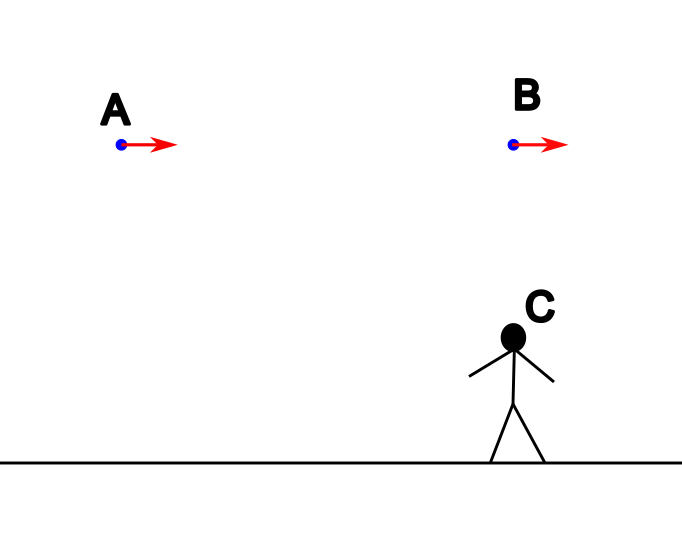
The key idea of this problem is that light has a finite velocity
\begin{figure}[H]
\centering
\includegraphics[width=0.5\linewidth]{14.1.3_Observer.png}
\caption{The point
\end{figure}
The light needs a time
The angle between
Using equation usingequation1 we obtain:
\end{document}
Answer
[Insert a concise answer or boxed result]