What should happen is the same number of molecules that are already in $V=1 mm^3$ should appear in $V.$ Total of molecules in the room (my bathroom after i take a shower $:)$ ): $$N=N_{A} \cdot \frac{PV_0}{RT}\approx N_{A} \cdot \frac{10^5 \cdot 10}{8.3 \cdot 300}\approx10^{26}$$ We need:$$n=N\cdot \frac{V}{V_0} \approx 10^{16}$$Probability of existing of $n$ molecules is $1$. Probability of existing in $V$ for $1$ molecule in $p= \frac{V}{V_0}.$
So final answer is $$P= (\frac{V}{V_0})^n=(\frac{V}{V_0})^{N \cdot \frac{V}{V_0}}=x^{Nx}, x=\frac{V}{V_0}$$In our case $\frac{V}{V_0}=10^{-10}$ and $P=10^{-10^{16}}$, which is close to Savchenko's estimation. The upper power depends strongly on temperature and volume.
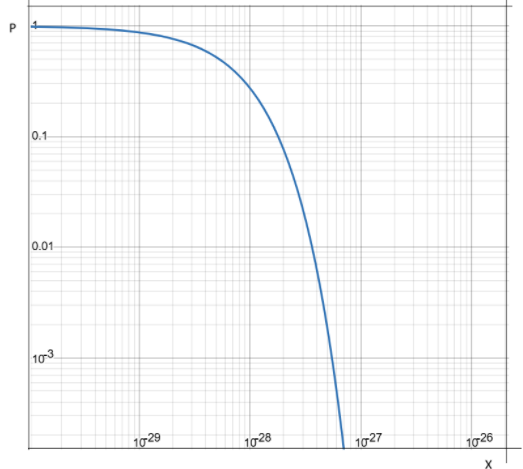
We can plot $P(x)$ and see that $P=10^{-4}%$ if $x=\frac{V}{V_0}\approx10^{-27}$, so $V=10^{-17} mm^3$
Intereating to notice, that with decreasing of $x$,$P$ goes to $1$.
Explanation in terms of our model is that if we consider a volume less than length of free fly of molecule, there should be all pairs of colliding molesules, so double density.
But much more truthful is the next fact:
The key postulate of thermodynamix say that we consider a system that has many enough partickles, so fluctuations of $n$ are negligible. But with decreasing of volume, we can no longer have this fact true.