Правка разделов «Statement», «Solution», «Answer»

en/14.2.17.md
+12 −3
| @@ -1,13 +1,22 @@ | |||
| ### Statement | |||
| − | $14.2.17.$ [Insert the problem statement] | ||
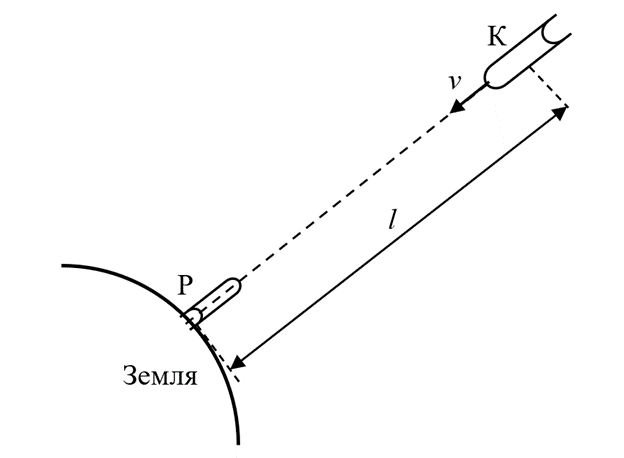
| + | $14.2.17.$ A spaceship moves toward Earth at a velocity $v$. When the distance to the ship measured from Earth was $l$, a rocket was launched from Earth. After what time from the launch will the rocket meet the spaceship according to observations from Earth and from the spaceship, if the rocket moved toward the spaceship: a) at a velocity $u$? b) with an acceleration $a$? | ||
| ### Solution | |||
| − |  | ||
| + | a) Relative to the Earth's reference frame, the time taken for the spaceship and the rocket to meet is calculated as: | ||
| + | $$\tau_1 = l / (u + v)$$ | ||
| + | Let us use the Lorentz transformation for time when changing to the spaceship's reference frame: | ||
| + | $$\tau_2 = \frac{\tau_1 - Vx / c^2}{\sqrt{1 - V^2 / c^2}}$$Here, $V = -v$ and $x = u\tau_1$. Substituting these values yields: | ||
| + | $$\tau_2 = \frac{\tau_1 + vu\tau_1 / c^2}{\sqrt{1 - v^2 / c^2}} = \tau_1 \left( \frac{1 + vu / c^2}{\sqrt{1 - v^2 / c^2}} \right)$$b) Relative to the Earth's reference frame, the coordinates of the rocket and the spaceship are expressed as:$$x_r(t) = \frac{at^2}{2}$$$$x_s(t) = l - vt$$Equating these functions gives a quadratic equation, from which we calculate the time of collision (discarding the negative root): | ||
| + | $$l - v\tau_1 = \frac{a\tau_1^2}{2}$$$$\tau_1^2 + \frac{2v}{a}\tau_1 - \frac{2l}{a} = 0$$$$\tau_1 = -\frac{v}{a} \pm \sqrt{\left(\frac{v}{a}\right)^2 + \frac{2l}{a}}$$$$\tau_1 = \frac{v}{a} \left( \sqrt{1 + \frac{2al}{v^2}} - 1 \right)$$Let us use the Lorentz transformation for time when changing to the spaceship's reference frame: | ||
| + | $$\tau_2 = \frac{\tau_1 - Vx / c^2}{\sqrt{1 - V^2 / c^2}}$$Here, $V = -v$ and $x = a\tau_1^2 / 2$. | ||
| + | Substituting these values yields:$$\tau_2 = \frac{\tau_1 + \frac{va\tau_1^2}{2c^2}}{\sqrt{1 - v^2 / c^2}} = \tau_1 \left( 1 + \frac{va\tau_1}{2c^2} \right) / \sqrt{1 - v^2 / c^2}$$ | ||
| #### Answer | |||
| − | [Insert a concise answer or boxed result] | ||
| + | a) $\tau_1 = l / (u + v)$, $\tau_2 = \tau_1 \left( 1 + vu / c^2 \right) / \sqrt{1 - v^2 / c^2}$;\ | ||
| + | b) $\tau_1 = \frac{v}{a} \left( \sqrt{1 + \frac{2al}{v^2}} - 1 \right)$, $\tau_2 = \tau_1 \left( 1 + \frac{va\tau_1}{2c^2} \right) / \sqrt{1 - v^2 / c^2}$. | ||
| @@ -1,13 +1,22 @@ | |||
| ### Statement | ### Statement | ||
| $14.2.17.$ [Insert the problem statement] | $14.2.17.$ A spaceship moves toward Earth at a velocity $v$. When the distance to the ship measured from Earth was $l$, a rocket was launched from Earth. After what time from the launch will the rocket meet the spaceship according to observations from Earth and from the spaceship, if the rocket moved toward the spaceship: a) at a velocity $u$? b) with an acceleration $a$? | ||
| ### Solution | ### Solution | ||
|  | ||
| a) Relative to the Earth's reference frame, the time taken for the spaceship and the rocket to meet is calculated as: | |||
| $$\tau_1 = l / (u + v)$$ | |||
| Let us use the Lorentz transformation for time when changing to the spaceship's reference frame: | |||
| $$\tau_2 = \frac{\tau_1 - Vx / c^2}{\sqrt{1 - V^2 / c^2}}$$Here, $V = -v$ and $x = u\tau_1$. Substituting these values yields: | |||
| $$\tau_2 = \frac{\tau_1 + vu\tau_1 / c^2}{\sqrt{1 - v^2 / c^2}} = \tau_1 \left( \frac{1 + vu / c^2}{\sqrt{1 - v^2 / c^2}} \right)$$b) Relative to the Earth's reference frame, the coordinates of the rocket and the spaceship are expressed as:$$x_r(t) = \frac{at^2}{2}$$$$x_s(t) = l - vt$$Equating these functions gives a quadratic equation, from which we calculate the time of collision (discarding the negative root): | |||
| $$l - v\tau_1 = \frac{a\tau_1^2}{2}$$$$\tau_1^2 + \frac{2v}{a}\tau_1 - \frac{2l}{a} = 0$$$$\tau_1 = -\frac{v}{a} \pm \sqrt{\left(\frac{v}{a}\right)^2 + \frac{2l}{a}}$$$$\tau_1 = \frac{v}{a} \left( \sqrt{1 + \frac{2al}{v^2}} - 1 \right)$$Let us use the Lorentz transformation for time when changing to the spaceship's reference frame: | |||
| $$\tau_2 = \frac{\tau_1 - Vx / c^2}{\sqrt{1 - V^2 / c^2}}$$Here, $V = -v$ and $x = a\tau_1^2 / 2$. | |||
| Substituting these values yields:$$\tau_2 = \frac{\tau_1 + \frac{va\tau_1^2}{2c^2}}{\sqrt{1 - v^2 / c^2}} = \tau_1 \left( 1 + \frac{va\tau_1}{2c^2} \right) / \sqrt{1 - v^2 / c^2}$$ | |||
| #### Answer | #### Answer | ||
| [Insert a concise answer or boxed result] | a) $\tau_1 = l / (u + v)$, $\tau_2 = \tau_1 \left( 1 + vu / c^2 \right) / \sqrt{1 - v^2 / c^2}$;\ | ||
| b) $\tau_1 = \frac{v}{a} \left( \sqrt{1 + \frac{2al}{v^2}} - 1 \right)$, $\tau_2 = \tau_1 \left( 1 + \frac{va\tau_1}{2c^2} \right) / \sqrt{1 - v^2 / c^2}$. | |||