Statement
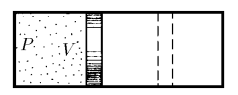
5.6.12. In a cylindrical vessel, a movable piston covers the volume of gas V at pressure
P. There is a vacuum on the other side of the piston. The plunger is released.
What work will the gas do on the piston, if the volume of gas when moving the
piston will double, and its pressure will be: a) remain constant; b) increase
with increasing volume linearly to a pressure of 2P?
Solution
We have a cylindrical vessel, with a movable piston with a gas on its left side, and vacuum on the right side. The gas is at pressure P and volume V. We need the work done by the gas on the piston, if the volume of the gas when moving the piston will double, and its pressure will be:
a)remain constant
b)increase with increasing volume linearly yo a pressure of
Assuming that we're working with ideal gases, and gas pushes the piston with a constant force, the work will be:
Let's go with a)
And the cosine of 0 is 1
Where S is the cross sectional area
The initial volume of the gas is:
And the final volume:
Then
Substituting this in the work we'll have:
For b)
We know that for a linear function
In our case, we have a
And substituting this in
If we graph this function, the work will be the area of the trapezoid under this two points, wich is (bass minor + base major) times height over 2
So
Answer
a)
b)