Light rays lying in a plane perpendicular to the axis of a glass semicylinder fall onto its flat surface at an angle of $45^{\circ}$. From which part of the lateral surface of the semicylinder will the light rays emerge? The refractive index of glass is $n$.
Solution
Before solving the problem, we need to understand its essence.
To do this, let us rephrase the question: "What is the range of the transmitting region on the curved surface of the cylinder from which light emerges?"
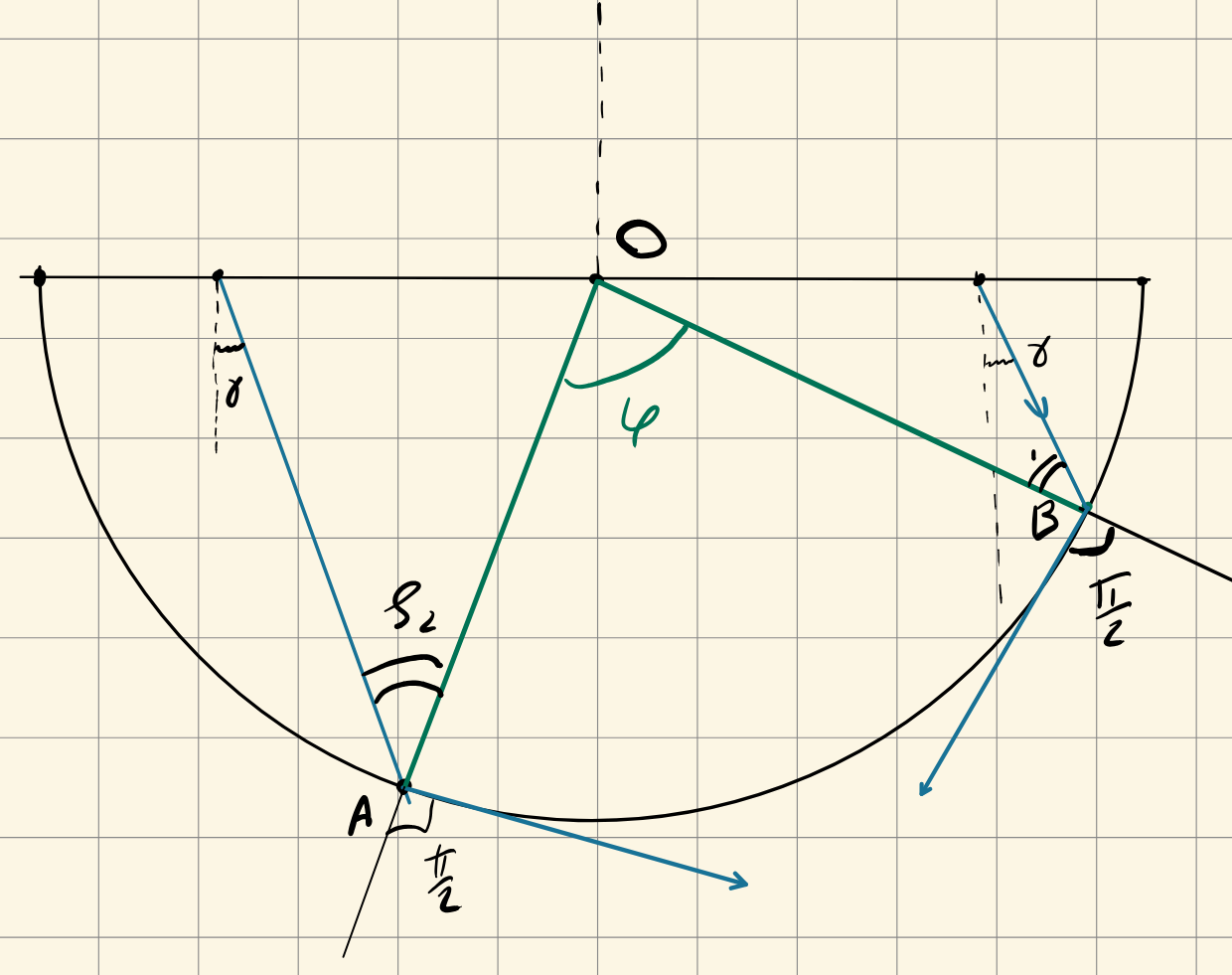
Now we understand that we are required to find the angle between the two boundary points (by boundary points I mean the points on the cylinder where rays will not pass through). We will consider the semicircle of the cylinder — that is, a top view.
(1) Finding the boundary points A and B.
Suppose we have a ray emerging from the interior of the semicircle to the outside. Then consider the projection onto the axis perpendicular to the tangent — i.e., onto the radius of the semicircle — and write Snell's law for this axis.
$$n \sin(\omega) = \sin(\sigma)$$
Since the rays emerge when $\sigma \leq \frac{\pi}{2}$, we have two boundary points A and B with the same equation. Thus we get:
\begin{cases} n \sin(\rho_{1}) = \sin(\sigma) \ n \sin(\rho_{2}) = \sin(\sigma) \end{cases}
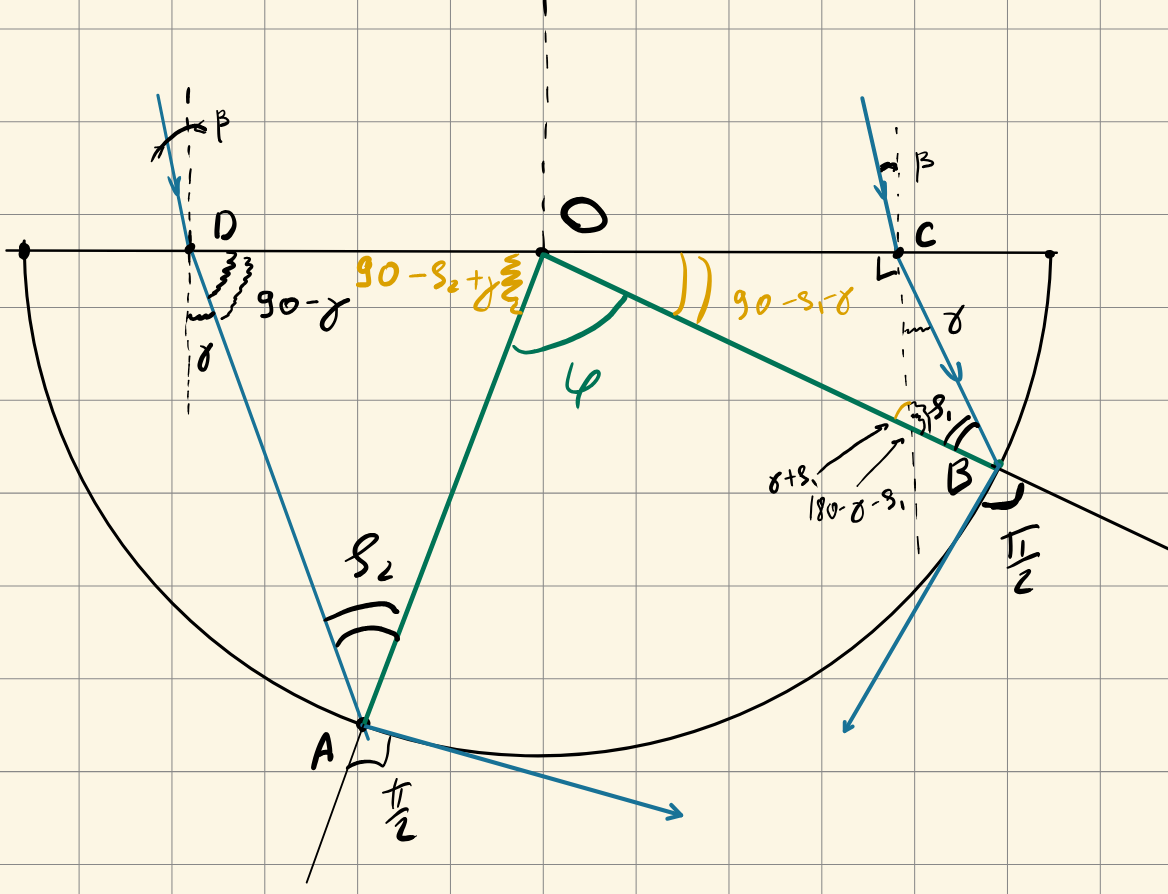
(2) We have found the main boundary points A and B. Now, through geometry, we need to find $\phi$.
From points D and C, draw rays from the external medium to points A and B respectively. Then we have triangles $\triangle DOA$ and $\triangle CBO$, where the angles $\rho_{1}$ and $\rho_{2}$ are known, and the angles ODA and OCB are equal to $\frac{\pi}{2} - \gamma$, where $\gamma$ is the angle of the refracted ray from the external medium into the cylinder (see Fig. 2).
$$\sin(\beta) = n \sin(\gamma) \quad \Rightarrow \quad \gamma = \arcsin\left(\frac{1}{n\sqrt{2}}\right)$$ ($\beta$ from the condition is $45^{\circ}$).