Новое решение

en/14.1.6.md
+87 −0
| @@ -0,0 +1,87 @@ | |||
| + | ### Statement | ||
| + | |||
| + | $14.1.6.$ [Insert the problem statement] | ||
| + | |||
| + | ### Solution | ||
| + | |||
| + | 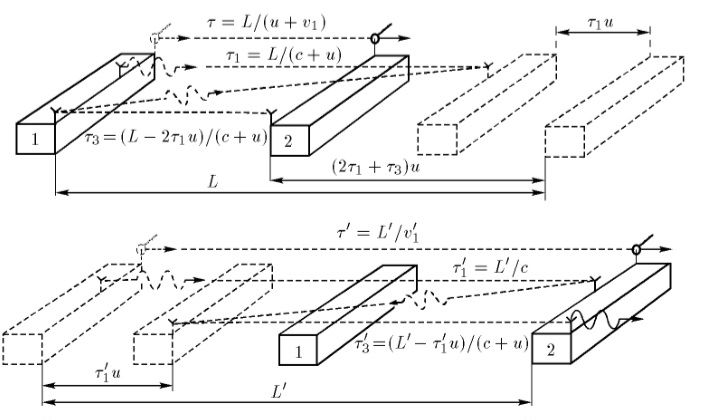 | ||
| + | |||
| + | |||
| + | We have: | ||
| + | |||
| + | · System S: attached to the first station (E1), at rest. | ||
| + | · System S': attached to the second station (E2), which moves with velocity v along the x-axis relative to S. | ||
| + | We consider v > 0 if E2 moves away from E1. | ||
| + | · At t = 0 (time of S), E1 is at x = 0 and E2 is at x = L. | ||
| + | · From E1, the following are emitted simultaneously: | ||
| + | · A light pulse (speed c). | ||
| + | · A test probe (constant speed u along x, to be determined). | ||
| + | · The light travels: E1 → E2 (bounce) → E1 (bounce) → E2. | ||
| + | The probe arrives at E2 exactly at the same instant that the light pulse returns to E2 for the third time. | ||
| + | |||
| + | The position of E2 as a function of time: x_{\text{E2}}(t) = L + v t. | ||
| + | |||
| + | · First leg (E1 → E2): | ||
| + | The light catches up to E2 when c t_1 = L + v t_1 \Rightarrow t_1 = \dfrac{L}{c - v}. | ||
| + | · Second leg (E2 → E1): | ||
| + | At t_1, the light reflects and returns to E1. The position of E1 is x = 0. | ||
| + | 0 = c t_1 - c(t_2 - t_1) \Rightarrow t_2 = 2t_1 = \dfrac{2L}{c - v}. | ||
| + | · Third leg (E1 → E2): | ||
| + | The light leaves E1 again at t_2 and reaches E2 at t_3. | ||
| + | c(t_3 - t_2) = L + v t_2 + v(t_3 - t_2). | ||
| + | Solving: t_3 - t_2 = \dfrac{L + v t_2}{c - v}. | ||
| + | Substituting t_2 and simplifying gives: | ||
| + | t_3 = \frac{2L}{c - v} + \frac{L(c+v)}{(c - v)^2} = L\,\frac{3c - v}{(c - v)^2}. | ||
| + | This is the total time the light takes to complete its path. | ||
| + | |||
| + | The probe moves with speed u and must catch E2 at the same instant t_3: | ||
| + | |||
| + | u t_3 = L + v t_3 \quad\Rightarrow\quad t_3 = \frac{L}{u - v} \quad (u > v). | ||
| + | |||
| + | Equating with the expression for t_3: | ||
| + | |||
| + | \frac{L}{u - v} = L\,\frac{3c - v}{(c - v)^2} \quad\Rightarrow\quad u - v = \frac{(c - v)^2}{3c - v}. | ||
| + | |||
| + | Therefore, the speed of the probe as measured from the first station is: | ||
| + | |||
| + | \boxed{u = v + \frac{(c - v)^2}{3c - v} = \frac{c(c + v)}{3c - v}}. | ||
| + | |||
| + | For an observer at E2 (system S'), the probe moves with speed u' given by the relativistic velocity addition formula. | ||
| + | Since S' moves at speed v relative to S: | ||
| + | |||
| + | u' = \frac{u - v}{1 - \dfrac{u v}{c^2}}. | ||
| + | |||
| + | Substituting u and simplifying: | ||
| + | |||
| + | u - v = \frac{(c - v)^2}{3c - v}, \qquad | ||
| + | 1 - \frac{u v}{c^2} = 1 - \frac{v\,c(c+v)}{c^2(3c - v)} = \frac{(3c - v)c - v(c+v)}{c(3c - v)} = \frac{(3c + v)(c - v)}{c(3c - v)}. | ||
| + | |||
| + | u' = \frac{\dfrac{(c - v)^2}{3c - v}}{\dfrac{(3c + v)(c - v)}{c(3c - v)}} = \frac{c(c - v)}{3c + v}. | ||
| + | |||
| + | \boxed{u' = \frac{c(c - v)}{3c + v}}. | ||
| + | |||
| + | This is the speed at which the probe approaches the second station according to E2's instruments. | ||
| + | |||
| + | By reciprocity between inertial systems, if E2 moves with speed v relative to E1, then E1 moves with speed -v relative to E2. Hence: | ||
| + | |||
| + | \boxed{v_{\text{E1 from E2}} = -v \quad \text{(magnitude } v\text{)}}. | ||
| + | |||
| + | The probe constitutes another inertial system (S''). For the probe: | ||
| + | |||
| + | · The first station moves with speed -u (magnitude u). | ||
| + | · The second station approaches with speed u' calculated above. | ||
| + | Thus, the probe's team records: | ||
| + | |||
| + | \boxed{v_{\text{E1}} = u = \frac{c(c+v)}{3c - v},\qquad | ||
| + | v_{\text{E2}} = u' = \frac{c(c - v)}{3c + v}}. | ||
| + | |||
| + | Special case: stations approaching each other | ||
| + | If the second station approaches the first with speed u (changing v \to -u), the formulas become: | ||
| + | |||
| + | · From E1: v_{\text{probe}} = c\,\dfrac{c-u}{3c+u}. | ||
| + | · From E2: v'_{\text{probe}} = c\,\dfrac{c+u}{3c-u}. | ||
| + | · From the probe: E1 recedes at c\,\dfrac{c-u}{3c+u}, E2 approaches at c\,\dfrac{c+u}{3c-u}. | ||
| + | |||
| + | #### Answer | ||
| + | |||
| + | [Insert a concise answer or boxed result] | ||
| @@ -0,0 +1,87 @@ | |||
| ### Statement | |||
| $14.1.6.$ [Insert the problem statement] | |||
| ### Solution | |||
|  | |||
| We have: | |||
| · System S: attached to the first station (E1), at rest. | |||
| · System S': attached to the second station (E2), which moves with velocity v along the x-axis relative to S. | |||
| We consider v > 0 if E2 moves away from E1. | |||
| · At t = 0 (time of S), E1 is at x = 0 and E2 is at x = L. | |||
| · From E1, the following are emitted simultaneously: | |||
| · A light pulse (speed c). | |||
| · A test probe (constant speed u along x, to be determined). | |||
| · The light travels: E1 → E2 (bounce) → E1 (bounce) → E2. | |||
| The probe arrives at E2 exactly at the same instant that the light pulse returns to E2 for the third time. | |||
| The position of E2 as a function of time: x_{\text{E2}}(t) = L + v t. | |||
| · First leg (E1 → E2): | |||
| The light catches up to E2 when c t_1 = L + v t_1 \Rightarrow t_1 = \dfrac{L}{c - v}. | |||
| · Second leg (E2 → E1): | |||
| At t_1, the light reflects and returns to E1. The position of E1 is x = 0. | |||
| 0 = c t_1 - c(t_2 - t_1) \Rightarrow t_2 = 2t_1 = \dfrac{2L}{c - v}. | |||
| · Third leg (E1 → E2): | |||
| The light leaves E1 again at t_2 and reaches E2 at t_3. | |||
| c(t_3 - t_2) = L + v t_2 + v(t_3 - t_2). | |||
| Solving: t_3 - t_2 = \dfrac{L + v t_2}{c - v}. | |||
| Substituting t_2 and simplifying gives: | |||
| t_3 = \frac{2L}{c - v} + \frac{L(c+v)}{(c - v)^2} = L\,\frac{3c - v}{(c - v)^2}. | |||
| This is the total time the light takes to complete its path. | |||
| The probe moves with speed u and must catch E2 at the same instant t_3: | |||
| u t_3 = L + v t_3 \quad\Rightarrow\quad t_3 = \frac{L}{u - v} \quad (u > v). | |||
| Equating with the expression for t_3: | |||
| \frac{L}{u - v} = L\,\frac{3c - v}{(c - v)^2} \quad\Rightarrow\quad u - v = \frac{(c - v)^2}{3c - v}. | |||
| Therefore, the speed of the probe as measured from the first station is: | |||
| \boxed{u = v + \frac{(c - v)^2}{3c - v} = \frac{c(c + v)}{3c - v}}. | |||
| For an observer at E2 (system S'), the probe moves with speed u' given by the relativistic velocity addition formula. | |||
| Since S' moves at speed v relative to S: | |||
| u' = \frac{u - v}{1 - \dfrac{u v}{c^2}}. | |||
| Substituting u and simplifying: | |||
| u - v = \frac{(c - v)^2}{3c - v}, \qquad | |||
| 1 - \frac{u v}{c^2} = 1 - \frac{v\,c(c+v)}{c^2(3c - v)} = \frac{(3c - v)c - v(c+v)}{c(3c - v)} = \frac{(3c + v)(c - v)}{c(3c - v)}. | |||
| u' = \frac{\dfrac{(c - v)^2}{3c - v}}{\dfrac{(3c + v)(c - v)}{c(3c - v)}} = \frac{c(c - v)}{3c + v}. | |||
| \boxed{u' = \frac{c(c - v)}{3c + v}}. | |||
| This is the speed at which the probe approaches the second station according to E2's instruments. | |||
| By reciprocity between inertial systems, if E2 moves with speed v relative to E1, then E1 moves with speed -v relative to E2. Hence: | |||
| \boxed{v_{\text{E1 from E2}} = -v \quad \text{(magnitude } v\text{)}}. | |||
| The probe constitutes another inertial system (S''). For the probe: | |||
| · The first station moves with speed -u (magnitude u). | |||
| · The second station approaches with speed u' calculated above. | |||
| Thus, the probe's team records: | |||
| \boxed{v_{\text{E1}} = u = \frac{c(c+v)}{3c - v},\qquad | |||
| v_{\text{E2}} = u' = \frac{c(c - v)}{3c + v}}. | |||
| Special case: stations approaching each other | |||
| If the second station approaches the first with speed u (changing v \to -u), the formulas become: | |||
| · From E1: v_{\text{probe}} = c\,\dfrac{c-u}{3c+u}. | |||
| · From E2: v'_{\text{probe}} = c\,\dfrac{c+u}{3c-u}. | |||
| · From the probe: E1 recedes at c\,\dfrac{c-u}{3c+u}, E2 approaches at c\,\dfrac{c+u}{3c-u}. | |||
| #### Answer | |||
| [Insert a concise answer or boxed result] | |||