Правка разделов «Statement», «Solution», «Answer»

en/13.3.5.md
+21 −3
| @@ -1,11 +1,29 @@ | |||
| ### Statement | |||
| − | $13.3.5.$ [Insert the problem statement] | ||
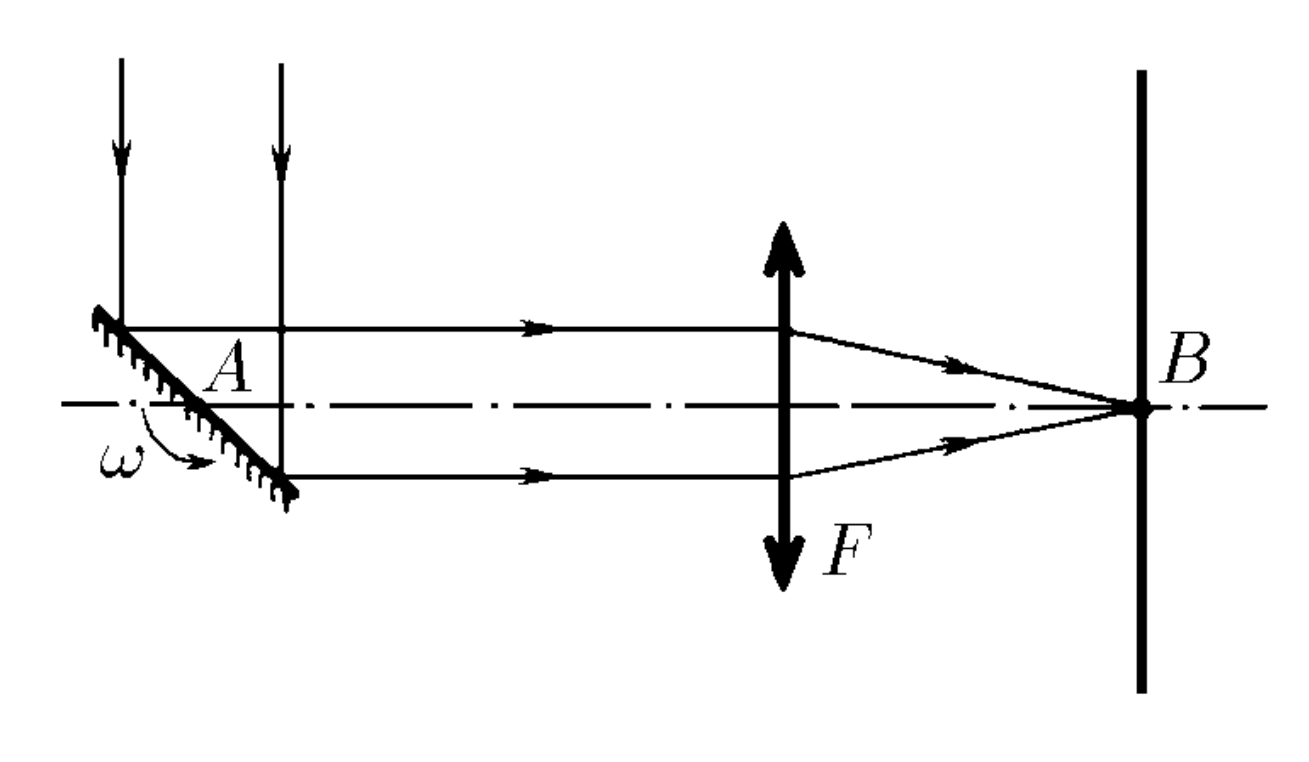
| + | $13.3.5$ On the optical axis $AB$ of the collecting lens there is a flat mirror rotating with an angular velocity $\omega$ around the axis passing through point $A$ and perpendicular to the drawing plane. A parallel beam of rays falls on the mirror, which after reflection focuses on the screen. The focal length of the lens is $f$. Find the speed of the light spot on the screen at the moment when it crosses the optical axis. The screen plane is perpendicular to the optical axis. | ||
| + |  | ||
| + | |||
| ### Solution | |||
| − | $13.3.5$ On the optical axis $AB$ of the collecting lens there is a flat mirror rotating with an angular velocity $\omega$ around the axis passing through point $A$ and perpendicular to the drawing plane. A parallel beam of rays falls on the mirror, which after reflection focuses on the screen. The focal length of the lens is $f$. Find the speed of the light spot on the screen at the moment when it crosses the optical axis. The screen plane is perpendicular to the optical axis. | ||
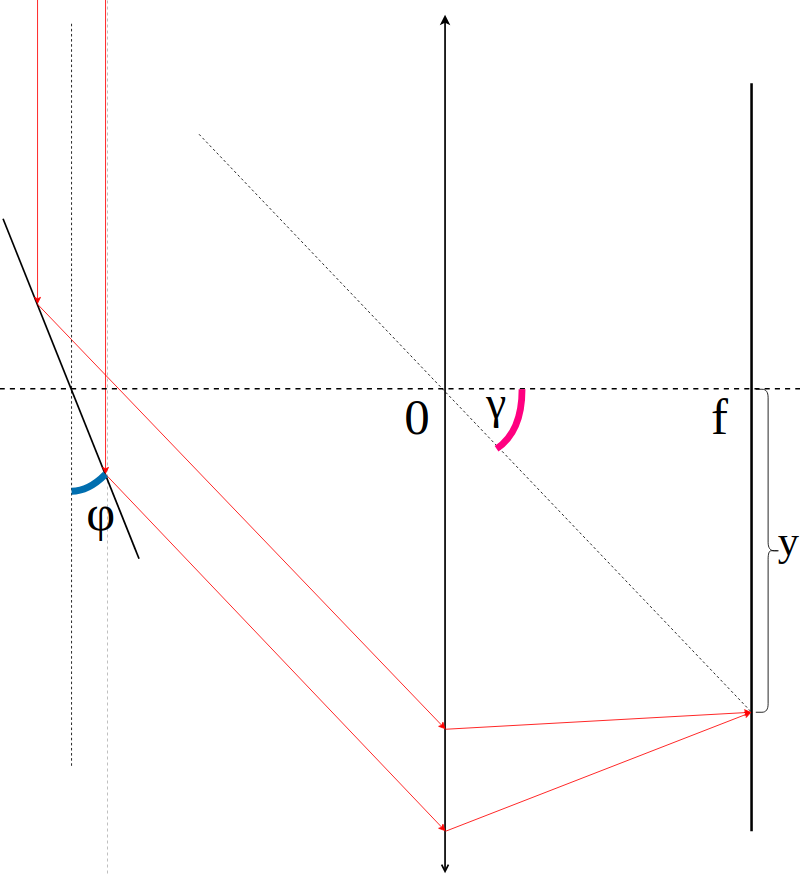
| + | The reflected beam incident on the lens rotates with double the angular velocity $2\omega$ relative to the optical axis, because when the mirror rotates by some angle $\varphi$, both the angle of incidence and the angle of reflection change by the same amount. This can also be seen from the drawing: | ||
| + |  | ||
| + | $$ | ||
| + | \gamma=\pi-2\varphi\quad\to\quad\frac{d\gamma}{dt}=2\omega \ - direction \ is \ not \ so \ important | ||
| + | $$ | ||
| + | $$ | ||
| + | y=f\tan\gamma | ||
| + | $$ | ||
| + | $$ | ||
| + | v(\gamma)=\frac{dy}{dt}=f\frac{d(\tan\gamma)}{d\gamma}\cdot\frac{d\gamma}{dt}=2\omega f\frac{1}{\cos^2(\gamma)} | ||
| + | $$ | ||
| + | $$ | ||
| + | v(0)= 2\omega f | ||
| + | $$ | ||
| + | |||
| #### Answer | |||
| − | [Insert a concise answer or boxed result] | ||
| + | $$ | ||
| + | \boxed{v_0 = 2\omega f} | ||
| + | $$ | ||
| @@ -1,11 +1,29 @@ | |||
| ### Statement | ### Statement | ||
| $13.3.5.$ [Insert the problem statement] | $13.3.5$ On the optical axis $AB$ of the collecting lens there is a flat mirror rotating with an angular velocity $\omega$ around the axis passing through point $A$ and perpendicular to the drawing plane. A parallel beam of rays falls on the mirror, which after reflection focuses on the screen. The focal length of the lens is $f$. Find the speed of the light spot on the screen at the moment when it crosses the optical axis. The screen plane is perpendicular to the optical axis. | ||
|  | |||
| ### Solution | ### Solution | ||
| $13.3.5$ On the optical axis $AB$ of the collecting lens there is a flat mirror rotating with an angular velocity $\omega$ around the axis passing through point $A$ and perpendicular to the drawing plane. A parallel beam of rays falls on the mirror, which after reflection focuses on the screen. The focal length of the lens is $f$. Find the speed of the light spot on the screen at the moment when it crosses the optical axis. The screen plane is perpendicular to the optical axis. | The reflected beam incident on the lens rotates with double the angular velocity $2\omega$ relative to the optical axis, because when the mirror rotates by some angle $\varphi$, both the angle of incidence and the angle of reflection change by the same amount. This can also be seen from the drawing: | ||
|  | |||
| $$ | |||
| \gamma=\pi-2\varphi\quad\to\quad\frac{d\gamma}{dt}=2\omega \ - direction \ is \ not \ so \ important | |||
| $$ | |||
| $$ | |||
| y=f\tan\gamma | |||
| $$ | |||
| $$ | |||
| v(\gamma)=\frac{dy}{dt}=f\frac{d(\tan\gamma)}{d\gamma}\cdot\frac{d\gamma}{dt}=2\omega f\frac{1}{\cos^2(\gamma)} | |||
| $$ | |||
| $$ | |||
| v(0)= 2\omega f | |||
| $$ | |||
| #### Answer | #### Answer | ||
| [Insert a concise answer or boxed result] | $$ | ||
| \boxed{v_0 = 2\omega f} | |||
| $$ | |||