Statement
12.2.11∗.
The drawing shows a flat glass plate with blackened ring sections. This
plate overlapped a parallel beam of monochromatic light with a wavelength
λ. It turned out that the blackened rings of the plate coincided with even
Fresnel zones for the axial point A. How did the light intensity change at this
point?
b. A parallel beam of monochromatic light was blocked by a plate in which the
blackened ring sections were replaced by layers of a dielectric that changes the
phase of the passing wave by π. How did the light intensity change at point
A in this case?
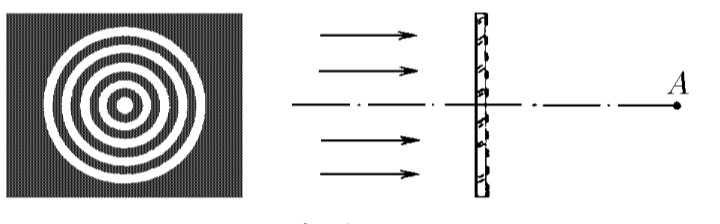
Solution
Data:
Parallel beam of monochromatic light of wavelength
Observation point A on the axis.
The plate has rings that coincide with the Fresnel zones.
It is considered that the plate covers the first m = 9 Fresnel zones.
Reference amplitude (without plate):
With the entire wavefront open, the amplitude at A is half of the first zone:
and the corresponding intensity is
Case (a): Opaque plate on even zones
The plate has the even zones blackened out (blocked): 2, 4, 6, 8.
The odd zones remain open: 1, 3, 5, 7, 9 (five zones).
Since the amplitudes of the zones are
Intensity:
Compared with the intensity without the plate:
Case (b): Phase plate (phase shift \pi) on even zones
The rings that were previously opaque are replaced by dielectric layers that add a phase shift of \pi to the wave passing through.
· The odd zones (1, 3, 5, 7, 9) pass with no phase change.
· The even zones (2, 4, 6, 8) would normally arrive with a phase shift of
Now all zones (9 in total) contribute constructively:
Intensity:
Compared with the intensity without the plate:
Answer
[Insert a concise answer or boxed result]