Правка разделов «Statement», «Solution», «References»

en/12.2.9.md
+23 −3
| @@ -1,11 +1,31 @@ | |||
| ### Statement | |||
| − | $12.2.9.$ [Insert the problem statement] | ||
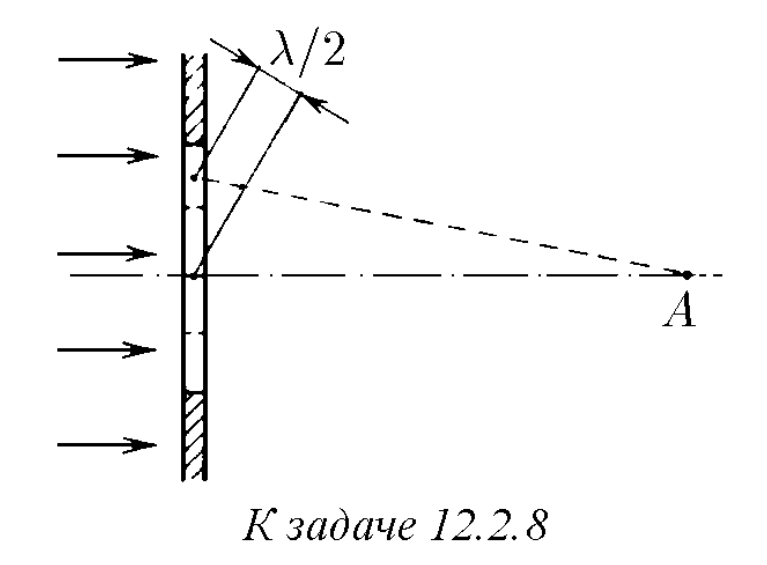
| + | $12.2.9.$ A parallel beam of light falls on a screen with a round hole. The radius of the hole coincides with the radius of the central Fresnel zone for point $A$ (see the figure for the previous problem). Using the graphical method, determine how many times the intensity of light from the central zone is greater than the intensity of light that would come to the same point if there were no screen. | ||
| + |  | ||
| + | |||
| ### Solution | |||
| + | Recall that by definition intensity is proportional to the square of the amplitude ($I \propto w \propto E^2 \propto A^2$). | ||
| − | 1 | ||
| + | Now we need to find the resultant amplitude of the oscillations. This is usually done using the method of vector diagrams. | ||
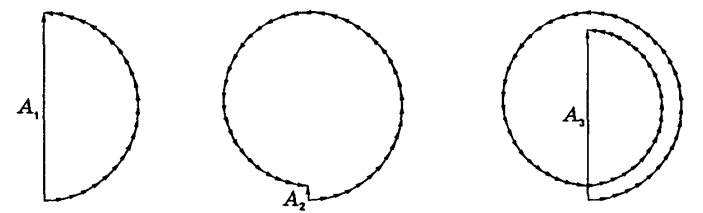
| + | In this simple method, the wave surface is mentally divided into very narrow annular zones. The amplitude of oscillations produced by each such zone will be represented by a vector $dA$. Due to the increase in distance $r$ (and some other effects that are not important now), the amplitude of oscillations produced by each subsequent narrow annular zone will decrease in magnitude and lag in phase behind the oscillations produced by the previous zone. We will represent the phase lag by rotating each vector $dA$ counterclockwise by the corresponding angle, obtaining a chain of vectors whose vector sum is the resultant amplitude of oscillations at point $P$. | ||
| + | |||
| + |  | ||
| + | |||
| + | The first figure shows the result of the action of the 1st Fresnel zone. Here the amplitude of oscillations $dA_N$ from the narrow ring adjacent to the boundary of the 1st Fresnel zone lags in phase by $\pi$ from the amplitude of oscillations arriving at point $P$ from the centre of the 1st zone – from $dA_1$, so the vectors corresponding to these amplitudes are oppositely directed. | ||
| + | |||
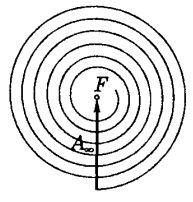
| + | Continuing the construction, we obtain the vector diagram for the resultant amplitude of oscillations at the point from the action of the first two Fresnel zones (to the right), then from the first three Fresnel zones, and so on. As the number of narrow annular zones increases, the chain will "curl" into a spiral, and as a result the amplitude from the action of all zones (the entire wave surface) will be equal to $A_{\infty}=A$. This spiral is called the Fresnel spiral. | ||
| + | |||
| + |  | ||
| + | |||
| + | From these constructions it is seen that the amplitude in the case of the 1st Fresnel zone is 2 times larger than for the full spiral – that is, when the screen is removed. Accordingly, the intensity increases 4 times. | ||
| + | |||
| + | #### References: | ||
| + | I.E. Irodov, "Wave Processes. Basic Laws", pp. 127–128 | ||
| + | |||
| #### Answer | |||
| − | [Insert a concise answer or boxed result] | ||
| + | $$ | ||
| + | \boxed{4 \ times} | ||
| + | $$ | ||
| @@ -1,11 +1,31 @@ | |||
| ### Statement | ### Statement | ||
| $12.2.9.$ [Insert the problem statement] | $12.2.9.$ A parallel beam of light falls on a screen with a round hole. The radius of the hole coincides with the radius of the central Fresnel zone for point $A$ (see the figure for the previous problem). Using the graphical method, determine how many times the intensity of light from the central zone is greater than the intensity of light that would come to the same point if there were no screen. | ||
|  | |||
| ### Solution | ### Solution | ||
| Recall that by definition intensity is proportional to the square of the amplitude ($I \propto w \propto E^2 \propto A^2$). | |||
| 1 | Now we need to find the resultant amplitude of the oscillations. This is usually done using the method of vector diagrams. | ||
| In this simple method, the wave surface is mentally divided into very narrow annular zones. The amplitude of oscillations produced by each such zone will be represented by a vector $dA$. Due to the increase in distance $r$ (and some other effects that are not important now), the amplitude of oscillations produced by each subsequent narrow annular zone will decrease in magnitude and lag in phase behind the oscillations produced by the previous zone. We will represent the phase lag by rotating each vector $dA$ counterclockwise by the corresponding angle, obtaining a chain of vectors whose vector sum is the resultant amplitude of oscillations at point $P$. | |||
|  | |||
| The first figure shows the result of the action of the 1st Fresnel zone. Here the amplitude of oscillations $dA_N$ from the narrow ring adjacent to the boundary of the 1st Fresnel zone lags in phase by $\pi$ from the amplitude of oscillations arriving at point $P$ from the centre of the 1st zone – from $dA_1$, so the vectors corresponding to these amplitudes are oppositely directed. | |||
| Continuing the construction, we obtain the vector diagram for the resultant amplitude of oscillations at the point from the action of the first two Fresnel zones (to the right), then from the first three Fresnel zones, and so on. As the number of narrow annular zones increases, the chain will "curl" into a spiral, and as a result the amplitude from the action of all zones (the entire wave surface) will be equal to $A_{\infty}=A$. This spiral is called the Fresnel spiral. | |||
|  | |||
| From these constructions it is seen that the amplitude in the case of the 1st Fresnel zone is 2 times larger than for the full spiral – that is, when the screen is removed. Accordingly, the intensity increases 4 times. | |||
| #### References: | |||
| I.E. Irodov, "Wave Processes. Basic Laws", pp. 127–128 | |||
| #### Answer | #### Answer | ||
| [Insert a concise answer or boxed result] | $$ | ||
| \boxed{4 \ times} | |||
| $$ | |||