| @@ -1,14 +1,13 @@ |
| ### Statement |
| ### Statement |
| |
| |
| $12.2.13.$ |
| $12.2.13.$ |
| |
| |
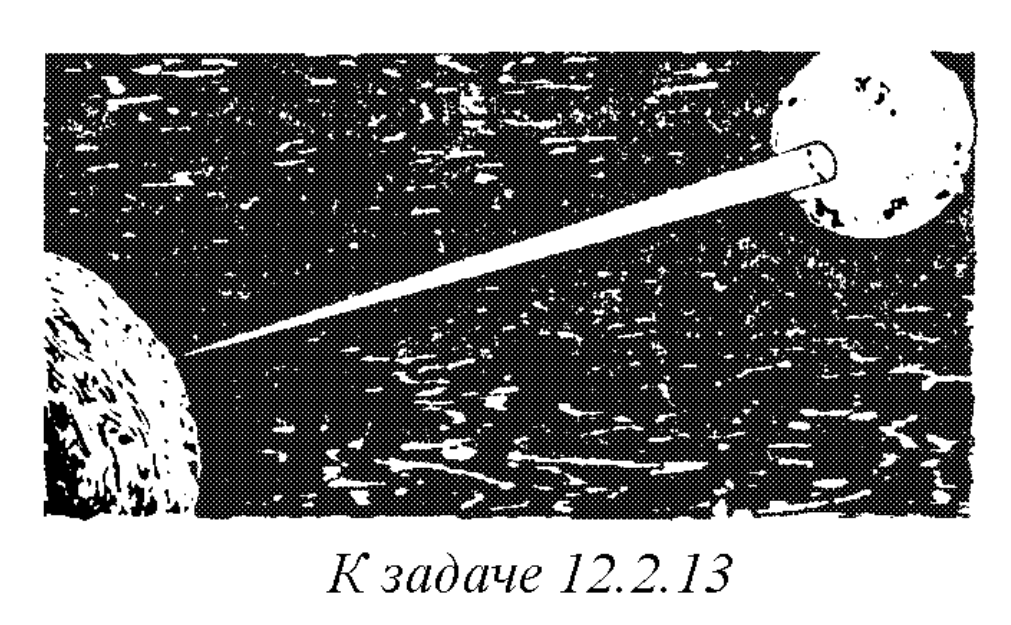
| Estimate the size of the light spot on the moon from the laser beam. The |
| $a.$ Estimate the size of the light spot on the moon from the laser beam. The laser is located on the Earth, its beam radius is $10 \ cm$, the wavelength is $10^{−5}$ cm. (The spot boundary is estimated from the condition that in the spot |
| laser is located on the Ground, its beam radius is 10 cm, the wavelength is |
| area the rays coming from separate sections of the wave do not cancel each other out.) |
| 10−5cm. (The spot boundary is estimated from the condition that in the spot |
| |
| area the rays coming from separate sections of the wave do not cancel each |
| $b.$ Estimate the size of the radar antenna emitting three-centimeter electromagnetic waves inside the angle of $0.01$ rad. |
| other out.) |
| |
| b. Estimate the size of the radar antenna emitting three-centimeter electro- |
|  |
| magnetic waves inside the angle of 0.01 rad. |
| |
| |
| |
| ### Solution |
| ### Solution |
| |
| |
| First the Data | | First the Data |
| | | |
| Beam radius: $a = 10\ \text{cm} = 0.1\ \text{m}$. | | Beam radius: $a = 10\ \text{cm} = 0.1\ \text{m}$. |
| | | |
| Wavelength: $\lambda = 10^{-5}\ \text{cm} = 10^{-7}\ \text{m}$ | | Wavelength: $\lambda = 10^{-5}\ \text{cm} = 10^{-7}\ \text{m}$ |
| | | |
| use visible light | | use visible light |
| $\lambda \approx 5\times10^{-5}\ \text{cm} = 5\times10^{-7}\ \text{m}$ | | $\lambda \approx 5\times10^{-5}\ \text{cm} = 5\times10^{-7}\ \text{m}$ |
| | | |
| We will adopt $ \lambda = 5\times10^{-7}\ \text{m}$. | | We will adopt $ \lambda = 5\times10^{-7}\ \text{m}$. |
| · Earth–Moon distance: | | · Earth–Moon distance: |
| $L \approx 3.84\times10^{8}\ \text{m}$. | | $L \approx 3.84\times10^{8}\ \text{m}$. |
| | | |
| | | |
| The laser beam emerges from a circular aperture of radius a. Diffraction produces an Airy pattern on the Moon. The first intensity minimum (where the waves begin to cancel) defines the limit of the central spot. For a circular aperture, the angle of the first minimum is: | | The laser beam emerges from a circular aperture of radius a. Diffraction produces an Airy pattern on the Moon. The first intensity minimum (where the waves begin to cancel) defines the limit of the central spot. For a circular aperture, the angle of the first minimum is: |
| | | |
| $\theta \approx \frac{0.61\lambda}{a}$ | | $\theta \approx \frac{0.61\lambda}{a}$ |
| | | |
| $R = L\,\theta = \frac{0.61\,\lambda L}{a}$. | | $R = L\,\theta = \frac{0.61\,\lambda L}{a}$. |
| | | |
| Multiply $\lambda L$: | | Multiply $\lambda L$: |
| | | |
| $\lambda L = (5\times10^{-7})\,(3.84\times10^{8}) = 192\ \text{m}$ | | $\lambda L = (5\times10^{-7})\,(3.84\times10^{8}) = 192\ \text{m}$ |
| | | |
| Divide by a: | | Divide by a: |
| | | |
| $\frac{\lambda L}{a} = \frac{192}{0.1} = 1920\ \text{m}$. | | $\frac{\lambda L}{a} = \frac{192}{0.1} = 1920\ \text{m}$. |
| | | |
| Apply the factor 0.61: | | Apply the factor 0.61: |
| | | |
| $R = 0.61 \times 1920 = 1171.2\ \text{m}$. | | $R = 0.61 \times 1920 = 1171.2\ \text{m}$. |
| | | |
| Rounding to order of magnitude: | | Rounding to order of magnitude: |
| | | |
| $\boxed{R \approx 1\ \text{km}}$. | | $\boxed{R \approx 1\ \text{km}}$. |
| | | |
| --- | | --- |
| | | |
| b) Radar antenna of 3 cm | | b) Radar antenna of 3 cm |
| | | |
| Data | | Data |
| | | |
| Wavelength: $\lambda = 3\ \text{cm} = 0.03\ \text{m}$. | | Wavelength: $\lambda = 3\ \text{cm} = 0.03\ \text{m}$. |
| · Total angular divergence of the beam: $\theta \approx 0.01\ \text{rad}$. | | · Total angular divergence of the beam: $\theta \approx 0.01\ \text{rad}$. |
| | | |
| A circular parabolic antenna of diameter D produces a beam whose angular width is limited by diffraction. The angular radius of the first minimum is: | | A circular parabolic antenna of diameter D produces a beam whose angular width is limited by diffraction. The angular radius of the first minimum is: |
| | | |
| $\theta \approx \frac{\lambda}{D}$. | | $\theta \approx \frac{\lambda}{D}$. |
| | | |
| Solve for D: | | Solve for D: |
| | | |
| $D \approx \frac{\lambda}{\theta} = \frac{0.03}{0.01} = 3\ \text{m}$. | | $D \approx \frac{\lambda}{\theta} = \frac{0.03}{0.01} = 3\ \text{m}$. |
| | | |
| The radius of the antenna is half the diameter: | | The radius of the antenna is half the diameter: |
| | | |
| $R = \frac{D}{2} = 1.5\ \text{m}$. | | $R = \frac{D}{2} = 1.5\ \text{m}$. |
| | | |
| $\boxed{R \approx 1.5\ \text{m}}$. | | $\boxed{R \approx 1.5\ \text{m}}$. |
| | | |
| #### Answer | | #### Answer |
| | | |
| $\boxed{R \approx 1\ \text{km}}$ | | $\boxed{R \approx 1\ \text{km}}$ |
| | | |
| $\boxed{R \approx 1.5\ \text{m}}$ | | $\boxed{R \approx 1.5\ \text{m}}$ |
