Новое решение

en/11.4.25.md
+21 −0
| @@ -0,0 +1,21 @@ | |||
| + | ### Statement | ||
| + | |||
| + | $11.4.25.$ [Insert the problem statement] | ||
| + | |||
| + | ### Solution | ||
| + | |||
| + |  | ||
| + | |||
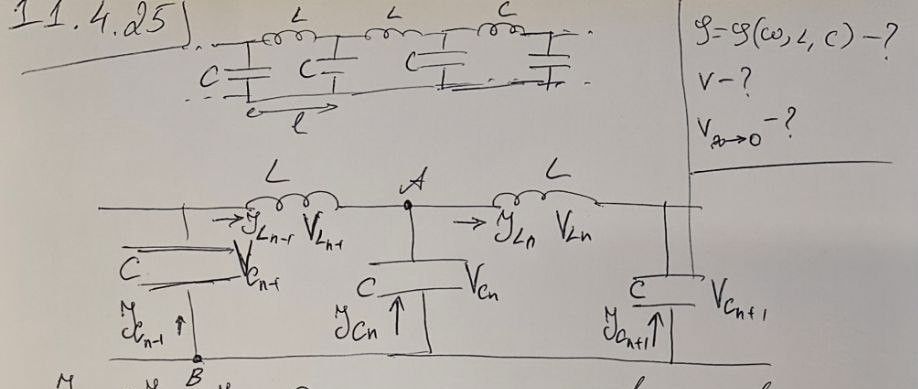
| + | $I_{L_{n-1}} + I_{C_n} - I_{L_n} = 0$ - charge conservation at point A. | ||
| + | |||
| + | $V_{C_{n-1}} + V_{L_{n-1}} - V_{C_n} = 0$ - potential difference between A and B is same going both ways along the circuit. | ||
| + | |||
| + | As the problem states we have sinusoidal wave running along the circuit such that there is $\phi$ phase difference between adjacent units of the circuit in voltage. Thus $V_n = V_0 sin(\omega t +n\phi)$. | ||
| + | $I_n = \frac{dQ_n}{dt} = \omega C V_0 cos(\omega t +n\phi)$. Let's define ${I_n}^`$ as the current flowing through capacitor n with phase lag of $\pi/2$. Then we get the following expression: $V_{C_{n-1}} = \frac{1}{\omega C} {I_n}^`$. In inductive element current lags behind by $\pi/2$ so we will define ${I_{L_n}}^`$ as current flowing through inductive element n with phase ahead of $I_{L_n}$ by $\pi/2$. | ||
| + | This will give us expression $V_{L_{n-1}} = \omega L {I_{L_{n-1}}}^`$. | ||
| + | Plugging expressions for voltages into potential difference equation between points A and B and after simplifications we end up with $I_{L_{n}} = \frac{V_0}{\omega L} 2sin(\omega t + (n+\frac{1}{2})\phi)sin\frac{\phi}{2}$. Plugging it into charge conservation equation at point A and simplifying it we get $\omega C V_0 cos(\omega t + n\phi) + \frac{V_0}{\omega L} \cdot 2sin\frac{\phi}{2}\cdot2cos(\omega t + n \phi)sin(-\frac{\phi}{2}) = 0$. This equation must hold for any moment in time. So we get $\omega C + \frac{4}{\omega L}sin^2(\frac{\phi}{2}) = 0$. Solving this gives us $\phi = \pm 2arcsin(\frac{\omega \sqrt{LC}}{2})$. Choosing direction of wave propagation such that sign of $\phi$ is + we get $\phi = 2arcsin(\frac{\omega \sqrt{LC}}{2})$. | ||
| + | Wave travels along one unit with length $l$ in time $\tau \implies v\tau = l$. For phase difference between circuit units we can write $\phi = \omega \tau$. From these equations we get $v = \frac{l\omega}{2arcsin(\frac{\omega \sqrt{LC}}{2})}$. For limit $\omega \to 0$ we get $v_{\omega \to 0} = \frac{l}{\sqrt{LC}}$. | ||
| + | |||
| + | #### Answer | ||
| + | |||
| + | [Insert a concise answer or boxed result] | ||
| @@ -0,0 +1,21 @@ | |||
| ### Statement | |||
| $11.4.25.$ [Insert the problem statement] | |||
| ### Solution | |||
|  | |||
| $I_{L_{n-1}} + I_{C_n} - I_{L_n} = 0$ - charge conservation at point A. | |||
| $V_{C_{n-1}} + V_{L_{n-1}} - V_{C_n} = 0$ - potential difference between A and B is same going both ways along the circuit. | |||
| As the problem states we have sinusoidal wave running along the circuit such that there is $\phi$ phase difference between adjacent units of the circuit in voltage. Thus $V_n = V_0 sin(\omega t +n\phi)$. | |||
| $I_n = \frac{dQ_n}{dt} = \omega C V_0 cos(\omega t +n\phi)$. Let's define ${I_n}^`$ as the current flowing through capacitor n with phase lag of $\pi/2$. Then we get the following expression: $V_{C_{n-1}} = \frac{1}{\omega C} {I_n}^`$. In inductive element current lags behind by $\pi/2$ so we will define ${I_{L_n}}^`$ as current flowing through inductive element n with phase ahead of $I_{L_n}$ by $\pi/2$. | |||
| This will give us expression $V_{L_{n-1}} = \omega L {I_{L_{n-1}}}^`$. | |||
| Plugging expressions for voltages into potential difference equation between points A and B and after simplifications we end up with $I_{L_{n}} = \frac{V_0}{\omega L} 2sin(\omega t + (n+\frac{1}{2})\phi)sin\frac{\phi}{2}$. Plugging it into charge conservation equation at point A and simplifying it we get $\omega C V_0 cos(\omega t + n\phi) + \frac{V_0}{\omega L} \cdot 2sin\frac{\phi}{2}\cdot2cos(\omega t + n \phi)sin(-\frac{\phi}{2}) = 0$. This equation must hold for any moment in time. So we get $\omega C + \frac{4}{\omega L}sin^2(\frac{\phi}{2}) = 0$. Solving this gives us $\phi = \pm 2arcsin(\frac{\omega \sqrt{LC}}{2})$. Choosing direction of wave propagation such that sign of $\phi$ is + we get $\phi = 2arcsin(\frac{\omega \sqrt{LC}}{2})$. | |||
| Wave travels along one unit with length $l$ in time $\tau \implies v\tau = l$. For phase difference between circuit units we can write $\phi = \omega \tau$. From these equations we get $v = \frac{l\omega}{2arcsin(\frac{\omega \sqrt{LC}}{2})}$. For limit $\omega \to 0$ we get $v_{\omega \to 0} = \frac{l}{\sqrt{LC}}$. | |||
| #### Answer | |||
| [Insert a concise answer or boxed result] | |||