Правка разделов «Statement», «Solution», «Answer»

en/6.6.22.md
+33 −5
| @@ -1,11 +1,39 @@ | |||
| ### Statement | |||
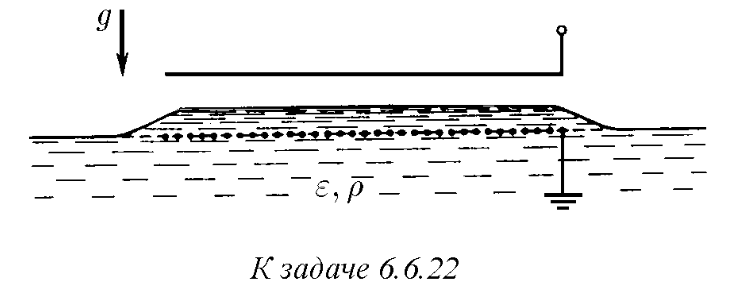
| + | $6.6.22.$ One plate of an uncharged capacitor is made of a fine grid and lies on the surface of a liquid of density $\rho$ and dielectric permittivity $\varepsilon$. The area of each plate is $S$. To what height will the liquid level rise in the capacitor if a charge $Q$ is given to it? | ||
| − | $6.6.22.$ [Insert the problem statement] | ||
| + |  | ||
| ### Solution | |||
| + | The capacitance of the capacitor (which can be viewed as two capacitors connected in series) is: | ||
| + | $$ | ||
| + | C = \left( \frac{d-h}{\varepsilon_0 S} + \frac{h}{\varepsilon \varepsilon_0 S} \right)^{-1} | ||
| + | = \frac{\varepsilon_0 S}{d - h + h/\varepsilon}. | ||
| + | $$ | ||
| + | The field energy at fixed charge is: | ||
| + | $$ | ||
| + | W_c = \frac{Q^2}{2C} = \frac{Q^2}{2\varepsilon_0 S} \left( d - h + \frac{h}{\varepsilon} \right). | ||
| + | $$ | ||
| + | The potential energy of the liquid is: | ||
| + | $$ | ||
| + | W_p = \frac{h}{2} m g = \frac{1}{2} S h^2 \rho g. | ||
| + | $$ | ||
| + | Equilibrium corresponds to a minimum of the total energy; we find this position using the derivative: | ||
| + | $$ | ||
| + | \frac{d}{dh} \bigl[ W_p - W_c \bigr] = 0 | ||
| + | \quad\Rightarrow\quad | ||
| + | S \rho g h - \frac{Q^2}{2\varepsilon_0 S} \left( 1 - \frac{1}{\varepsilon} \right) = 0. | ||
| + | $$ | ||
| + | The second derivative: | ||
| + | $$ | ||
| + | \frac{d}{dh} \left[ S \rho g h - \frac{Q^2}{2\varepsilon_0 S} \left( 1 - \frac{1}{\varepsilon} \right) \right] > 0 | ||
| + | \quad\Rightarrow\quad h > 0 \text{ – obviously.} | ||
| + | $$ | ||
| + | Hence the only equilibrium height of rise is: | ||
| + | $$ | ||
| + | h = \frac{(\varepsilon - 1) Q^2}{2\varepsilon_0 \varepsilon \rho g S^2}. | ||
| + | $$ | ||
| − | 1 | ||
| − | |||
| #### Answer | |||
| − | |||
| − | [Insert a concise answer or boxed result] | ||
| + | $$ | ||
| + | \boxed{h = \frac{(\varepsilon - 1) Q^2}{2\varepsilon_0 \varepsilon \rho g S^2}}. | ||
| + | $$ | ||
| @@ -1,11 +1,39 @@ | |||
| ### Statement | ### Statement | ||
| $6.6.22.$ One plate of an uncharged capacitor is made of a fine grid and lies on the surface of a liquid of density $\rho$ and dielectric permittivity $\varepsilon$. The area of each plate is $S$. To what height will the liquid level rise in the capacitor if a charge $Q$ is given to it? | |||
| $6.6.22.$ [Insert the problem statement] |  | ||
| ### Solution | ### Solution | ||
| The capacitance of the capacitor (which can be viewed as two capacitors connected in series) is: | |||
| $$ | |||
| C = \left( \frac{d-h}{\varepsilon_0 S} + \frac{h}{\varepsilon \varepsilon_0 S} \right)^{-1} | |||
| = \frac{\varepsilon_0 S}{d - h + h/\varepsilon}. | |||
| $$ | |||
| The field energy at fixed charge is: | |||
| $$ | |||
| W_c = \frac{Q^2}{2C} = \frac{Q^2}{2\varepsilon_0 S} \left( d - h + \frac{h}{\varepsilon} \right). | |||
| $$ | |||
| The potential energy of the liquid is: | |||
| $$ | |||
| W_p = \frac{h}{2} m g = \frac{1}{2} S h^2 \rho g. | |||
| $$ | |||
| Equilibrium corresponds to a minimum of the total energy; we find this position using the derivative: | |||
| $$ | |||
| \frac{d}{dh} \bigl[ W_p - W_c \bigr] = 0 | |||
| \quad\Rightarrow\quad | |||
| S \rho g h - \frac{Q^2}{2\varepsilon_0 S} \left( 1 - \frac{1}{\varepsilon} \right) = 0. | |||
| $$ | |||
| The second derivative: | |||
| $$ | |||
| \frac{d}{dh} \left[ S \rho g h - \frac{Q^2}{2\varepsilon_0 S} \left( 1 - \frac{1}{\varepsilon} \right) \right] > 0 | |||
| \quad\Rightarrow\quad h > 0 \text{ – obviously.} | |||
| $$ | |||
| Hence the only equilibrium height of rise is: | |||
| $$ | |||
| h = \frac{(\varepsilon - 1) Q^2}{2\varepsilon_0 \varepsilon \rho g S^2}. | |||
| $$ | |||
| 1 | |||
| #### Answer | #### Answer | ||
| $$ | |||
| [Insert a concise answer or boxed result] | \boxed{h = \frac{(\varepsilon - 1) Q^2}{2\varepsilon_0 \varepsilon \rho g S^2}}. | ||
| $$ | |||