Правка разделов «Statement», «Solution», «Answer»

en/11.6.7.md
+18 −5
| @@ -1,11 +1,24 @@ | |||
| ### Statement | |||
| − | $11.6.7.$ [Insert the problem statement] | ||
| + | $11.6.7.$ A parallel‑plate capacitor, with electric field strength $E$ inside it, moves with velocity $v$. The velocity makes an angle $\alpha$ with the plates. What is the magnetic induction inside the capacitor? | ||
| ### Solution | |||
| + | The magnetic field here can arise due to the change in the electric flux. This phenomenon is described by the equation used in the previous problems: | ||
| + | $$ | ||
| + | \oint \vec B \, d\vec l = \mu_0 \varepsilon_0 \frac{d}{dt} \left( \int \vec E \, d\vec S \right). \tag{1} | ||
| + | $$ | ||
| + | Over a small time interval, the capacitor shifts by $v\,dt$ in the direction of the velocity. Choose a contour of width $l$ and small length $v\,dt$ as follows: | ||
| + | 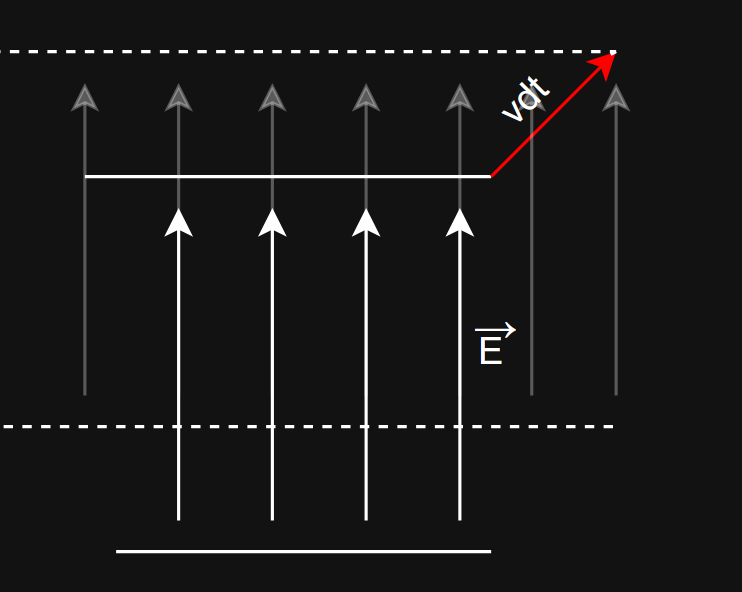 | ||
| + | We see that during the time $dt$, the field through this contour changes from $0$ to $E$. Then, rewriting (1) in scalar form: | ||
| + | $$ | ||
| + | B \cdot l = \mu_0 \varepsilon_0 \frac{d(E \cdot l v \cos\alpha \, dt)}{dt}, | ||
| + | $$ | ||
| + | $$ | ||
| + | B = \mu_0 \varepsilon_0 E v \cos\alpha. \tag{2} | ||
| + | $$ | ||
| + | P.S. From this it follows that when the capacitor moves perpendicularly to the plates, no magnetic field appears at all. | ||
| − | 1 | ||
| − | |||
| #### Answer | |||
| − | |||
| − | [Insert a concise answer or boxed result] | ||
| + | $$ | ||
| + | \boxed{B = \mu_0 \varepsilon_0 E v \cos\alpha}. | ||
| + | $$ | ||
| @@ -1,11 +1,24 @@ | |||
| ### Statement | ### Statement | ||
| $11.6.7.$ [Insert the problem statement] | $11.6.7.$ A parallel‑plate capacitor, with electric field strength $E$ inside it, moves with velocity $v$. The velocity makes an angle $\alpha$ with the plates. What is the magnetic induction inside the capacitor? | ||
| ### Solution | ### Solution | ||
| The magnetic field here can arise due to the change in the electric flux. This phenomenon is described by the equation used in the previous problems: | |||
| $$ | |||
| \oint \vec B \, d\vec l = \mu_0 \varepsilon_0 \frac{d}{dt} \left( \int \vec E \, d\vec S \right). \tag{1} | |||
| $$ | |||
| Over a small time interval, the capacitor shifts by $v\,dt$ in the direction of the velocity. Choose a contour of width $l$ and small length $v\,dt$ as follows: | |||
|  | |||
| We see that during the time $dt$, the field through this contour changes from $0$ to $E$. Then, rewriting (1) in scalar form: | |||
| $$ | |||
| B \cdot l = \mu_0 \varepsilon_0 \frac{d(E \cdot l v \cos\alpha \, dt)}{dt}, | |||
| $$ | |||
| $$ | |||
| B = \mu_0 \varepsilon_0 E v \cos\alpha. \tag{2} | |||
| $$ | |||
| P.S. From this it follows that when the capacitor moves perpendicularly to the plates, no magnetic field appears at all. | |||
| 1 | |||
| #### Answer | #### Answer | ||
| $$ | |||
| [Insert a concise answer or boxed result] | \boxed{B = \mu_0 \varepsilon_0 E v \cos\alpha}. | ||
| $$ | |||