Правка разделов «Statement», «Solution», «Answer»

en/13.2.17.md
+4 −4
| @@ -1,10 +1,10 @@ | |||
| ### Statement | |||
| − | $13.2.17.$ [Insert the problem statement] | ||
| + | $13.2.17.$ A lens with a focal length $f$ and radii of curvature $r$ was embedded in the wall of the aquarium. Refractive index of water $n$. Determine at what distance from the lens the parallel beam of light is focused: a) entering the aquarium; b) leaving the aquarium. | ||
| ### Solution | |||
| − | 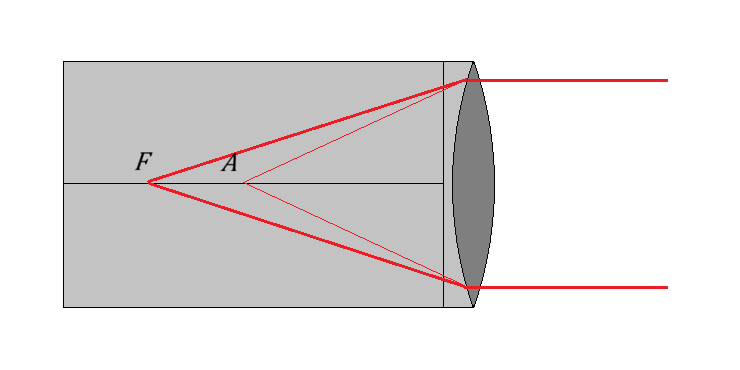 | ||
| We consider compound lenses consisting of a thin glass lens with focal length $f$ and a thin water lens with one flat surface and one concave surface with radius $r$. According to the lens maker formula, the focal length of the concave lens is $-r/(n-1)$. Consequently, the focal length of the compound lenses is $f'$ satisfying the equation | |||
| \[\frac{1}{f'}=\frac{1}{f}-\frac{n-1}{r},\] | |||
| i.e. | |||
| @@ -14,8 +14,8 @@Solution | |||
| \[f'=\frac{rf}{r+f-nf}.\] | |||
| − | Light rays parallel to the principal axis leaving the aquarium converge to the point at the distance $f'$ from the compound lenses. Assuming that the aquarium is sufficiently large in the direction of the principal axis, light rays parallel to the principal axis entering the aquarium are refracted by additional water to Point | ||
| + | Light rays parallel to the principal axis leaving the aquarium converge to the point at the distance $f'$ from the compound lenses, because additional water in front of the compound lenses is irrelevant. Assuming that the aquarium is sufficiently large in the direction of the principal axis, light rays parallel to the principal axis entering the aquarium are refracted by additional water to Point $F$ at the distance $nf'$ from the compound lenses. (That is, $n$ times as far as the distance from Point $A$ from the compound lenses, where light rays would have converged had there not been additional water.) | ||
| #### Answer | |||
| − | [Insert a concise answer or boxed result] | ||
| + | a) $\frac{nrf}{r+f-nf}$ b) $\frac{rf}{r+f-nf}$ | ||
| @@ -1,10 +1,10 @@ | |||
| ### Statement | ### Statement | ||
| $13.2.17.$ [Insert the problem statement] | $13.2.17.$ A lens with a focal length $f$ and radii of curvature $r$ was embedded in the wall of the aquarium. Refractive index of water $n$. Determine at what distance from the lens the parallel beam of light is focused: a) entering the aquarium; b) leaving the aquarium. | ||
| ### Solution | ### Solution | ||
|  | ||
| We consider compound lenses consisting of a thin glass lens with focal length $f$ and a thin water lens with one flat surface and one concave surface with radius $r$. According to the lens maker formula, the focal length of the concave lens is $-r/(n-1)$. Consequently, the focal length of the compound lenses is $f'$ satisfying the equation | We consider compound lenses consisting of a thin glass lens with focal length $f$ and a thin water lens with one flat surface and one concave surface with radius $r$. According to the lens maker formula, the focal length of the concave lens is $-r/(n-1)$. Consequently, the focal length of the compound lenses is $f'$ satisfying the equation | ||
| \[\frac{1}{f'}=\frac{1}{f}-\frac{n-1}{r},\] | \[\frac{1}{f'}=\frac{1}{f}-\frac{n-1}{r},\] | ||
| i.e. | i.e. | ||
| @@ -14,8 +14,8 @@Solution | |||
| \[f'=\frac{rf}{r+f-nf}.\] | \[f'=\frac{rf}{r+f-nf}.\] | ||
| Light rays parallel to the principal axis leaving the aquarium converge to the point at the distance $f'$ from the compound lenses. Assuming that the aquarium is sufficiently large in the direction of the principal axis, light rays parallel to the principal axis entering the aquarium are refracted by additional water to Point |
Light rays parallel to the principal axis leaving the aquarium converge to the point at the distance $f'$ from the compound lenses, because additional water in front of the compound lenses is irrelevant. Assuming that the aquarium is sufficiently large in the direction of the principal axis, light rays parallel to the principal axis entering the aquarium are refracted by additional water to Point $F$ at the distance $nf'$ from the compound lenses. (That is, $n$ times as far as the distance from Point $A$ from the compound lenses, where light rays would have converged had there not been additional water.) | ||
| #### Answer | #### Answer | ||
| [Insert a concise answer or boxed result] | a) $\frac{nrf}{r+f-nf}$ b) $\frac{rf}{r+f-nf}$ | ||