| @@ -1,39 +1,34 @@ |
| ### Statement |
| ### Statement |
| |
| |
| $1.4.6.$ [Insert the problem statement] |
| |
| |
| |
| ### Solution |
| |
| |
| |
| ### Problem |
| |
| |
| |
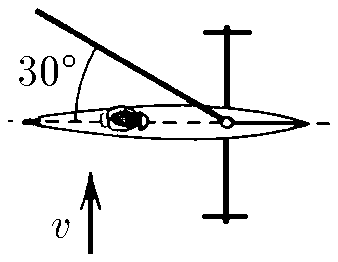
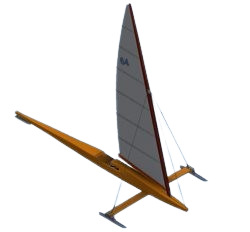
| $1.4.6^*.$ An iceboat is a sailing sled. It can only move along the line in which its runners are pointed. The wind blows with a speed $v$ perpendicular to the direction of the iceboat's motion. The sail makes an angle of $30^\circ$ with the direction of motion. What maximum speed can the iceboat reach under this wind? |
| $1.4.6^*.$ An iceboat is a sailing sled. It can only move along the line in which its runners are pointed. The wind blows with a speed $v$ perpendicular to the direction of the iceboat's motion. The sail makes an angle of $30^\circ$ with the direction of motion. What maximum speed can the iceboat reach under this wind? |
| |
|  |
| |
| |
| ### Solution |
| ### Solution |
| |
| |
| |
|  |
| |
| |
| At the initial moment, when the iceboat is stationary, the air moves relative to it with a velocity $\vec{v}$. |
| At the initial moment, when the iceboat is stationary, the air moves relative to it with a velocity $\vec{v}$. |
| |
| |
| As the iceboat starts moving and acquires its own velocity $\vec{v}_b$, the relative velocity of the wind changes. According to the velocity addition formula, the relative velocity of the wind is: |
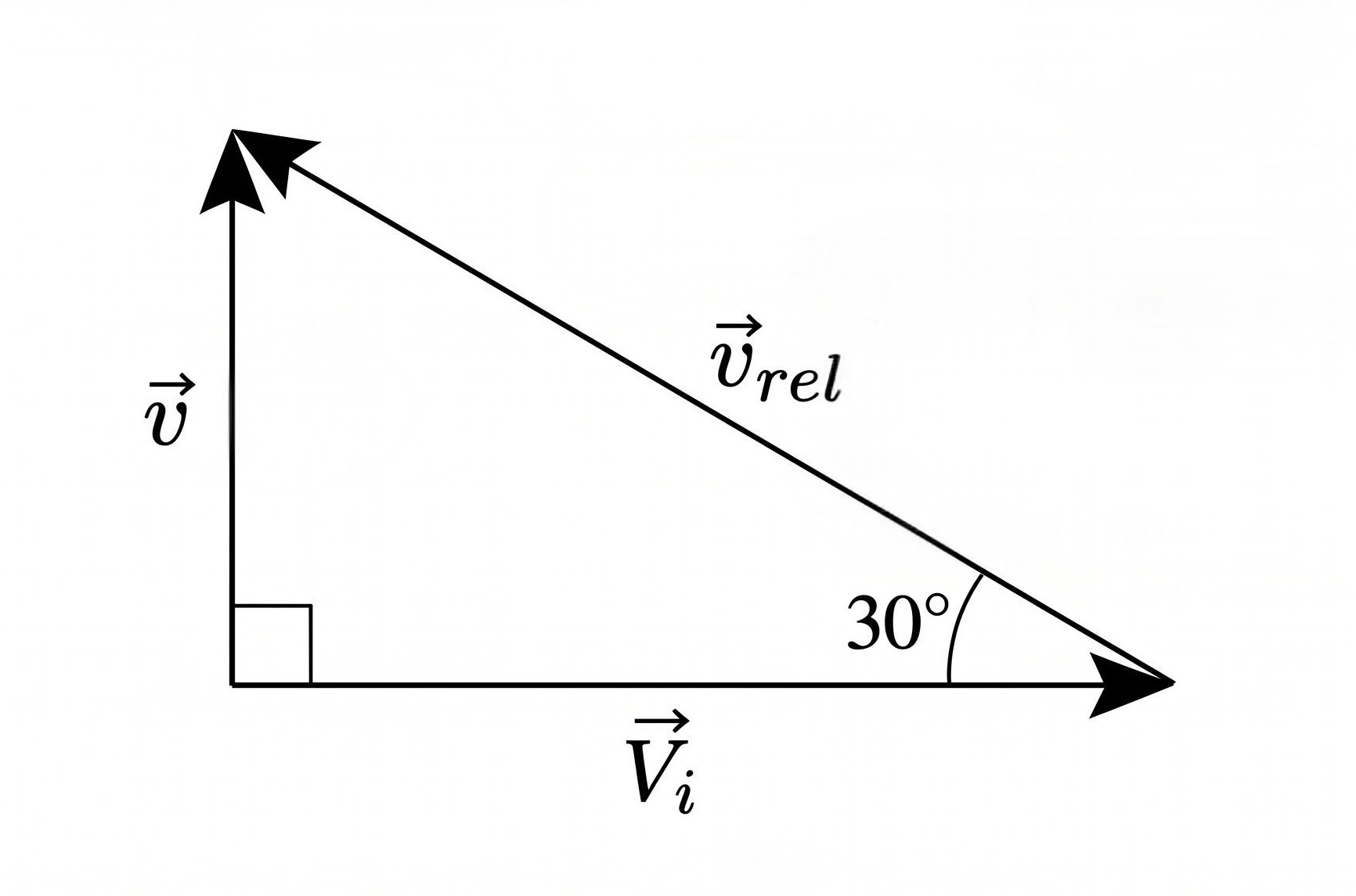
| As the iceboat starts moving and acquires its own velocity $\vec{v}_i$, the relative velocity of the wind changes. According to the velocity addition formula, the relative velocity of the wind is: |
| $$ \vec{v}_{rel} = \vec{v} - \vec{v}_b $$ |
| $$ \vec{v}_{rel} = \vec{v} - \vec{v}_i $$ |
| |
| |
| Since the absolute wind velocity $\vec{v}$ is perpendicular to the iceboat's velocity $\vec{v}_b$, these vectors form a right-angled triangle. |
| Since the absolute wind velocity $\vec{v}$ is perpendicular to the iceboat's velocity $\vec{v}_i$, these vectors form a right-angled triangle. |
| |
| |
| The wind will continue to exert pressure on the sail and accelerate the iceboat as long as the relative wind velocity $\vec{v}_{rel}$ pushes against it. The iceboat reaches its maximum speed when the wind stops exerting force on the sail. This condition is met when the relative wind velocity vector $\vec{v}_{rel}$ becomes parallel to the sail. |
| The wind will continue to exert pressure on the sail and accelerate the iceboat as long as the relative wind velocity $\vec{v}_{rel}$ pushes against it. The iceboat reaches its maximum speed when the wind stops exerting force on the sail. This condition is met when the relative wind velocity vector $\vec{v}_{rel}$ becomes parallel to the sail. |
| |
| |
| According to the problem, the sail is set at an angle of $30^\circ$ to the direction of the iceboat's motion. Therefore, in the limiting case, the angle between the vectors $\vec{v}_b$ and $\vec{v}_{rel}$ in our right-angled triangle is exactly $30^\circ$. |
| According to the problem, the sail is set at an angle of $30^\circ$ to the direction of the iceboat's motion. Therefore, in the limiting case, the angle between the vectors $\vec{v}_i$ and $\vec{v}_{rel}$ in our right-angled triangle is exactly $30^\circ$. |
| |
| |
| |
|  |
| |
| |
| From this velocity vector triangle, we can express the relationship: |
| From this velocity vector triangle, we can express the relationship: |
| $$ \tan 30^\circ = \frac{v}{v_b} $$ |
| $$ \tan 30^\circ = \frac{v}{v_i} $$ |
| |
| |
| Solving for the maximum speed of the iceboat $v_b$: |
| Solving for the maximum speed of the iceboat $v_i$: |
| $$ v_b = \frac{v}{\tan 30^\circ} = v \cot 30^\circ $$ |
| $$ v_i = \frac{v}{\tan 30^\circ} = v \cot 30^\circ $$ |
| |
| |
| Since $\cot 30^\circ = \sqrt{3}$, we obtain: |
| Since $\cot 30^\circ = \sqrt{3}$, we obtain: |
| $$ v_b = v\sqrt{3} $$ |
| $$ v_i = v\sqrt{3} $$ |
| |
| |
| #### Answer |
| #### Answer |
| |
| |
| $$ v_{max} = v\sqrt{3} $$ |
| $$ v_{max} = v\sqrt{3} $$ |
| |
| |
| #### Answer |
| |
| |
| |
| [Insert a concise answer or boxed result] |
| |
