Новое решение

en/13.1.18.md
+13 −0
| @@ -0,0 +1,13 @@ | |||
| + | ### Statement | ||
| + | |||
| + | $13.1.18.$ [Insert the problem statement] | ||
| + | |||
| + | ### Solution | ||
| + | |||
| + |  | ||
| + | |||
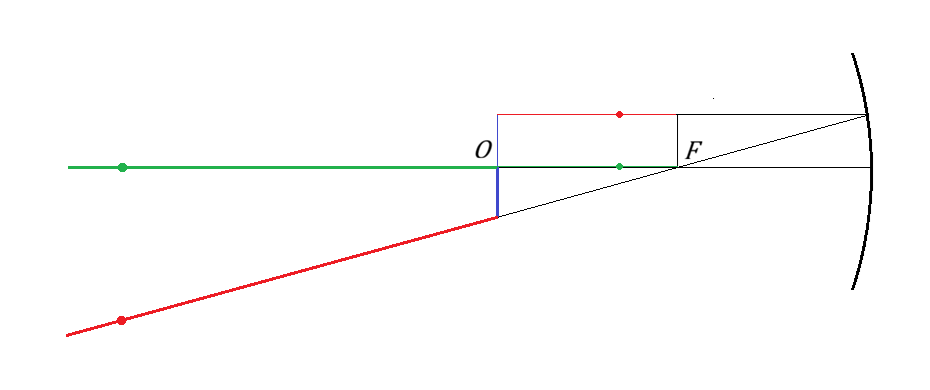
| + | The bottom left corner of the rectangle is at the center of curvature of the mirror, so its image remains at that point. The top left corner of the rectangle and its image are symmetric with respect to the principal axis. The bottom right corner of the rectangle is at the focal point of the mirror, so its image is on the principal axis at infinity. The top right corner of the rectangle is also at infinity. As a result of the thin lens equation, the image of any other point on the top side at the distance $x$ from the mirror will be at the distance $x'=xf/(x-f)=xm$ from the mirror, where $m$ is the magnification of the image. If the top side of the rectangle is at the distance $h$ from the principal axis, then the image of a point on the top side will be at the distance $y'=hm=h(x'-f)/f$ from the principal axis. Consequently, the image of the top side is part of a line through the focal point. In the figure, the rectangle is shown with thin lines, while its image is shown with thick lines. | ||
| + | |||
| + | #### Answer | ||
| + | |||
| + | [Insert a concise answer or boxed result] | ||
| @@ -0,0 +1,13 @@ | |||
| ### Statement | |||
| $13.1.18.$ [Insert the problem statement] | |||
| ### Solution | |||
|  | |||
| The bottom left corner of the rectangle is at the center of curvature of the mirror, so its image remains at that point. The top left corner of the rectangle and its image are symmetric with respect to the principal axis. The bottom right corner of the rectangle is at the focal point of the mirror, so its image is on the principal axis at infinity. The top right corner of the rectangle is also at infinity. As a result of the thin lens equation, the image of any other point on the top side at the distance $x$ from the mirror will be at the distance $x'=xf/(x-f)=xm$ from the mirror, where $m$ is the magnification of the image. If the top side of the rectangle is at the distance $h$ from the principal axis, then the image of a point on the top side will be at the distance $y'=hm=h(x'-f)/f$ from the principal axis. Consequently, the image of the top side is part of a line through the focal point. In the figure, the rectangle is shown with thin lines, while its image is shown with thick lines. | |||
| #### Answer | |||
| [Insert a concise answer or boxed result] | |||