Новое решение

en/13.3.25.md
+19 −0
| @@ -0,0 +1,19 @@ | |||
| + | ### Statement | ||
| + | |||
| + | $13.3.25.$ [Insert the problem statement] | ||
| + | |||
| + | ### Solution | ||
| + | |||
| + |  | ||
| + | |||
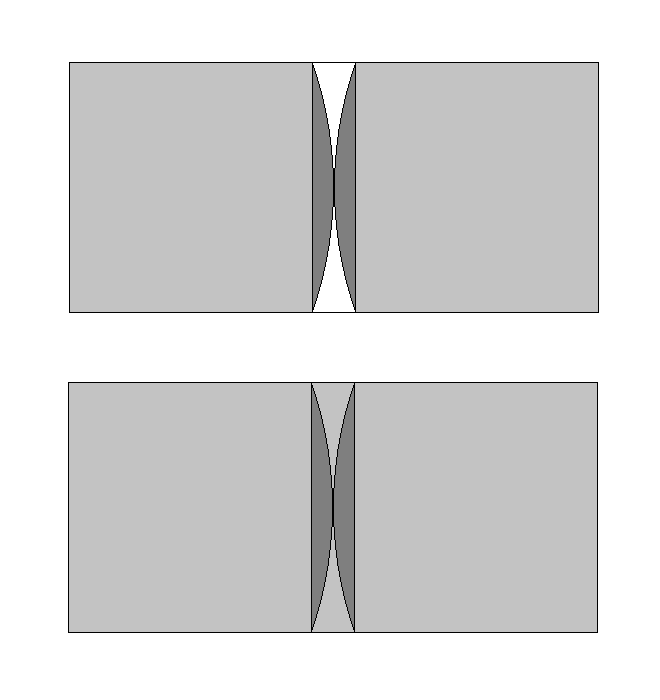
| + | When two planoconvex lenses with focal length $f=R/(n_0-1)$ in the air are placed next to each other, the focal length of the compound lenses becomes $f/2$. After submerging a frame containing the compound lenses under a liquid with refractive index $n$ (as in the top figure), the focal length of the compound lenses becomes $nf/2$ as a result of refraction at flat contact surface of the liquid and the compound lenses. When the liquid fills the space between the lenses (as in the bottom figure), the focal length $f'$ of the compound lenses satisfies the equation | ||
| + | |||
| + | \[\frac{1}{f'}=\left(\frac{n_0}{n}-1\right)\cdot\frac{2}{R}=\frac{2(n_0-n)}{n(n_0-1)f}.\] | ||
| + | |||
| + | Therefore, | ||
| + | |||
| + | \[f'=\frac{n(n_0-1)f}{2(n_0-n)}.\] | ||
| + | |||
| + | #### Answer | ||
| + | |||
| + | [Insert a concise answer or boxed result] | ||
| @@ -0,0 +1,19 @@ | |||
| ### Statement | |||
| $13.3.25.$ [Insert the problem statement] | |||
| ### Solution | |||
|  | |||
| When two planoconvex lenses with focal length $f=R/(n_0-1)$ in the air are placed next to each other, the focal length of the compound lenses becomes $f/2$. After submerging a frame containing the compound lenses under a liquid with refractive index $n$ (as in the top figure), the focal length of the compound lenses becomes $nf/2$ as a result of refraction at flat contact surface of the liquid and the compound lenses. When the liquid fills the space between the lenses (as in the bottom figure), the focal length $f'$ of the compound lenses satisfies the equation | |||
| \[\frac{1}{f'}=\left(\frac{n_0}{n}-1\right)\cdot\frac{2}{R}=\frac{2(n_0-n)}{n(n_0-1)f}.\] | |||
| Therefore, | |||
| \[f'=\frac{n(n_0-1)f}{2(n_0-n)}.\] | |||
| #### Answer | |||
| [Insert a concise answer or boxed result] | |||