| @@ -1,22 +1,22 @@ |
| | | ### Statement |
| | | |
| | − | $3.5.42.$ [Insert the problem statement] |
| | + | $3.5.42.$ At time $t=0$, a particle of mass $m$ is subjected to a force $F_x=F_0\sin(\omega t)$ in the $x$-axis direction, and a force $F_y=F_0\cos(\omega t)$ in the $y$-axis direction. Find the trajectory of the particle if at the initial moment it is at rest. What is the average velocity of the particle over a large time? What initial velocity must the particle have in order to move in the presence of these forces on a circle? What is the radius of this circle? |
| | | |
| | + |  |
| | + | |
| | | ### Solution |
| | | |
| | − | From $F_x=F_0\sin(\omega t)$ and $F_y=F_0\cos(\omega t)$ and the initial conditions $v_x=v_y=0$ and $x=y=0$ at , we have |
| | + | From $F_x=F_0\sin(\omega t)$ and $F_y=F_0\cos(\omega t)$ and the initial conditions $v_x=v_y=0$ and $x=y=0$ at $t=0$, we have |
| | | |
| | − | \begin{eqnarray} |
| | − | a_x&=&\frac{F_0}{m}\sin(\omega t),\\ |
| | − | a_y&=&\frac{F_0}{m}\cos(\omega t),\\ |
| | − | v_x&=&\frac{F_0}{m\omega}-\frac{F_0}{m\omega}\cos(\omega t)\\ |
| | − | v_y&=&\frac{F_0}{m\omega}\sin(\omega t)\\ |
| | − | x&=&\frac{F_0}{m\omega}t-\frac{F_0}{m\omega^2}\sin(\omega t)\\ |
| | − | y&=&\frac{F_0}{m\omega^2}-\frac{F_0}{m\omega^2}\cos(\omega t) |
| | − | \end{eqnarray} |
| | + | \[a_x=\frac{F_0}{m}\sin(\omega t),\] |
| | + | \[a_y=\frac{F_0}{m}\cos(\omega t),\] |
| | + | \[v_x=\frac{F_0}{m\omega}-\frac{F_0}{m\omega}\cos(\omega t),\] |
| | + | \[v_y=\frac{F_0}{m\omega}\sin(\omega t),\] |
| | + | \[x=\frac{F_0}{m\omega}t-\frac{F_0}{m\omega^2}\sin(\omega t),\] |
| | + | \[y=\frac{F_0}{m\omega^2}-\frac{F_0}{m\omega^2}\cos(\omega t).\] |
| | | |
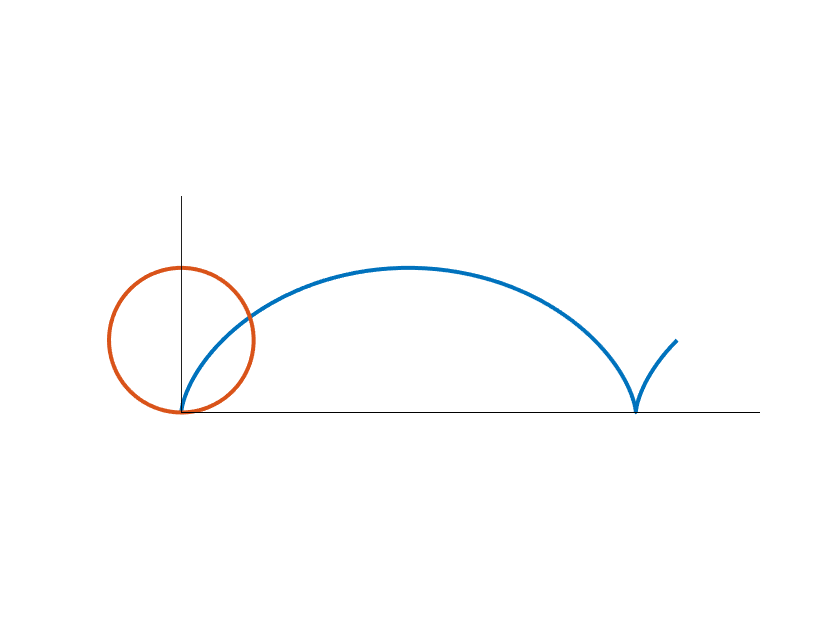
| | − | The last two equations are parametric equations of a cycloid, which is the trajectory of a point on the rim of a disk of radius $R=F_0/(m\omega^2)$ that rolls without slipping on the $x$-axis (shown in blue). Its average velocity is $F_0/(m\omega)$ in the positive $x$ direction. If the initial velocity is $v_0=F_0/(m\omega)$ in the negative $x$ direction, which is perpendicular to the initial force, then the time-dependent force will keep it in a circular orbit (shown in red) as the equation $F_0=mv_0^2/R$ for centripetal force is satisfied. |
| | + | The last two equations are parametric equations of a cycloid (shown in blue), which is the trajectory of a point on the rim of a disk of radius $R=F_0/(m\omega^2)$ that rolls without slipping on the $x$-axis. Its average velocity is $F_0/(m\omega)$ in the positive $x$ direction. If the initial velocity is $v_0=F_0/(m\omega)$ in the negative $x$ direction, which is perpendicular to the initial force, then the time-dependent force will keep it in a circular orbit of radius $R$ (shown in red) as the equation $F_0=mv_0^2/R$ for centripetal force is satisfied. |
| | | |
| | | #### Answer |
| | | |
| | − | [Insert a concise answer or boxed result] |
| | + | See the last paragraph in the solution. |
