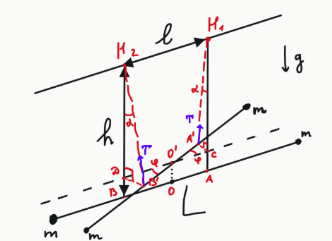
3.1.14∗. A weightless rod of length $L > l$ with masses $m$ at its ends hangs on threads of length $h$ located at a distance $l$ from each other. The rod is horizontal. Show that when the rod is rotated about its vertical axis of symmetry by a small angle $\varphi$, the torque of the forces acting on the masses is proportional to $\varphi$, and the change in the potential energy of the masses is proportional to $\varphi^2$. Find the maximum angular velocity of the rod if it is released after being initially rotated by an angle $\varphi_0$.
Solution
For problem $3.1.14$
Let's analyze the geometry of the displacement when the rod is rotated by an angle $\varphi$. The point of attachment of the thread moves along an arc. The horizontal displacement of the thread from its vertical position is given by the chord $A'C$.
From the side view, we can express this displacement as: $$A'C = h \sin\alpha$$ where $\alpha$ is the angle of deviation of the thread from the vertical.
Considering the top view, let the center of rotation be $O'$. The distance to the thread attachment point is $O'C = O'A' = \frac{l}{2}$.
Using the Law of Sines in the isosceles triangle $\triangle O'CA'$: $$\frac{A'C}{\sin\varphi} = \frac{O'C}{\sin\left(\frac{\pi}{2} - \frac{\varphi}{2}\right)}$$
Equating the two expressions for $A'C$, we find the relationship between $\alpha$ and $\varphi$: $$\sin\alpha = \frac{l \sin\varphi}{2h \cos\left(\frac{\varphi}{2}\right)}$$
Next, let's find the restoring torque torque $\vec{M} = [\vec{r} \times \vec{T}]$ caused by the tension force $T$.
The tension force has a horizontal component that pulls the rod back towards its equilibrium position. This horizontal force is: $$F_h = T \sin\alpha$$
For a small angle $\varphi$, this horizontal force acts approximately perpendicular to the rod. The distance from the axis of rotation to the thread attachment point (the lever arm) is $l/2$. Therefore, the restoring torque is simply the product of the force and the lever arm: $$M_z = - F_h \cdot \frac{l}{2} = - \frac{l}{2} T \sin\alpha$$
For small angles $\varphi \to 0$, we have $\sin\varphi \approx \varphi$ and the denominator approaches $1$. Thus: $$M_z \approx -\frac{l^2 T}{4h} \varphi$$ This proves that the restoring torque is proportional to the angle: $M \sim \varphi$.
Now, let's calculate the change in potential energy. The vertical displacement $z$ of the rod is: $$z = h(1 - \cos\alpha) = h(1 - \sqrt{1 - \sin^2\alpha})$$
For small angles $\varphi \to 0$, applying the approximation $(1+x)^a \approx 1 + ax$, we obtain: $$z \approx h \left( 1 - \left[ 1 - \left( \frac{l\varphi}{2h} \right)^2 \right]^{1/2} \right) \approx h \left( 1 - 1 + \frac{1}{2}\left(\frac{l}{2h}\right)^2 \varphi^2 \right) = \frac{l^2}{8h} \varphi^2$$ This proves that the change in potential energy is proportional to the square of the angle: $U \sim \varphi^2$.
Finally, to find the maximum angular velocity $\omega$, we apply the law of conservation of energy. The maximum kinetic energy at the equilibrium position equals the initial potential energy at the maximum deflection angle $\varphi_0$: $$\frac{mv^2}{2} = mgz \implies v = \sqrt{2gz}$$
The linear velocity of the masses at the ends of the rod is related to the angular velocity by $v = \omega \frac{L}{2}$. Therefore: $$\omega = \frac{2v}{L} = \frac{2\sqrt{2gz}}{L}$$
Substituting $z = \frac{l^2}{8h} \varphi_0^2$ into the equation: $$\omega = \frac{2\sqrt{2g \cdot \frac{l^2}{8h} \varphi_0^2}}{L} = \frac{l}{L} \sqrt{\frac{g}{h}} \varphi_0$$