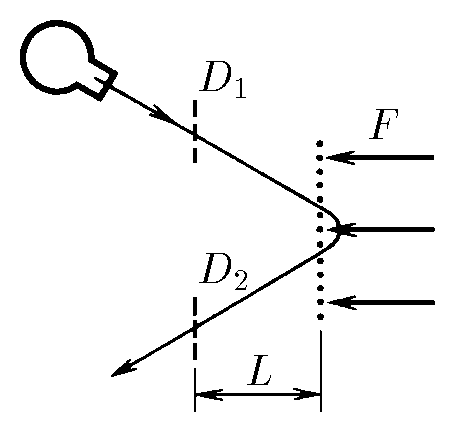
2.2.4∗. In a time-of-flight mass spectrometer, a source emits a bunch of charged particles, which initially fly freely and pass through the first detector $D_1$, located at a distance $L$ from the grid. Behind the grid, an electrical force $F$ acts on the particles along the normal to it. The particles turn around and fly back out through the grid, passing through the second detector $D_2$, located at the same distance from the grid. The velocity of the emitted particles depends on the source voltage, but its exact value remains unknown. By varying the voltage, the time between the triggering of the detectors is measured, and its minimum value $\Delta t$ is found. What is the mass of the particle? How can the mass of the particles be found if the source emits several types of particles with different masses?
For problem $2.2.4$
Solution
Time of flight over the distance $2L$:
$$t_1 = \frac{2L}{v_0}$$
Turnaround time of the particle:
$$t_2 = 2\frac{mv_0}{F}$$
Dependence of the time on the particle's velocity:
$$t(v) = \frac{2L}{v_0} + 2\frac{mv_0}{F}$$
We find the derivative of the time with respect to velocity and look for an extremum (from the condition for the minimum $\Delta t$):
$$\Delta t = 4\sqrt{\frac{mL}{F}} \Rightarrow \boxed{m = \frac{F{\Delta t}^2}{16L}}$$
If the source emits a mixture of particles with different masses, then as the voltage changes, several local minima of time $\Delta t_i$ will be observed, each corresponding to a specific type of particle. The mass of each particle can be found using the same formula: