Новое решение

en/13.3.22.md
+19 −0
| @@ -0,0 +1,19 @@ | |||
| + | ### Statement | ||
| + | |||
| + | $13.3.22.$ [Insert the problem statement] | ||
| + | |||
| + | ### Solution | ||
| + | |||
| + |  | ||
| + | |||
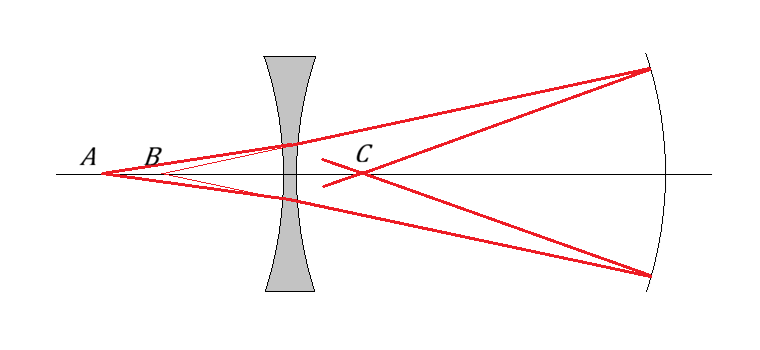
| + | An object placed in front of a concave lens (Point $A$) always has its (virtual) image (Point $B$) between the lens and the focal point in front of the lens. This image serves as the object for the concave mirror. There are two major scenarios in which the final image produced by the lens is virtual depending on the location of the image from the mirror which serves as the object for the lens. | ||
| + | |||
| + | 1. The focal length of the mirror is at most $f/2$. In this case, the center of curvature of the mirror is at or to the right of the lens, and the image from the mirror at Point $C$ is to the right of its center of curvature (and to the left of its focal point) and hence to the right of the lens as shown in the figure. | ||
| + | |||
| + | 2. The focal length of the mirror is at least $f$. There are two minor scenarios. First, if Point $B$ is at or to the left of the focal point of the mirror (and to the right of its center of curvature), then its image is to the left of the center of curvature of the mirror (possibly at infinity) and hence to the left of the left focal point of the lens. Second, if Point $B$ is to the right of the focal point of the mirror (which is always the case if the focal length of the mirror is at least $2f$), then its image is to the right of the mirror and hence to the right of the lens. | ||
| + | |||
| + | Using $f=0.6$ m, we conclude that the mirror has to have focal length of at most $0.3$ m OR at least $0.6$ m in order for the final image from the lens to always be virtual regardless of where the object is placed in front of the lens. | ||
| + | |||
| + | #### Answer | ||
| + | |||
| + | [Insert a concise answer or boxed result] | ||
| @@ -0,0 +1,19 @@ | |||
| ### Statement | |||
| $13.3.22.$ [Insert the problem statement] | |||
| ### Solution | |||
|  | |||
| An object placed in front of a concave lens (Point $A$) always has its (virtual) image (Point $B$) between the lens and the focal point in front of the lens. This image serves as the object for the concave mirror. There are two major scenarios in which the final image produced by the lens is virtual depending on the location of the image from the mirror which serves as the object for the lens. | |||
| 1. The focal length of the mirror is at most $f/2$. In this case, the center of curvature of the mirror is at or to the right of the lens, and the image from the mirror at Point $C$ is to the right of its center of curvature (and to the left of its focal point) and hence to the right of the lens as shown in the figure. | |||
| 2. The focal length of the mirror is at least $f$. There are two minor scenarios. First, if Point $B$ is at or to the left of the focal point of the mirror (and to the right of its center of curvature), then its image is to the left of the center of curvature of the mirror (possibly at infinity) and hence to the left of the left focal point of the lens. Second, if Point $B$ is to the right of the focal point of the mirror (which is always the case if the focal length of the mirror is at least $2f$), then its image is to the right of the mirror and hence to the right of the lens. | |||
| Using $f=0.6$ m, we conclude that the mirror has to have focal length of at most $0.3$ m OR at least $0.6$ m in order for the final image from the lens to always be virtual regardless of where the object is placed in front of the lens. | |||
| #### Answer | |||
| [Insert a concise answer or boxed result] | |||