Statement
10.2.7. Prove that a charged particle in crossed electric and magnetic fields orbits with a frequency
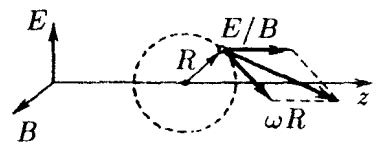
Solution
Equation of motion in the laboratory frame
Let us write Newton's second law for a charged particle in crossed fields in our stationary (laboratory) reference frame:Transition to a moving reference frame
Let us try to find an inertial reference framemoving with some constant velocity relative to the laboratory, in which the particle's motion will look simple.
According to the classical Galilean velocity addition law, the particle's velocity in the laboratory frame
Let's substitute this velocity into Newton's second law. Since frame
Expanding the cross product:
Let us group the constant terms that do not depend on the particle's current velocity
- Condition for the drift velocity
Now for the main physical trick: we can choose the velocity vectorto be whatever we want. Let us select a frame velocity such that the constant bracket in our equation becomes strictly zero:
Since the fields are crossed by the problem's condition (i.e.,
This is exactly the drift velocity
- Rotation in the new reference frame
If we transition to the reference frame moving with this drift velocity, the constant force disappears (the effective electric field is nullified purely mechanically, without any Lorentz transformations!). The equation of motion for the particle in this new frame takes the simplest form:
This is the standard equation of motion for a charge solely in a uniform magnetic field. As is well known, under the action of the Lorentz force, the particle undergoes uniform circular motion.
Let's write Newton's second law for this rotation (where the centripetal acceleration is
Conclusion
We have rigorously proven that the particle's motion is a superposition of two simple motions:
- Translational rectilinear motion (drift) with velocity
. - Rotation around this drifting center with the cyclotron frequency
.