Statement
2.1.66∗ . [Insert the problem statement]
Solution
For problem $2.1.66$
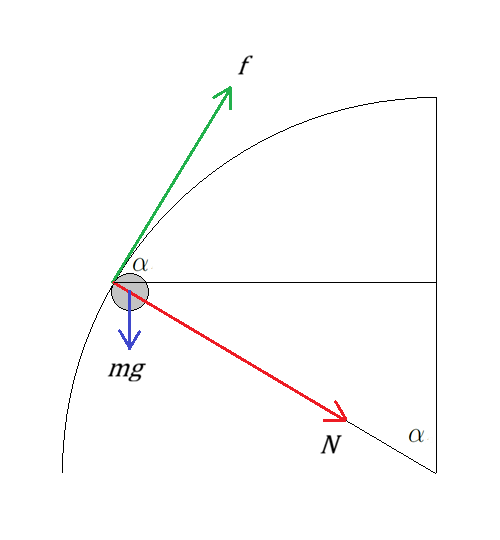
If the rider uses minimum speed possible, the friction from the surface is maximum possible, i.e. $f=\mu N$
$$f\sin\alpha-N\cos\alpha-mg=0\qquad\Rightarrow N(\mu\sin\alpha-\cos\alpha)=mg.$$
The horizontal component of the total force serves as the centripetal force, so
$$f\cos\alpha+N\sin\alpha=\frac{mv^2}{R\sin\alpha}\qquad\Rightarrow N(\mu\cos\alpha+\sin\alpha)=\frac{mv^2}{R\sin\alpha}.$$
Eliminating $N$ $v$
$$v=\sqrt{\frac{gR\sin\alpha(\mu\cos\alpha+\sin\alpha)}{\mu\sin\alpha-\cos\alpha}}=\sqrt{\frac{gR\sin\alpha(\mu+\tan\alpha)}{\mu\tan\alpha-1}},$$
which is possible when $\tan\alpha>1/\mu$
Answer
[Insert a concise answer or boxed result]