Новое решение

en/4.2.24.md
+29 −0
| @@ -0,0 +1,29 @@ | |||
| + | ### Statement | ||
| + | |||
| + | $4.2.24.$ [Insert the problem statement] | ||
| + | |||
| + | ### Solution | ||
| + | |||
| + |  | ||
| + | |||
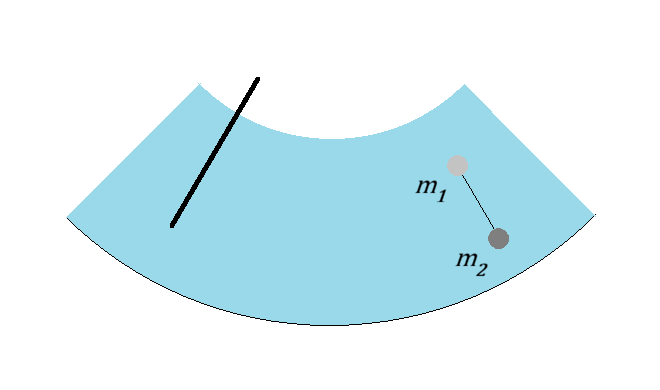
| + | a. The rotation of the spaceship creates an outward pseudo-gravitational field $\omega^2r$, where $r$ is the distance from the axis of the spaceship. Thus, the surface of the pool is a part of a cylinder with the same axis of symmetry as the spaceship. Archimedes' Principles still holds in this situation, and astronauts can still float and swim in the pool. Let $a$ be the cross-section of the stick. Then, a short element $dr$ of the stick has mass $\rho a\,dr$, where $\rho$ is the density of the stick, and will experience outward gravitational force $\rho a\omega^2r\,dr$ and (if submerged in the pool) inward buoyancy force $\rho_wa\omega^2r\,dr$, where $\rho_w$ is the density of water. Since the stick is stationary, gravity and buoyancy have the same magnitude, i.e. | ||
| + | |||
| + | \[\int_{R-H-\Delta}^{R-H+l-\Delta}\rho a\omega^2r\,dr=\int_{R-H}^{R-H+l-\Delta}\rho_wa\omega^2r\,dr.\] | ||
| + | |||
| + | Consequently, | ||
| + | |||
| + | \[\rho=\rho_w\cdot\frac{(l-\Delta)[2(R-H)+l-\Delta]}{l[2(R-H-\Delta)+l]}\] | ||
| + | |||
| + | b. Suppose mass $m_1$ with density $\rho_1<\rho_w$ and mass $m_2$ with density $\rho_2>\rho_w$ are linked by a thread of length $2d$. Since $m_1$ is pulled inward and $m_2$ is pushed outward, they will align in a radial direction. Let $D$ be the distance between the midpoint of the thread and the axis of the space ship when the system is in equilibrium (if possible). Then, the outward push on $m_2$ and the inward pull on $m_1$ have the same magnitude, i.e. | ||
| + | |||
| + | \[m_2\left(1-\frac{\rho_w}{\rho_2}\right)\omega^2(D+d)=m_1\left(\frac{\rho_w}{\rho_1}-1\right)\omega^2(D-d),\] | ||
| + | |||
| + | which can be solved to obtain an expression for $D$. Under the assumption that | ||
| + | |||
| + | \[m_2\left(1-\frac{\rho_w}{\rho_2}\right)>m_1\left(\frac{\rho_w}{\rho_1}-1\right),\] | ||
| + | |||
| + | if the midpoint of the thread is at a distance $r>D$, then the outward push on $m_2$ is stronger than the inward pull on $m_1$, and the system will sink toward the wall of the spacecraft. On the other hand, if the midpoint of the thread is at a distance $r<D$, then the outward push on $m_2$ is weaker than the inward pull on $m_1$, and the system will float toward the free surface. If the inequality in the assumption is reversed, then the equilibrium when the midpoint of the thread is at the distance $D$ from the axis of the spacecraft is stable. | ||
| + | |||
| + | #### Answer | ||
| + | |||
| + | [Insert a concise answer or boxed result] | ||
| @@ -0,0 +1,29 @@ | |||
| ### Statement | |||
| $4.2.24.$ [Insert the problem statement] | |||
| ### Solution | |||
|  | |||
| a. The rotation of the spaceship creates an outward pseudo-gravitational field $\omega^2r$, where $r$ is the distance from the axis of the spaceship. Thus, the surface of the pool is a part of a cylinder with the same axis of symmetry as the spaceship. Archimedes' Principles still holds in this situation, and astronauts can still float and swim in the pool. Let $a$ be the cross-section of the stick. Then, a short element $dr$ of the stick has mass $\rho a\,dr$, where $\rho$ is the density of the stick, and will experience outward gravitational force $\rho a\omega^2r\,dr$ and (if submerged in the pool) inward buoyancy force $\rho_wa\omega^2r\,dr$, where $\rho_w$ is the density of water. Since the stick is stationary, gravity and buoyancy have the same magnitude, i.e. | |||
| \[\int_{R-H-\Delta}^{R-H+l-\Delta}\rho a\omega^2r\,dr=\int_{R-H}^{R-H+l-\Delta}\rho_wa\omega^2r\,dr.\] | |||
| Consequently, | |||
| \[\rho=\rho_w\cdot\frac{(l-\Delta)[2(R-H)+l-\Delta]}{l[2(R-H-\Delta)+l]}\] | |||
| b. Suppose mass $m_1$ with density $\rho_1<\rho_w$ and mass $m_2$ with density $\rho_2>\rho_w$ are linked by a thread of length $2d$. Since $m_1$ is pulled inward and $m_2$ is pushed outward, they will align in a radial direction. Let $D$ be the distance between the midpoint of the thread and the axis of the space ship when the system is in equilibrium (if possible). Then, the outward push on $m_2$ and the inward pull on $m_1$ have the same magnitude, i.e. | |||
| \[m_2\left(1-\frac{\rho_w}{\rho_2}\right)\omega^2(D+d)=m_1\left(\frac{\rho_w}{\rho_1}-1\right)\omega^2(D-d),\] | |||
| which can be solved to obtain an expression for $D$. Under the assumption that | |||
| \[m_2\left(1-\frac{\rho_w}{\rho_2}\right)>m_1\left(\frac{\rho_w}{\rho_1}-1\right),\] | |||
| if the midpoint of the thread is at a distance $r>D$, then the outward push on $m_2$ is stronger than the inward pull on $m_1$, and the system will sink toward the wall of the spacecraft. On the other hand, if the midpoint of the thread is at a distance $r<D$, then the outward push on $m_2$ is weaker than the inward pull on $m_1$, and the system will float toward the free surface. If the inequality in the assumption is reversed, then the equilibrium when the midpoint of the thread is at the distance $D$ from the axis of the spacecraft is stable. | |||
| #### Answer | |||
| [Insert a concise answer or boxed result] | |||