Правка разделов «Statement», «Solution», «Answer»

en/2.1.56.md
+11 −21
| @@ -1,47 +1,41 @@ | |||
| ### Statement | |||
| − | $2.1.56.$ [Insert the problem statement] | ||
| − | |||
| − | ### Solution | ||
| − | |||
| − | ### Statement | ||
| − | |||
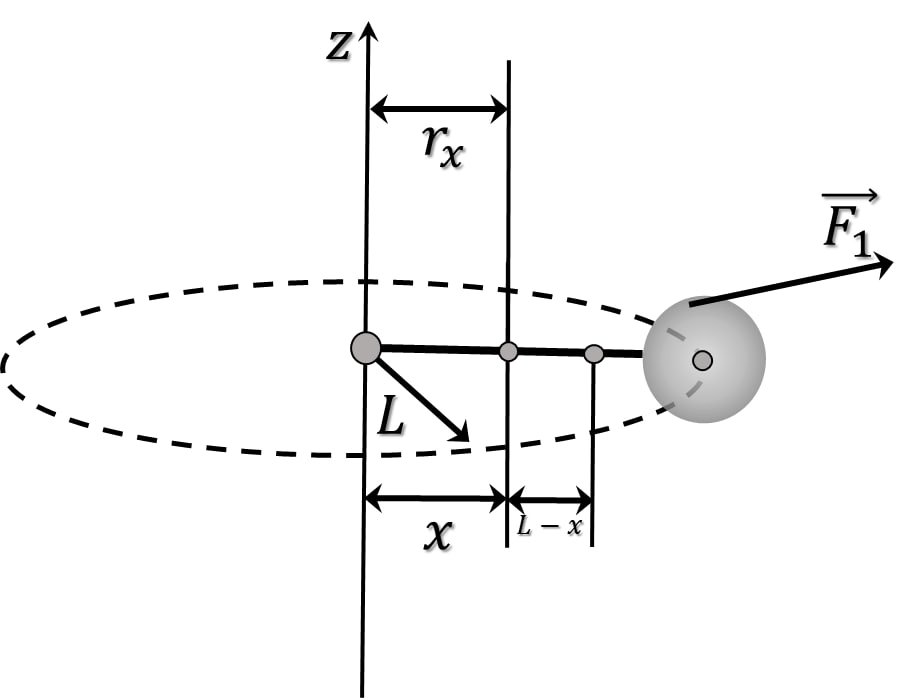
| $2.1.56.$ A body of mass $M$ is connected by a thread of length $l$ to an axis around which it revolves with an angular velocity $\\omega$. Find the tension force of the thread. The dimensions of the body are small; neglect gravity. Replace the thread with a uniform rope of mass $m$ and find its tension force at a distance $x$ from the axis of rotation. | |||
| ### Solution | |||
| − |  | ||
| − | 1\ | ||
| + | 1\. In the case of a weightless and inextensible thread, its tension is determined as: | ||
| $$ | |||
| − | T = F_i = \\frac{Mv^2}{L} = \\frac{M\\omega^2 | ||
| + | T = F_i = \\frac{Mv^2}{L} = \\frac{M\\omega^2L^2}{L} | ||
| $$ | |||
| $$ | |||
| − | \\boxed{T = M\\omega^2 | ||
| + | \\boxed{T = M\\omega^2L} | ||
| $$ | |||
| − | 2\ | ||
| + | 2\. Let us isolate a specified cross-section of the rope at distance $x$ and determine the mass of its outer part of length $(L-x)$: | ||
| $$ | |||
| − | m_x = m\\frac{ | ||
| + | m_x = m\\frac{L-x}{L} | ||
| $$ | |||
| − | 3\ | ||
| + | 3\. Let us determine the distance from the rotation axis $Oz$ to the center of mass of this rope segment: | ||
| $$ | |||
| − | r_x = | ||
| + | r_x = L - \\frac{L-x}{2} | ||
| $$ | |||
| $$ | |||
| − | r_x = \\frac{ | ||
| + | r_x = \\frac{L+x}{2} | ||
| $$ | |||
| − | 4\ | ||
| + | 4\. The tension of the rope at section $x$ will be caused by the inertial (centrifugal) force of the rotating mass $M$ and the mass of the outer rope segment $m_x$: | ||
| $$ | |||
| − | \\boxed{T_x = M\\omega^2 | ||
| + | \\boxed{T_x = M\\omega^2L + \\frac{m\\omega^2(L^2-x^2)}{2L}} | ||
| $$ | |||
| #### Answer | |||
| $$ | |||
| T = M\\omega^2l | |||
| $$ | |||
| @@ -53,7 +47,3 @@Answer | |||
| $$ | |||
| T_x = M\\omega^2l + m\\omega^2(l^2 - x^2)/(2l) | |||
| $$ | |||
| − | |||
| − | #### Answer | ||
| − | |||
| − | [Insert a concise answer or boxed result] | ||
| @@ -1,47 +1,41 @@ | |||
| ### Statement | ### Statement | ||
| $2.1.56.$ [Insert the problem statement] | |||
| ### Solution | |||
| ### Statement | |||
| $2.1.56.$ A body of mass $M$ is connected by a thread of length $l$ to an axis around which it revolves with an angular velocity $\\omega$. Find the tension force of the thread. The dimensions of the body are small; neglect gravity. Replace the thread with a uniform rope of mass $m$ and find its tension force at a distance $x$ from the axis of rotation. | $2.1.56.$ A body of mass $M$ is connected by a thread of length $l$ to an axis around which it revolves with an angular velocity $\\omega$. Find the tension force of the thread. The dimensions of the body are small; neglect gravity. Replace the thread with a uniform rope of mass $m$ and find its tension force at a distance $x$ from the axis of rotation. | ||
| ### Solution | ### Solution | ||
|  | ||
| 1\ |
1\. In the case of a weightless and inextensible thread, its tension is determined as: | ||
| $$ | $$ | ||
| T = F_i = \\frac{Mv^2}{L} = \\frac{M\\omega^2 |
T = F_i = \\frac{Mv^2}{L} = \\frac{M\\omega^2L^2}{L} | ||
| $$ | $$ | ||
| $$ | $$ | ||
| \\boxed{T = M\\omega^2 |
\\boxed{T = M\\omega^2L} | ||
| $$ | $$ | ||
| 2\ |
2\. Let us isolate a specified cross-section of the rope at distance $x$ and determine the mass of its outer part of length $(L-x)$: | ||
| $$ | $$ | ||
| m_x = m\\frac{ |
m_x = m\\frac{L-x}{L} | ||
| $$ | $$ | ||
| 3\ |
3\. Let us determine the distance from the rotation axis $Oz$ to the center of mass of this rope segment: | ||
| $$ | $$ | ||
| r_x = |
r_x = L - \\frac{L-x}{2} | ||
| $$ | $$ | ||
| $$ | $$ | ||
| r_x = \\frac{ |
r_x = \\frac{L+x}{2} | ||
| $$ | $$ | ||
| 4\ |
4\. The tension of the rope at section $x$ will be caused by the inertial (centrifugal) force of the rotating mass $M$ and the mass of the outer rope segment $m_x$: | ||
| $$ | $$ | ||
| \\boxed{T_x = M\\omega^2 |
\\boxed{T_x = M\\omega^2L + \\frac{m\\omega^2(L^2-x^2)}{2L}} | ||
| $$ | $$ | ||
| #### Answer | #### Answer | ||
| $$ | $$ | ||
| T = M\\omega^2l | T = M\\omega^2l | ||
| $$ | $$ | ||
| @@ -53,7 +47,3 @@Answer | |||
| $$ | $$ | ||
| T_x = M\\omega^2l + m\\omega^2(l^2 - x^2)/(2l) | T_x = M\\omega^2l + m\\omega^2(l^2 - x^2)/(2l) | ||
| $$ | $$ | ||
| #### Answer | |||
| [Insert a concise answer or boxed result] | |||