Правка разделов «Statement», «Solution», «Answer»

en/6.3.32.md
+3 −3
| @@ -1,10 +1,10 @@ | |||
| ### Statement | |||
| − | $6.3.32.$ | ||
| + | $6.3.32.$ What is the charge induced on the surface of a grounded metal ball by a point charge $q$ located at a distance $L$ from the center of the ball? Ball radius $R<L$. | ||
| ### Solution | |||
| − | 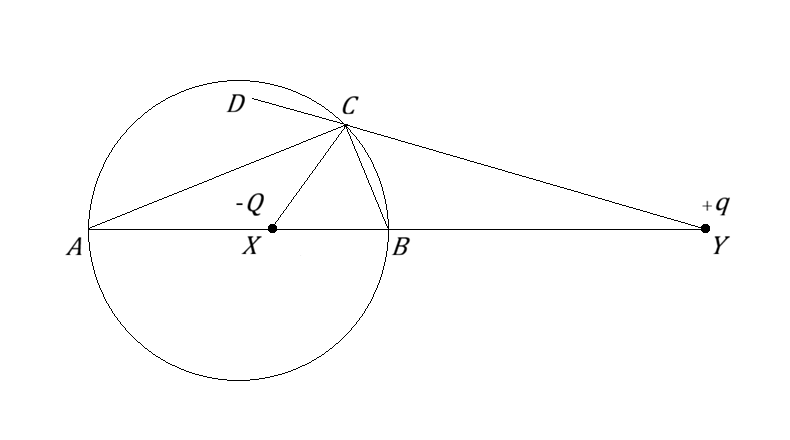 | ||
| From Gauss' Theorem, the question is equivalent to asking where, without the metal ball, a point charge $-Q$ can be placed so that together with the point charge $+q$ a zero-potential surface is created where the metal ball used to be. By symmetry, the point charge $-Q$ must be placed on a line joining the point charge $+q$ and where the center of the metal ball used to be. As a result, we may solve this problem in two dimensions, i.e. considering a zero-potential circle instead of a zero-potential sphere. Let the point charge $+q$ be at point $Y$ on the extension of the diameter $AB$ of the circle and let $C$ be any point on the circle. We claim that the point charge $-Q$ must be placed at point $X$ on $AB$ so that $\angle XCB=\angle YCB$. Since $\angle ACB=90^\circ$, it follows that $\angle XCA=\angle DCA$ as well. By angle-bisector theorems, | |||
| \[\frac{XB}{YB}=\frac{XC}{YC}=\frac{XA}{YA}\qquad\Rightarrow\qquad\frac{XB}{L-R}=\frac{XA}{L+R}.\] | |||
| Together with the fact that $XA+XB=2R$, we get $XA=R(L+R)/L$, which is independent of point $C$. As $XC/YC=XA/YA=R/L$ and electric potential from a point charge varies inversely with the distance from the point charge, we choose $-Q=-qR/L$ to guarantee that the electric potential due to point charges $+q$ and $-Q$ are identically zero on the circle. | |||
| @@ -14,4 +14,4 @@Solution | |||
| #### Answer | |||
| − | [Insert a concise answer or boxed result] | ||
| + | $-qR/L$ | ||
| @@ -1,10 +1,10 @@ | |||
| ### Statement | ### Statement | ||
| $6.3.32.$ |
$6.3.32.$ What is the charge induced on the surface of a grounded metal ball by a point charge $q$ located at a distance $L$ from the center of the ball? Ball radius $R<L$. | ||
| ### Solution | ### Solution | ||
|  | ||
| From Gauss' Theorem, the question is equivalent to asking where, without the metal ball, a point charge $-Q$ can be placed so that together with the point charge $+q$ a zero-potential surface is created where the metal ball used to be. By symmetry, the point charge $-Q$ must be placed on a line joining the point charge $+q$ and where the center of the metal ball used to be. As a result, we may solve this problem in two dimensions, i.e. considering a zero-potential circle instead of a zero-potential sphere. Let the point charge $+q$ be at point $Y$ on the extension of the diameter $AB$ of the circle and let $C$ be any point on the circle. We claim that the point charge $-Q$ must be placed at point $X$ on $AB$ so that $\angle XCB=\angle YCB$. Since $\angle ACB=90^\circ$, it follows that $\angle XCA=\angle DCA$ as well. By angle-bisector theorems, | From Gauss' Theorem, the question is equivalent to asking where, without the metal ball, a point charge $-Q$ can be placed so that together with the point charge $+q$ a zero-potential surface is created where the metal ball used to be. By symmetry, the point charge $-Q$ must be placed on a line joining the point charge $+q$ and where the center of the metal ball used to be. As a result, we may solve this problem in two dimensions, i.e. considering a zero-potential circle instead of a zero-potential sphere. Let the point charge $+q$ be at point $Y$ on the extension of the diameter $AB$ of the circle and let $C$ be any point on the circle. We claim that the point charge $-Q$ must be placed at point $X$ on $AB$ so that $\angle XCB=\angle YCB$. Since $\angle ACB=90^\circ$, it follows that $\angle XCA=\angle DCA$ as well. By angle-bisector theorems, | ||
| \[\frac{XB}{YB}=\frac{XC}{YC}=\frac{XA}{YA}\qquad\Rightarrow\qquad\frac{XB}{L-R}=\frac{XA}{L+R}.\] | \[\frac{XB}{YB}=\frac{XC}{YC}=\frac{XA}{YA}\qquad\Rightarrow\qquad\frac{XB}{L-R}=\frac{XA}{L+R}.\] | ||
| Together with the fact that $XA+XB=2R$, we get $XA=R(L+R)/L$, which is independent of point $C$. As $XC/YC=XA/YA=R/L$ and electric potential from a point charge varies inversely with the distance from the point charge, we choose $-Q=-qR/L$ to guarantee that the electric potential due to point charges $+q$ and $-Q$ are identically zero on the circle. | Together with the fact that $XA+XB=2R$, we get $XA=R(L+R)/L$, which is independent of point $C$. As $XC/YC=XA/YA=R/L$ and electric potential from a point charge varies inversely with the distance from the point charge, we choose $-Q=-qR/L$ to guarantee that the electric potential due to point charges $+q$ and $-Q$ are identically zero on the circle. | ||
| @@ -14,4 +14,4 @@Solution | |||
| #### Answer | #### Answer | ||
| [Insert a concise answer or boxed result] | $-qR/L$ | ||