Правка разделов «Statement», «Solution»

en/7.1.22.md
+5 −11
| @@ -1,4 +1,4 @@ | |||
| − | ### | ||
| + | ### Statement | ||
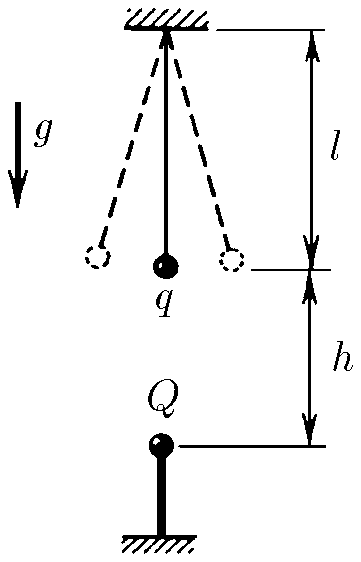
| $7.1.22^*.$ Find the frequency of small oscillations of the mathematical pendulum relative to its lower equilibrium position, if a charge $Q$ is fixed directly under the equilibrium position of the ball at a distance $h$ from it. Length of the thread $l$, mass of the ball $m$, charge $q$. | |||
|  | |||
| ### Solution | |||
| 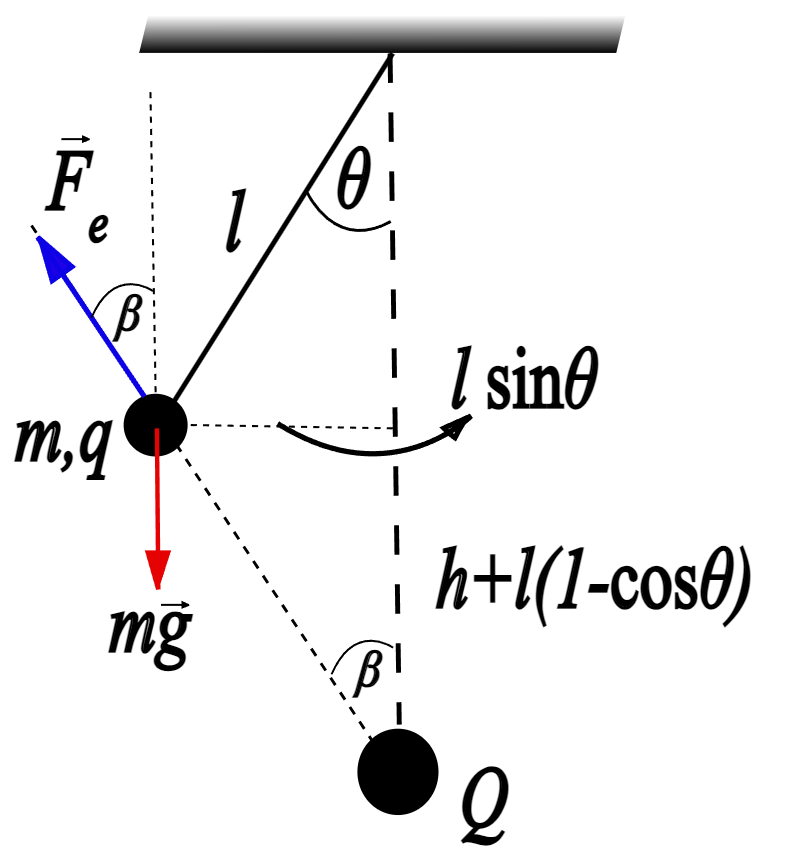 | |||
| Applying Newton's Second Law: | |||
| $$ | |||
| mg\sin{\theta}-\frac{kqQ}{\left[h+l(1-\cos\theta )\right]^2+l^2\sin^2 {\theta}}\sin{(\beta +\theta )} = m\frac{dv}{dt} \tag{1} | |||
| $$ | |||
| where, | |||
| $$ | |||
| \tan{\beta} = \frac{l\sin{\theta}}{h+l\left(1-\cos\theta\right)} \tag{2} | |||
| $$ | |||
| and, it is known that | |||
| $$ | |||
| \sin{(\beta +\theta )} = \sin{\beta}\cos{\theta}+\cos{\beta}\sin{\theta} | |||
| $$ | |||
| @@ -29,7 +29,7 @@Solution | |||
| as $\theta$ is small (small oscillations), $\sin{\theta}\approx\theta$ and $\cos{\theta}\approx1-\theta^2/2$, then | |||
| $$ | |||
| − | \sin{(\beta +\theta )} = \sin{\beta}\left(1-\frac{\theta^2}{2}\right)+\theta\cos{\beta} | ||
| + | \sin{(\beta +\theta )} = \sin{\beta}\left(1-\frac{\theta^2}{2}\right)+\theta\cos{\beta} \tag{3} | ||
| $$ | |||
| Modifying $(2)$, | |||
| $$ | |||
| \tan{\beta} = \frac{l\theta}{h+\frac{l\theta^2}{2}} \tag{4} | |||
| $$ | |||
| @@ -41,19 +41,19 @@Solution | |||
| Substituting $(3)$ and $(4)$ into $(1)$ and taking account $\sin{\theta}\approx\theta$ | |||
| $$ | |||
| − | mg\theta -\frac{kqQ}{\left(h+\frac{l\theta^2}{2}\right)^2+l^2\theta^2}\left[\sin{\beta}\left(1-\frac{\theta^2}{2}\right)+\theta\cos{\beta}\right] = m\frac{dv}{dt} | ||
| + | mg\theta -\frac{kqQ}{\left(h+\frac{l\theta^2}{2}\right)^2+l^2\theta^2}\left[\sin{\beta}\left(1-\frac{\theta^2}{2}\right)+\theta\cos{\beta}\right] = m\frac{dv}{dt} | ||
| $$ | |||
| Since angular acceleration is related to lineal acceleration according $dv/dt = \ddot{\theta}l$, dividing all equation by $ml$ and take out $\cos{\beta}$ from second term of left side, it is obtained | |||
| $$ | |||
| − | \frac{g}{l}\theta -\frac{kqQ\cos{\beta}}{ml\left[\left(h+\frac{l\theta^2}{2}\right)^2+l^2\theta^2\right]}\left[\left(1-\frac{\theta^2}{2}\right)\tan{\beta}+\theta\right] = \ddot{\theta} | ||
| + | \frac{g}{l}\theta -\frac{kqQ\cos{\beta}}{ml\left[\left(h+\frac{l\theta^2}{2}\right)^2+l^2\theta^2\right]}\left[\left(1-\frac{\theta^2}{2}\right)\tan{\beta}+\theta\right] = \ddot{\theta} \tag{5} | ||
| $$ | |||
| Graphically it can be seen that, with cosine and sine approximations applied, | |||
| $$ | |||
| − | \cos{\beta} = \frac{h+\frac{l\theta^2}{2}}{\sqrt{\left(h+\frac{l\theta^2}{2}\right)^2+l^2\theta^2}} | ||
| + | \cos{\beta} = \frac{h+\frac{l\theta^2}{2}}{\sqrt{\left(h+\frac{l\theta^2}{2}\right)^2+l^2\theta^2}} \tag{6} | ||
| $$ | |||
| Putting $(4)$ and $(6)$ into $(5)$ and developing algebraically | |||
| $$ | |||
| \frac{g}{l}\theta -\frac{kqQ}{ml}\frac{h}{\left[\left(h+\frac{l\theta^2}{2}\right)^2+l^2\theta^2\right]^{\frac{3}{2}}}\left[\left(1+\frac{l}{h+\frac{l\theta^2}{2}}\right)\theta -\frac{l\theta^3}{2h+l\theta^2}\right] = \ddot{\theta} | |||
| $$ | |||
| Since there are small oscillations, $\theta\rightarrow0$, but terms $\theta^2$ and $\theta^3$ tend to zero faster than $\theta$, so they are negligible respect to $\theta$. | |||
| $$ | |||
| \left[\frac{g}{l}-\frac{kqQ\left(l+h\right)}{mh^3l}\right]\theta = \ddot{\theta} | |||
| $$ | |||
| as $k = \frac{1}{4\pi\varepsilon_0}$, | |||
| $$ | |||
| \left[\frac{g}{l}-\frac{qQ\left(l+h\right)}{4\pi\varepsilon_0mh^3l}\right]\theta = \ddot{\theta} | |||
| $$ | |||
| Finally, | |||
| $$ | |||
| \boxed{\omega = \sqrt{\frac{g}{l}-\frac{qQ\left(h+l\right)}{4\pi\varepsilon_0mh^3l}}} | |||
| @@ -81,9 +81,3 @@Solution | |||
| $$ | |||
| valid for the condition $\frac{qQ(h+l)}{4\pi\varepsilon_0h^3} < mg$ | |||
| − | |||
| − | |||
| − | |||
| − | |||
| − | |||
| − | |||
| @@ -1,4 +1,4 @@ | |||
| ### |
### Statement | ||
| $7.1.22^*.$ Find the frequency of small oscillations of the mathematical pendulum relative to its lower equilibrium position, if a charge $Q$ is fixed directly under the equilibrium position of the ball at a distance $h$ from it. Length of the thread $l$, mass of the ball $m$, charge $q$. | $7.1.22^*.$ Find the frequency of small oscillations of the mathematical pendulum relative to its lower equilibrium position, if a charge $Q$ is fixed directly under the equilibrium position of the ball at a distance $h$ from it. Length of the thread $l$, mass of the ball $m$, charge $q$. | ||
|  |  | ||
| ### Solution | ### Solution | ||
|  |  | ||
| Applying Newton's Second Law: | Applying Newton's Second Law: | ||
| $$ | $$ | ||
| mg\sin{\theta}-\frac{kqQ}{\left[h+l(1-\cos\theta )\right]^2+l^2\sin^2 {\theta}}\sin{(\beta +\theta )} = m\frac{dv}{dt} \tag{1} | mg\sin{\theta}-\frac{kqQ}{\left[h+l(1-\cos\theta )\right]^2+l^2\sin^2 {\theta}}\sin{(\beta +\theta )} = m\frac{dv}{dt} \tag{1} | ||
| $$ | $$ | ||
| where, | where, | ||
| $$ | $$ | ||
| \tan{\beta} = \frac{l\sin{\theta}}{h+l\left(1-\cos\theta\right)} \tag{2} | \tan{\beta} = \frac{l\sin{\theta}}{h+l\left(1-\cos\theta\right)} \tag{2} | ||
| $$ | $$ | ||
| and, it is known that | and, it is known that | ||
| $$ | $$ | ||
| \sin{(\beta +\theta )} = \sin{\beta}\cos{\theta}+\cos{\beta}\sin{\theta} | \sin{(\beta +\theta )} = \sin{\beta}\cos{\theta}+\cos{\beta}\sin{\theta} | ||
| $$ | $$ | ||
| @@ -29,7 +29,7 @@Solution | |||
| as $\theta$ is small (small oscillations), $\sin{\theta}\approx\theta$ and $\cos{\theta}\approx1-\theta^2/2$, then | as $\theta$ is small (small oscillations), $\sin{\theta}\approx\theta$ and $\cos{\theta}\approx1-\theta^2/2$, then | ||
| $$ | $$ | ||
| \sin{(\beta +\theta )} = \sin{\beta}\left(1-\frac{\theta^2}{2}\right)+\theta\cos{\beta} |
\sin{(\beta +\theta )} = \sin{\beta}\left(1-\frac{\theta^2}{2}\right)+\theta\cos{\beta} \tag{3} | ||
| $$ | $$ | ||
| Modifying $(2)$, | Modifying $(2)$, | ||
| $$ | $$ | ||
| \tan{\beta} = \frac{l\theta}{h+\frac{l\theta^2}{2}} \tag{4} | \tan{\beta} = \frac{l\theta}{h+\frac{l\theta^2}{2}} \tag{4} | ||
| $$ | $$ | ||
| @@ -41,19 +41,19 @@Solution | |||
| Substituting $(3)$ and $(4)$ into $(1)$ and taking account $\sin{\theta}\approx\theta$ | Substituting $(3)$ and $(4)$ into $(1)$ and taking account $\sin{\theta}\approx\theta$ | ||
| $$ | $$ | ||
| mg\theta -\frac{kqQ}{\left(h+\frac{l\theta^2}{2}\right)^2+l^2\theta^2}\left[\sin{\beta}\left(1-\frac{\theta^2}{2}\right)+\theta\cos{\beta}\right] = m\frac{dv}{dt} |
mg\theta -\frac{kqQ}{\left(h+\frac{l\theta^2}{2}\right)^2+l^2\theta^2}\left[\sin{\beta}\left(1-\frac{\theta^2}{2}\right)+\theta\cos{\beta}\right] = m\frac{dv}{dt} | ||
| $$ | $$ | ||
| Since angular acceleration is related to lineal acceleration according $dv/dt = \ddot{\theta}l$, dividing all equation by $ml$ and take out $\cos{\beta}$ from second term of left side, it is obtained | Since angular acceleration is related to lineal acceleration according $dv/dt = \ddot{\theta}l$, dividing all equation by $ml$ and take out $\cos{\beta}$ from second term of left side, it is obtained | ||
| $$ | $$ | ||
| \frac{g}{l}\theta -\frac{kqQ\cos{\beta}}{ml\left[\left(h+\frac{l\theta^2}{2}\right)^2+l^2\theta^2\right]}\left[\left(1-\frac{\theta^2}{2}\right)\tan{\beta}+\theta\right] = \ddot{\theta} |
\frac{g}{l}\theta -\frac{kqQ\cos{\beta}}{ml\left[\left(h+\frac{l\theta^2}{2}\right)^2+l^2\theta^2\right]}\left[\left(1-\frac{\theta^2}{2}\right)\tan{\beta}+\theta\right] = \ddot{\theta} \tag{5} | ||
| $$ | $$ | ||
| Graphically it can be seen that, with cosine and sine approximations applied, | Graphically it can be seen that, with cosine and sine approximations applied, | ||
| $$ | $$ | ||
| \cos{\beta} = \frac{h+\frac{l\theta^2}{2}}{\sqrt{\left(h+\frac{l\theta^2}{2}\right)^2+l^2\theta^2}} | \cos{\beta} = \frac{h+\frac{l\theta^2}{2}}{\sqrt{\left(h+\frac{l\theta^2}{2}\right)^2+l^2\theta^2}} \tag{6} | ||
| $$ | $$ | ||
| Putting $(4)$ and $(6)$ into $(5)$ and developing algebraically | Putting $(4)$ and $(6)$ into $(5)$ and developing algebraically | ||
| $$ | $$ | ||
| \frac{g}{l}\theta -\frac{kqQ}{ml}\frac{h}{\left[\left(h+\frac{l\theta^2}{2}\right)^2+l^2\theta^2\right]^{\frac{3}{2}}}\left[\left(1+\frac{l}{h+\frac{l\theta^2}{2}}\right)\theta -\frac{l\theta^3}{2h+l\theta^2}\right] = \ddot{\theta} | \frac{g}{l}\theta -\frac{kqQ}{ml}\frac{h}{\left[\left(h+\frac{l\theta^2}{2}\right)^2+l^2\theta^2\right]^{\frac{3}{2}}}\left[\left(1+\frac{l}{h+\frac{l\theta^2}{2}}\right)\theta -\frac{l\theta^3}{2h+l\theta^2}\right] = \ddot{\theta} | ||
| $$ | $$ | ||
| Since there are small oscillations, $\theta\rightarrow0$, but terms $\theta^2$ and $\theta^3$ tend to zero faster than $\theta$, so they are negligible respect to $\theta$. | Since there are small oscillations, $\theta\rightarrow0$, but terms $\theta^2$ and $\theta^3$ tend to zero faster than $\theta$, so they are negligible respect to $\theta$. | ||
| $$ | $$ | ||
| \left[\frac{g}{l}-\frac{kqQ\left(l+h\right)}{mh^3l}\right]\theta = \ddot{\theta} | \left[\frac{g}{l}-\frac{kqQ\left(l+h\right)}{mh^3l}\right]\theta = \ddot{\theta} | ||
| $$ | $$ | ||
| as $k = \frac{1}{4\pi\varepsilon_0}$, | as $k = \frac{1}{4\pi\varepsilon_0}$, | ||
| $$ | $$ | ||
| \left[\frac{g}{l}-\frac{qQ\left(l+h\right)}{4\pi\varepsilon_0mh^3l}\right]\theta = \ddot{\theta} | \left[\frac{g}{l}-\frac{qQ\left(l+h\right)}{4\pi\varepsilon_0mh^3l}\right]\theta = \ddot{\theta} | ||
| $$ | $$ | ||
| Finally, | Finally, | ||
| $$ | $$ | ||
| \boxed{\omega = \sqrt{\frac{g}{l}-\frac{qQ\left(h+l\right)}{4\pi\varepsilon_0mh^3l}}} | \boxed{\omega = \sqrt{\frac{g}{l}-\frac{qQ\left(h+l\right)}{4\pi\varepsilon_0mh^3l}}} | ||
| @@ -81,9 +81,3 @@Solution | |||
| $$ | $$ | ||
| valid for the condition $\frac{qQ(h+l)}{4\pi\varepsilon_0h^3} < mg$ | valid for the condition $\frac{qQ(h+l)}{4\pi\varepsilon_0h^3} < mg$ | ||