Правка разделов «Statement», «Solution», «Answer»

en/6.5.9.md
+4 −4
| @@ -1,17 +1,17 @@ | |||
| ### Statement | |||
| − | $6.5.9.$ [Insert the problem statement] | ||
| + | $6.5.9.$ A uniformly charged sphere of radius $R$ is cut into two parts along a plane spaced at a distance $h$ from the center of the sphere. Find the force with which these parts repel each other. Full charge of the sphere $Q$. What is the minimum charge you need to put in the center of the sphere so that its parts do not fly apart? | ||
| ### Solution | |||
| − | 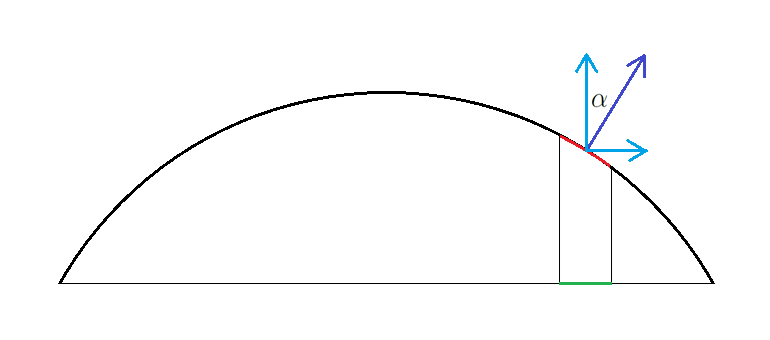 | ||
| The electric field at the surface of a uniformly charged sphere is $Q/(4\pi\epsilon_0R^2)=\sigma/\epsilon_0$, where $\sigma$ is the surface charge density. Since a small piece of the sphere contributes $\sigma/(2\epsilon_0)$ of local electric field, this means that the field due to the sphere minus that piece is also $\sigma/(2\epsilon_0)$. If that small piece (shown in red) has area $a$, then it has charge $\sigma a$ and experience an outward force of magnitude $\sigma^2a/(2\epsilon_0)$. Due to the symmetry of the problem, only the vertical component $\sigma^2a\cos\alpha/(2\epsilon_0)$ of this force contributes to the total force to be determined. Since $a\cos\alpha$ is the area of the horizontal projection (shown in green) of this small piece, the total force on the upper part of the sphere is the product of $\sigma^2/(2\epsilon_0)$ and the area of its horizontal projection $\pi(R^2-h^2)$. We have | |||
| − | \[F=\frac{\sigma^2}{2\epsilon_0}\cdot\pi(R^2-h^2)=\frac{Q^2(R^2-h^2)}{32\pi\epsilon_0R^4}\] | ||
| + | \[F=\frac{\sigma^2}{2\epsilon_0}\cdot\pi(R^2-h^2)=\frac{Q^2(R^2-h^2)}{32\pi\epsilon_0R^4}.\] | ||
| To hold the two parts of the sphere together, we need to put a point charge $-Q/2$ at the center of the sphere to produce the electric field that nullifies the field $\sigma/(2\epsilon_0)$ on each small piece of the sphere. | |||
| #### Answer | |||
| − | [Insert a concise answer or boxed result] | ||
| + | $F=\frac{Q^2(R^2-h^2)}{32\pi\epsilon_0R^4}$ | ||
| @@ -1,17 +1,17 @@ | |||
| ### Statement | ### Statement | ||
| $6.5.9.$ [Insert the problem statement] | $6.5.9.$ A uniformly charged sphere of radius $R$ is cut into two parts along a plane spaced at a distance $h$ from the center of the sphere. Find the force with which these parts repel each other. Full charge of the sphere $Q$. What is the minimum charge you need to put in the center of the sphere so that its parts do not fly apart? | ||
| ### Solution | ### Solution | ||
|  | ||
| The electric field at the surface of a uniformly charged sphere is $Q/(4\pi\epsilon_0R^2)=\sigma/\epsilon_0$, where $\sigma$ is the surface charge density. Since a small piece of the sphere contributes $\sigma/(2\epsilon_0)$ of local electric field, this means that the field due to the sphere minus that piece is also $\sigma/(2\epsilon_0)$. If that small piece (shown in red) has area $a$, then it has charge $\sigma a$ and experience an outward force of magnitude $\sigma^2a/(2\epsilon_0)$. Due to the symmetry of the problem, only the vertical component $\sigma^2a\cos\alpha/(2\epsilon_0)$ of this force contributes to the total force to be determined. Since $a\cos\alpha$ is the area of the horizontal projection (shown in green) of this small piece, the total force on the upper part of the sphere is the product of $\sigma^2/(2\epsilon_0)$ and the area of its horizontal projection $\pi(R^2-h^2)$. We have | The electric field at the surface of a uniformly charged sphere is $Q/(4\pi\epsilon_0R^2)=\sigma/\epsilon_0$, where $\sigma$ is the surface charge density. Since a small piece of the sphere contributes $\sigma/(2\epsilon_0)$ of local electric field, this means that the field due to the sphere minus that piece is also $\sigma/(2\epsilon_0)$. If that small piece (shown in red) has area $a$, then it has charge $\sigma a$ and experience an outward force of magnitude $\sigma^2a/(2\epsilon_0)$. Due to the symmetry of the problem, only the vertical component $\sigma^2a\cos\alpha/(2\epsilon_0)$ of this force contributes to the total force to be determined. Since $a\cos\alpha$ is the area of the horizontal projection (shown in green) of this small piece, the total force on the upper part of the sphere is the product of $\sigma^2/(2\epsilon_0)$ and the area of its horizontal projection $\pi(R^2-h^2)$. We have | ||
| \[F=\frac{\sigma^2}{2\epsilon_0}\cdot\pi(R^2-h^2)=\frac{Q^2(R^2-h^2)}{32\pi\epsilon_0R^4}\] | \[F=\frac{\sigma^2}{2\epsilon_0}\cdot\pi(R^2-h^2)=\frac{Q^2(R^2-h^2)}{32\pi\epsilon_0R^4}.\] | ||
| To hold the two parts of the sphere together, we need to put a point charge $-Q/2$ at the center of the sphere to produce the electric field that nullifies the field $\sigma/(2\epsilon_0)$ on each small piece of the sphere. | To hold the two parts of the sphere together, we need to put a point charge $-Q/2$ at the center of the sphere to produce the electric field that nullifies the field $\sigma/(2\epsilon_0)$ on each small piece of the sphere. | ||
| #### Answer | #### Answer | ||
| [Insert a concise answer or boxed result] | $F=\frac{Q^2(R^2-h^2)}{32\pi\epsilon_0R^4}$ | ||