Новое решение

en/13.1.20.md
+21 −0
| @@ -0,0 +1,21 @@ | |||
| + | ### Statement | ||
| + | |||
| + | $13.1.20.$ [Insert the problem statement] | ||
| + | |||
| + | ### Solution | ||
| + | |||
| + |  | ||
| + | |||
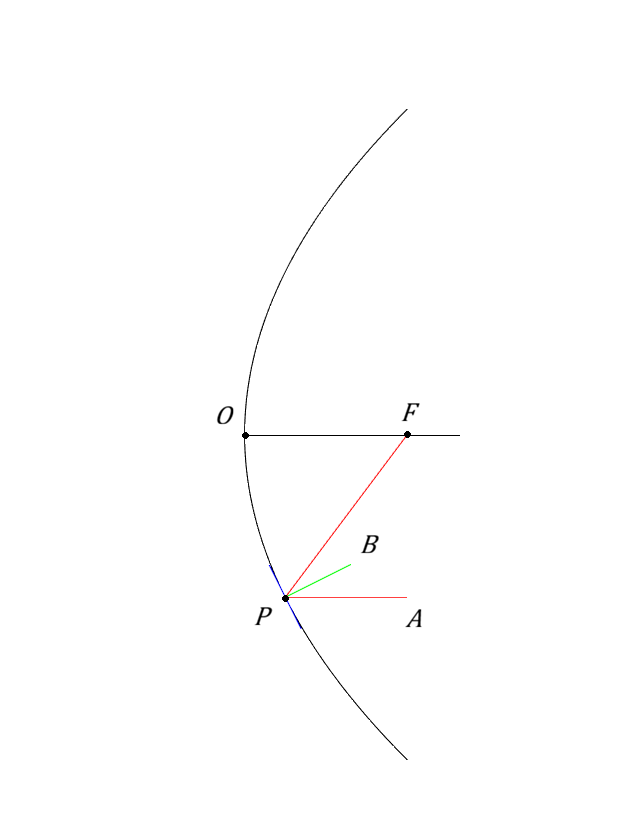
| + | We show that a parabolic surface will collect all light rays parallel to its axis of symmetry to its focal point as follows. Suppose that the equation of the parabola in the figure is $y^2=4cx$, so its focal point is at $F(c,0)$. Let $P(a^2/(4c),a)$ be any point on the parabola. (In the figure, $a$ is negative.) Then the slope of the tangent line (shown in blue) at $P$ is | ||
| + | |||
| + | \[\left.\frac{dy}{dx}\right|_{y=a}=\frac{2c}{a},\] | ||
| + | |||
| + | and the slope of the normal line (shown in green) at $P$ is $-a/(2c)$. The slope of $PF$ is | ||
| + | |||
| + | \[\tan\angle APF=\frac{a}{a^2/(4c)-c}=\frac{2(-a/(2c))}{1-(-a/(2c))^2)}=\tan(2\angle APB.)\] | ||
| + | |||
| + | In other words, the red lines obey the law of reflection, so an arbitrary light ray parallel to the axis of symmetry of the parabola is collected at its focal point. | ||
| + | |||
| + | #### Answer | ||
| + | |||
| + | [Insert a concise answer or boxed result] | ||
| @@ -0,0 +1,21 @@ | |||
| ### Statement | |||
| $13.1.20.$ [Insert the problem statement] | |||
| ### Solution | |||
|  | |||
| We show that a parabolic surface will collect all light rays parallel to its axis of symmetry to its focal point as follows. Suppose that the equation of the parabola in the figure is $y^2=4cx$, so its focal point is at $F(c,0)$. Let $P(a^2/(4c),a)$ be any point on the parabola. (In the figure, $a$ is negative.) Then the slope of the tangent line (shown in blue) at $P$ is | |||
| \[\left.\frac{dy}{dx}\right|_{y=a}=\frac{2c}{a},\] | |||
| and the slope of the normal line (shown in green) at $P$ is $-a/(2c)$. The slope of $PF$ is | |||
| \[\tan\angle APF=\frac{a}{a^2/(4c)-c}=\frac{2(-a/(2c))}{1-(-a/(2c))^2)}=\tan(2\angle APB.)\] | |||
| In other words, the red lines obey the law of reflection, so an arbitrary light ray parallel to the axis of symmetry of the parabola is collected at its focal point. | |||
| #### Answer | |||
| [Insert a concise answer or boxed result] | |||