Новое решение

en/3.3.7.md
+21 −0
| @@ -0,0 +1,21 @@ | |||
| + | ### Statement | ||
| + | |||
| + | $3.3.7.$ [Insert the problem statement] | ||
| + | |||
| + | ### Solution | ||
| + | |||
| + |  | ||
| + | |||
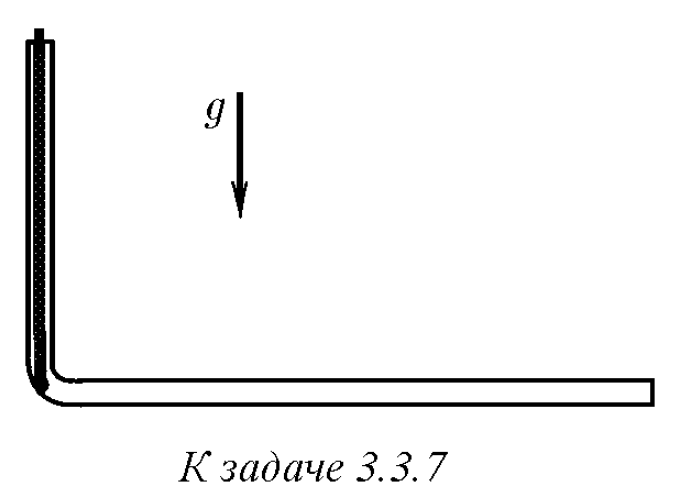
| + | Let $x$ be the length of the vertical part of the rope. (We may think of $x$ as the distance of the right endpoint of the rope from where it will be when the rope is completely horizontal.) The mass of the vertical part of the rope is $mx/l$, where $m$ is the mass of the entire rope, and its center of mass is $x/2$ high. Consequently, the gravitational potential energy of the rope is | ||
| + | |||
| + | \[\frac{m\omega^2x^2}{2}=\frac{mgx^2}{2l}\qquad\Rightarrow\qquad\omege=\sqrt{\frac{g}{l}}.\] | ||
| + | |||
| + | The motion of the rope from when it is released to when it is completely horizontal is a quarter of a period of this motion, so | ||
| + | |||
| + | \[\frac{T}{4}=\frac{\pi}{2\omega}=\frac{\pi}{2}\sqrt{l}{g}.\] | ||
| + | |||
| + | Note that the motion of the rope remains simple harmonic withe the same (quarter) period as long as there is a point on the rope at the bend of the pipe. Thus, releasing the rope when a part of it is already horizontal does not change the time it takes to become completely horizontal, because the (quarter) period of simple harmonic motion is independent of its amplitude. | ||
| + | |||
| + | #### Answer | ||
| + | |||
| + | [Insert a concise answer or boxed result] | ||
| @@ -0,0 +1,21 @@ | |||
| ### Statement | |||
| $3.3.7.$ [Insert the problem statement] | |||
| ### Solution | |||
|  | |||
| Let $x$ be the length of the vertical part of the rope. (We may think of $x$ as the distance of the right endpoint of the rope from where it will be when the rope is completely horizontal.) The mass of the vertical part of the rope is $mx/l$, where $m$ is the mass of the entire rope, and its center of mass is $x/2$ high. Consequently, the gravitational potential energy of the rope is | |||
| \[\frac{m\omega^2x^2}{2}=\frac{mgx^2}{2l}\qquad\Rightarrow\qquad\omege=\sqrt{\frac{g}{l}}.\] | |||
| The motion of the rope from when it is released to when it is completely horizontal is a quarter of a period of this motion, so | |||
| \[\frac{T}{4}=\frac{\pi}{2\omega}=\frac{\pi}{2}\sqrt{l}{g}.\] | |||
| Note that the motion of the rope remains simple harmonic withe the same (quarter) period as long as there is a point on the rope at the bend of the pipe. Thus, releasing the rope when a part of it is already horizontal does not change the time it takes to become completely horizontal, because the (quarter) period of simple harmonic motion is independent of its amplitude. | |||
| #### Answer | |||
| [Insert a concise answer or boxed result] | |||