Правка разделов «Statement», «Solution», «Answer»

en/5.5.10.md
+4 −4
| @@ -1,17 +1,17 @@ | |||
| ### Statement | |||
| − | $5.5.10.$ [Insert the problem statement] | ||
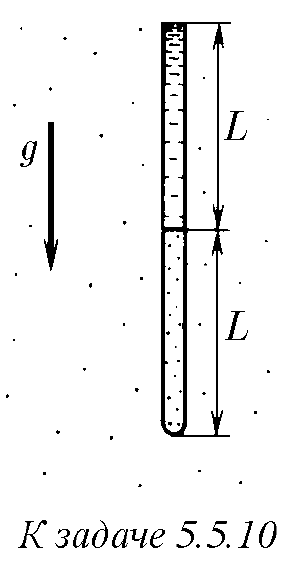
| + | $5.5.10.$ The lower end of the vertical narrow tube of length $2L$ (in mm) is sealed, and the upper end is open to the atmosphere. The lower half of the tube contains gas at a temperature of $T_0$, and its upper half is filled with mercury. To what minimum temperature should the gas in the tube be heated so that it displaces all the mercury? The external pressure in millimeters of mercury is equal to $L$. | ||
| ### Solution | |||
|  | |||
| − | At temperature $T_0$, the pressure of the gas is $2L$ mmHg and its volume is $aL$ mm$^3$, where $a$ mm$^2$ is the cross-section area of the tube. Suppose that the temperature of the gas is $T$ | ||
| + | At temperature $T_0$, the pressure of the gas is $2L$ mmHg and its volume is $aL$ mm$^3$, where $a$ mm$^2$ is the cross-section area of the tube. Suppose that the temperature of the gas is $T$ after the volume $ax$ mm$^3$ of mercury has overflown off the tube. Then the pressure of the gas is $2L-x$ mmHg and its volume is $a(L+x)$ mm$^3$. From ideal gas law, | ||
| − | \[\frac{2L\cdot aL}{T_0}=\frac{(2L-x)\cdota(L | ||
| + | \[\frac{2L\cdot aL}{T_0}=\frac{(2L-x)\cdot a(L+x)}{T}\qquad\Rightarrow\qquad T=T_0\cdot\frac{(2L-x)(L+x)}{2L^2},\] | ||
| which has maximum value of $9T_0/8$, when $x=L/2$. Thus, the gas must be heated to at least this temperature in order for it to displace all the mercury in the tube. | |||
| #### Answer | |||
| − | [Insert a concise answer or boxed result] | ||
| + | $\frac{9T_0}{8}$ | ||
| @@ -1,17 +1,17 @@ | |||
| ### Statement | ### Statement | ||
| $5.5.10.$ [Insert the problem statement] | $5.5.10.$ The lower end of the vertical narrow tube of length $2L$ (in mm) is sealed, and the upper end is open to the atmosphere. The lower half of the tube contains gas at a temperature of $T_0$, and its upper half is filled with mercury. To what minimum temperature should the gas in the tube be heated so that it displaces all the mercury? The external pressure in millimeters of mercury is equal to $L$. | ||
| ### Solution | ### Solution | ||
|  |  | ||
| At temperature $T_0$, the pressure of the gas is $2L$ mmHg and its volume is $aL$ mm$^3$, where $a$ mm$^2$ is the cross-section area of the tube. Suppose that the temperature of the gas is $T$ |
At temperature $T_0$, the pressure of the gas is $2L$ mmHg and its volume is $aL$ mm$^3$, where $a$ mm$^2$ is the cross-section area of the tube. Suppose that the temperature of the gas is $T$ after the volume $ax$ mm$^3$ of mercury has overflown off the tube. Then the pressure of the gas is $2L-x$ mmHg and its volume is $a(L+x)$ mm$^3$. From ideal gas law, | ||
| \[\frac{2L\cdot aL}{T_0}=\frac{(2L-x)\cdota(L |
\[\frac{2L\cdot aL}{T_0}=\frac{(2L-x)\cdot a(L+x)}{T}\qquad\Rightarrow\qquad T=T_0\cdot\frac{(2L-x)(L+x)}{2L^2},\] | ||
| which has maximum value of $9T_0/8$, when $x=L/2$. Thus, the gas must be heated to at least this temperature in order for it to displace all the mercury in the tube. | which has maximum value of $9T_0/8$, when $x=L/2$. Thus, the gas must be heated to at least this temperature in order for it to displace all the mercury in the tube. | ||
| #### Answer | #### Answer | ||
| [Insert a concise answer or boxed result] | $\frac{9T_0}{8}$ | ||