| @@ -1,21 +1,23 @@ |
| ### Statement |
| ### Statement |
| |
| |
| $3.7.14.$ [Insert the problem statement] |
| $3.7.14.$ A plane wave is incident on a plane interface with sound velocity $c_1$ at angle $\alpha$ to the normal. Find the direction of propagation of the reflected and refracted wave if the velocity of the wave in the second medium is equal to $c_2$. |
| |
| |
| ### Solution |
| ### Solution |
| |
| |
|  |
|  |
| |
| |
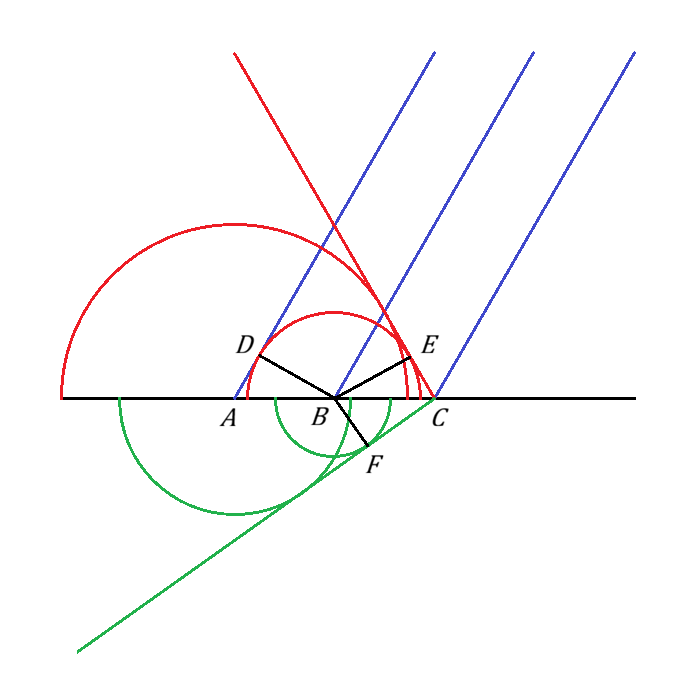
| The blue lines in the figure are the same wavefront at different equally-spaced time points. The angle of incident is $\angle DAB=\alpha$. When the wavefront reach the interface of the two media at $A$, $B$, $C$, these points become sources of new spherical waves. (The figure shows the moment when the wavefront has just reached $C$.) Since the red spherical wave originating from $B$ is tangent to the first blue line and the reflected wavefront (as the speed of the wavefront equals the speed of sound), we have $\triangle DAB\cong\triangle ECB$. Thus, the reflected angle $\angle ECB=\angle DAB=\alpha$. |
| The blue lines in the figure are the same wavefront at different equally-spaced time points. The incident angle is $\angle DAB=\alpha$. When the wavefront reaches the interface of the two media at $A$, $B$, $C$, these points become sources of new spherical waves. (The figure shows the moment when the wavefront has just reached $C$.) Since the red spherical wave originating from $B$ is tangent to the first blue line and the reflected wavefront (as the speed of the wavefront equals the speed of sound), we have $\triangle DAB\cong\triangle ECB$. Thus, the reflected angle $\angle ECB=\angle DAB=\alpha$. |
| |
| |
| The ratio of the radii of the red and green spherical waves originating from $B$ is $c_1/c_2$. Consequently, |
| The ratio of the radii of the red and green spherical waves originating from $B$ is $c_1/c_2$. Consequently, |
| |
| |
| \[\frac{\sin\angle ECB}{\sin\angle FCB}=\frac{BE/BC}{BF/BC}=\frac{c_1}{c_2}.\] |
| \[\frac{\sin\angle ECB}{\sin\angle FCB}=\frac{BE/BC}{BF/BC}=\frac{c_1}{c_2}.\] |
| |
| |
| Therefore, the refracted angle is |
| Therefore, the refracted angle is |
| |
| |
| \[\angle FCB=\arcsin\left(\frac{c_2}{c_1}\sin\alpha\right).\] |
| \[\angle FCB=\arcsin\left(\frac{c_2}{c_1}\cdot\sin\alpha\right).\] |
| |
| |
| #### Answer |
| #### Answer |
| |
| |
| [Insert a concise answer or boxed result] |
| Reflected angle = $\alpha$. |
| |
| |
| |
| Refracted angle = $\arcsin\left(\frac{c_2}{c_1}\cdot\sin\alpha\right)$. |
