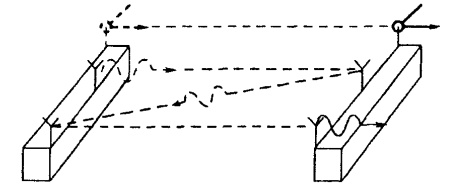
Statement
14.1.5. From the first space station to the second station, which is stationary relative to the first, a test probe and a light signal were sent simultaneously. After reflecting from the second station, then from the first, the light signal returned to the second station at the moment the space probe arrived there. What velocity of the probe relative to the station will the observers on the stations record? What relative velocity will the probe's equipment record?
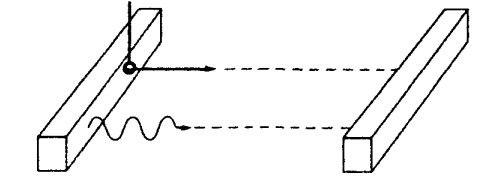
Solution
1. In the frame of reference of the stations:
Let
The time of flight of the probe from the first to the second station is:
The light signal makes three trips between the stations (1
According to the condition, the probe and the signal arrive at the second station simultaneously:
From this, we find the velocity of the probe relative to the stations:
2. In the frame of reference of the probe:
According to the principle of relativity, the relative velocity of the stations in the probe's frame of reference,
In the probe's frame of reference, both stations move towards it with a velocity
The time it takes for the second station to reach the stationary probe is:
Consider the motion of the light signal in this frame of reference. The speed of light is always
- The signal goes from the first station to the second. The second station moves towards the light with velocity
, so the closing speed is . Time: - The signal reflects from the second station to the first. The light moves in the same direction as the first station. Their closing speed is
. Time: - The signal again goes from the first to the second station (towards each other). Time:
Total travel time of the light:
Equating the travel times of the stations and the light (
Canceling
The velocity of the stations relative to the probe is
Answer
The observers on the stations and the probe's equipment will record the same relative velocity