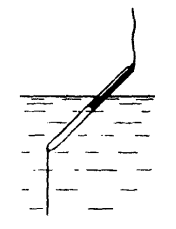
4.2.10. Determine the tension force of the lower fishing line of the float shown in the figure, if the float is submerged in water by two-thirds of its length. The mass of the float is $2 \text{ g}$.
For problem $4.2.10$
Solution
Three forces act on the float: gravity $mg$, Archimedes' buoyancy force $F_A$, and the tension of the lower line $T$. (The upper line going to the fishing rod is assumed to be slack, so we neglect its tension).
Since the float is in equilibrium, the sum of the torques about any point must be zero. It is most convenient to choose point $O$ — the center of buoyancy (the point where the Archimedes force is applied) — as the axis of rotation. In this case, the torque of the Archimedes force becomes zero.
Let us determine the lever arms of the remaining forces. Let the total length of the uniform float be $L$, and its angle of deviation from the vertical be $\alpha$: * Since the float is submerged by $2/3$ of its length, the center of the submerged part (point $O$) is at a distance of $\frac{L}{3}$ from the bottom end. * The tension force $T$ is applied to the bottom end. Its lever arm relative to point $O$ is $\frac{L}{3} \sin\alpha$. * The center of gravity of the uniform float is exactly in the middle, at a distance of $\frac{L}{2}$ from the bottom end. Therefore, the distance from point $O$ to the center of gravity is $\frac{L}{2} - \frac{L}{3} = \frac{L}{6}$. The lever arm of the gravity force is $\frac{L}{6} \sin\alpha$.
Let us write the torque equation about point $O$: $$mg \cdot \frac{L}{6} \sin\alpha - T \cdot \frac{L}{3} \sin\alpha = 0$$
Canceling $L \sin\alpha$ from both sides of the equation: $$mg \cdot \frac{1}{6} = T \cdot \frac{1}{3}$$ $$T = \frac{mg}{2}$$