Правка разделов «Statement», «Solution», «Answer»

en/7.1.14.md
+4 −4
| @@ -1,17 +1,17 @@ | |||
| ### Statement | |||
| − | $7.1.14.$ [Insert the problem statement] | ||
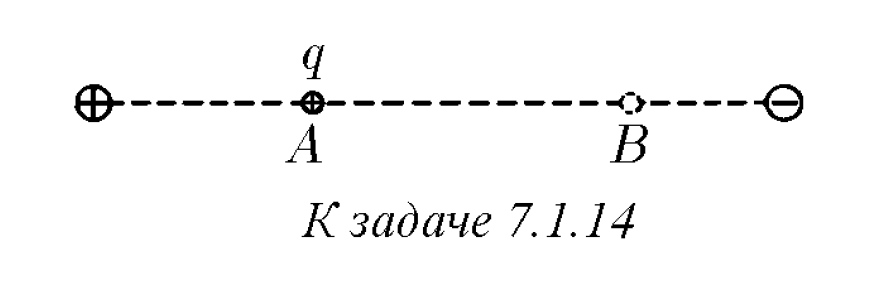
| + | $7.1.14.$ A particle with charge $q$ is released between two fixed charges at point $A$. The distance $AB$ is covered by this particle in time $t$. How long will the same distance be covered by a particle with charge $3q$ if it is released at point $A$? The particle masses are the same. | ||
| ### Solution | |||
| − |  | ||
| − | Since the charge is tripled, the force experienced and hence the acceleration at each point are tripled as well (as the mass remains the same). Suppose the former particle has acceleration $a(x)$ m/s$^2$. If we define a new unit of time S = s | ||
| + | Since the charge is tripled, the force experienced and hence the acceleration at each point are tripled as well (as the mass remains the same). Suppose the former particle has acceleration $a(x)$ m/s$^2$. If we define a new unit of time S = s$/\sqrt3$, then the latter particle has acceleration | ||
| \[3\cdot a(x)\mbox{ m/s}^2=a(x)\mbox{ m/(s/}\sqrt3)^2=a(x)\mbox{ m/S}^2;\] | |||
| that is, the numerical value of the acceleration of the latter particle in m/S$^2$ becomes the same as the numerical value of the acceleration of the former particle in m/s$^2$. Consequently, the time it takes the latter particle to travel the same distance is $t$ S = $t/\sqrt3$ s. | |||
| #### Answer | |||
| − | [Insert a concise answer or boxed result] | ||
| + | $t/\sqrt3$ | ||
| @@ -1,17 +1,17 @@ | |||
| ### Statement | ### Statement | ||
| $7.1.14.$ [Insert the problem statement] | $7.1.14.$ A particle with charge $q$ is released between two fixed charges at point $A$. The distance $AB$ is covered by this particle in time $t$. How long will the same distance be covered by a particle with charge $3q$ if it is released at point $A$? The particle masses are the same. | ||
| ### Solution | ### Solution | ||
|  | ||
| Since the charge is tripled, the force experienced and hence the acceleration at each point are tripled as well (as the mass remains the same). Suppose the former particle has acceleration $a(x)$ m/s$^2$. If we define a new unit of time S = s |
Since the charge is tripled, the force experienced and hence the acceleration at each point are tripled as well (as the mass remains the same). Suppose the former particle has acceleration $a(x)$ m/s$^2$. If we define a new unit of time S = s$/\sqrt3$, then the latter particle has acceleration | ||
| \[3\cdot a(x)\mbox{ m/s}^2=a(x)\mbox{ m/(s/}\sqrt3)^2=a(x)\mbox{ m/S}^2;\] | \[3\cdot a(x)\mbox{ m/s}^2=a(x)\mbox{ m/(s/}\sqrt3)^2=a(x)\mbox{ m/S}^2;\] | ||
| that is, the numerical value of the acceleration of the latter particle in m/S$^2$ becomes the same as the numerical value of the acceleration of the former particle in m/s$^2$. Consequently, the time it takes the latter particle to travel the same distance is $t$ S = $t/\sqrt3$ s. | that is, the numerical value of the acceleration of the latter particle in m/S$^2$ becomes the same as the numerical value of the acceleration of the former particle in m/s$^2$. Consequently, the time it takes the latter particle to travel the same distance is $t$ S = $t/\sqrt3$ s. | ||
| #### Answer | #### Answer | ||
| [Insert a concise answer or boxed result] | $t/\sqrt3$ | ||