7.4.8∗. Two electrons are located at a distance $r$ from each other, and the velocity of one of them is zero, and the velocity of the other is directed at an acute angle to the line connecting the electrons. What will be the angle between the electron velocities when they are again at a distance $r$ from each other?
Solution
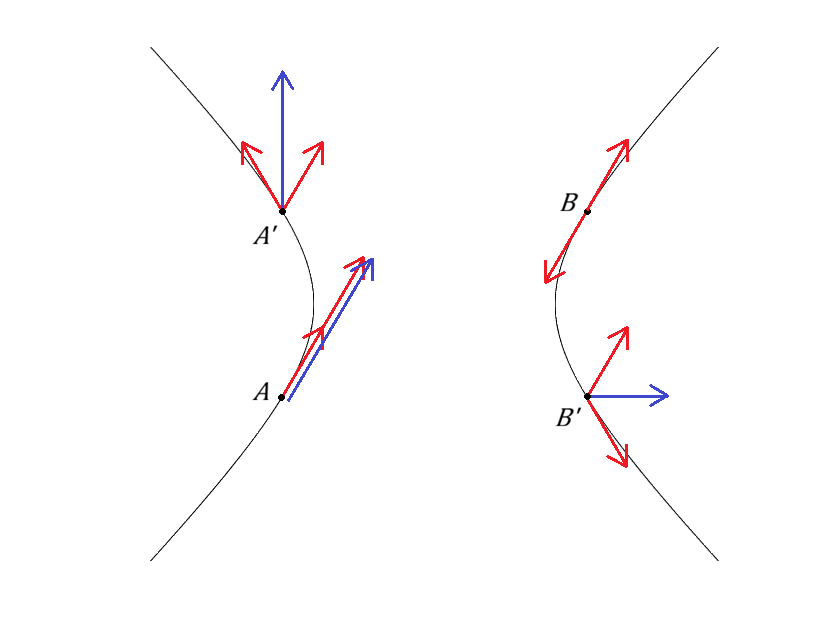
For problem $7.4.8$
In the center-of-mass frame of reference, both electrons move with velocities that are equal in magnitude but have opposite directions (shown in red tangent to the curve). If the electron at $A$ has velocity $\vec u=u_x\,\hat\imath+u_y\,\hat\jmath$, then the electron at $B$ has velocity $-\vec u$. Since the force between the electrons is repulsive and inverse-squared, they will move on different branches of a hyperbola and remain symmetric with each other with respect to the center of the hyperbola (i.e. the center of mass). The fact that the angle between the velocity of the electron and the line joining it with the other electron is initially acute means that each of them is moving toward the vertex of its respective branch. When they move away from the vertices and the distance between them equals the initial distance, their speed will be the same as the initial speed by conservation of energy. By the symmetry of the hyperbola, the velocities of the electrons at $A'$ and $B'$ are $\vec u'=-u_x\,\hat\imath+u_y\,\hat\jmath$ and $-\vec u'$, respectively. Initially in the laboratory frame of reference, the electron at $B$ is at rest, which means that $\vec u$ must be added to any velocity vector in the CM frame to transform it to the lab frame. Consequently, the velocities of the electrons at $A'$ and $B'$ are $\vec u'+\vec u=2u_y\,\hat\jmath$ and $-\vec u'+\vec u=2u_x\,\hat\imath$, respectively, in the lab frame (shown in blue). Therefore, their velocities are perpendicular to each other.