Новое решение

en/3.7.8.md
+27 −0
| @@ -0,0 +1,27 @@ | |||
| + | ### Statement | ||
| + | |||
| + | $3.7.8.$ [Insert the problem statement] | ||
| + | |||
| + | ### Solution | ||
| + | |||
| + |  | ||
| + | |||
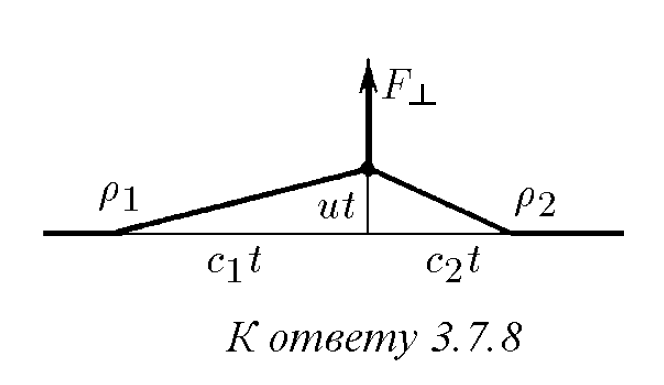
| + | The speeds of propagation of the waveform to the left and the right are $c_1=\sqrt{F_\parallel/\rho_1}$ and $c_2=\sqrt{F_\parallel/\rho_2}$, respectively. Consequently, the mass of the portion of the rope that has transverse momentum increases linearly with time, and its transverse speed $u$ must be constant, because the transverse force is constant. After time $t$, transverse momentum of the waveform is | ||
| + | |||
| + | \[P_\perp=(\rho_1\sqrt{(c_1t)^2+(ut)^2}+\rho_2\sqrt{(c_2t)^2+(ut)^2})u.\] | ||
| + | |||
| + | As a result, | ||
| + | |||
| + | \[F_\perp=P_\perp/t=\rho_1c_1^2\cdot\frac{u}{c_1}\sqrt{1+\left(\frac{u}{c_1}\right)^2}+\rho_2c_2^2\cdot\frac{u}{c_2}\sqrt{1+\left(\frac{u}{c_2}\right)^2}\] | ||
| + | |||
| + | Under the assumption that $F_\parallel\gg F_\perp=\rho_1c_1^2=\rho_2c_2^2$, it follows that $c_1,c_2\gg u$, and we have the approximation | ||
| + | |||
| + | \[F_\perp\approx F_\parallel\left(\frac{u}{c_1}+\frac{u}{c_2}\right).\] | ||
| + | |||
| + | Therefore, | ||
| + | |||
| + | \[u\approx\frac{c_1c_2}{c_1+c_2}\cdot\frac{F_\perp}{F_\parallel}.\] | ||
| + | |||
| + | #### Answer | ||
| + | |||
| + | [Insert a concise answer or boxed result] | ||
| @@ -0,0 +1,27 @@ | |||
| ### Statement | |||
| $3.7.8.$ [Insert the problem statement] | |||
| ### Solution | |||
|  | |||
| The speeds of propagation of the waveform to the left and the right are $c_1=\sqrt{F_\parallel/\rho_1}$ and $c_2=\sqrt{F_\parallel/\rho_2}$, respectively. Consequently, the mass of the portion of the rope that has transverse momentum increases linearly with time, and its transverse speed $u$ must be constant, because the transverse force is constant. After time $t$, transverse momentum of the waveform is | |||
| \[P_\perp=(\rho_1\sqrt{(c_1t)^2+(ut)^2}+\rho_2\sqrt{(c_2t)^2+(ut)^2})u.\] | |||
| As a result, | |||
| \[F_\perp=P_\perp/t=\rho_1c_1^2\cdot\frac{u}{c_1}\sqrt{1+\left(\frac{u}{c_1}\right)^2}+\rho_2c_2^2\cdot\frac{u}{c_2}\sqrt{1+\left(\frac{u}{c_2}\right)^2}\] | |||
| Under the assumption that $F_\parallel\gg F_\perp=\rho_1c_1^2=\rho_2c_2^2$, it follows that $c_1,c_2\gg u$, and we have the approximation | |||
| \[F_\perp\approx F_\parallel\left(\frac{u}{c_1}+\frac{u}{c_2}\right).\] | |||
| Therefore, | |||
| \[u\approx\frac{c_1c_2}{c_1+c_2}\cdot\frac{F_\perp}{F_\parallel}.\] | |||
| #### Answer | |||
| [Insert a concise answer or boxed result] | |||