Новое решение

en/11.2.16.md
+29 −0
| @@ -0,0 +1,29 @@ | |||
| + | ### Statement | ||
| + | |||
| + | $11.2.16.$ [Insert the problem statement] | ||
| + | |||
| + | ### Solution | ||
| + | |||
| + |  | ||
| + | |||
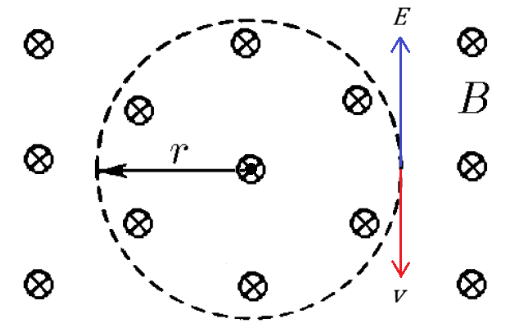
| + | The magnetic force $evB$ provides centripetal acceleration to the electron, so | ||
| + | |||
| + | \[evB=\frac{mv^2}{r}\qquad\Rightarrow\qquad r=\frac{mv}{eB},\] | ||
| + | |||
| + | where $-e$ and $m$ are the charge and the mass of the electron, respectively. Thus in order for the electron to maintain the same circular orbit, we must have | ||
| + | |||
| + | \[\frac{v+\Delta v}{B+\Delta B}=\frac{v}{B}\qquad\Rightarrow\qquad\frac{\Delta v}{\Delta B}=\frac{v}{B}=\frac{er}{m}.\] | ||
| + | |||
| + | The change in electron's speed is caused by induced electric field | ||
| + | |||
| + | \[E=\frac{1}{2\pi r}\cdot\pi r^2\cdot\frac{\Delta B}{\Delta t}=\frac{r}{2}\cdot\frac{\Delta B}{\Delta t}\] | ||
| + | |||
| + | as a result of changing magnetic flux. Thus, | ||
| + | |||
| + | \[\Delta v=\frac{eE\Delta t}{m}\qquad\Rightarrow\qquad\frac{\Delta v}{\Delta B}=\frac{er}{2m}.\] | ||
| + | |||
| + | (Note that the electric force on the electron is in the opposite direction to the electric field.) Therefore, the additional speed caused by induced electric field is not sufficient to keep the electron in the same orbit, and the radius of curvature of the trajectory will decrease. | ||
| + | |||
| + | #### Answer | ||
| + | |||
| + | [Insert a concise answer or boxed result] | ||
| @@ -0,0 +1,29 @@ | |||
| ### Statement | |||
| $11.2.16.$ [Insert the problem statement] | |||
| ### Solution | |||
|  | |||
| The magnetic force $evB$ provides centripetal acceleration to the electron, so | |||
| \[evB=\frac{mv^2}{r}\qquad\Rightarrow\qquad r=\frac{mv}{eB},\] | |||
| where $-e$ and $m$ are the charge and the mass of the electron, respectively. Thus in order for the electron to maintain the same circular orbit, we must have | |||
| \[\frac{v+\Delta v}{B+\Delta B}=\frac{v}{B}\qquad\Rightarrow\qquad\frac{\Delta v}{\Delta B}=\frac{v}{B}=\frac{er}{m}.\] | |||
| The change in electron's speed is caused by induced electric field | |||
| \[E=\frac{1}{2\pi r}\cdot\pi r^2\cdot\frac{\Delta B}{\Delta t}=\frac{r}{2}\cdot\frac{\Delta B}{\Delta t}\] | |||
| as a result of changing magnetic flux. Thus, | |||
| \[\Delta v=\frac{eE\Delta t}{m}\qquad\Rightarrow\qquad\frac{\Delta v}{\Delta B}=\frac{er}{2m}.\] | |||
| (Note that the electric force on the electron is in the opposite direction to the electric field.) Therefore, the additional speed caused by induced electric field is not sufficient to keep the electron in the same orbit, and the radius of curvature of the trajectory will decrease. | |||
| #### Answer | |||
| [Insert a concise answer or boxed result] | |||