| @@ -1,45 +1,37 @@ |
| | − | ### Statement |
| | + | ### Statement |
| | | |
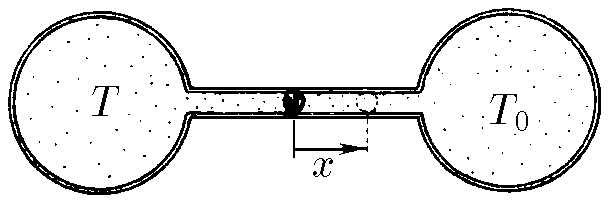
| | − | \\$5.5.16\\$ The gas thermometer consists in two identical containers with volume \\$V_0\\$ each one, linked by a tube of length \\$l\\$ and cross section \\$S\\$. A mercury droplet obstructs the tube. If temperatures of gasses in the volumes are equal, the mercury lies in the center of the tube. The right volume is connected to a thermostat with temperature \\$T_0\\$. Scale the thermometer finding the dependence between gas temperature in left volume and the displacement \\$x\\$ of mercury respect to equilibrium position. |
| | + | $5.5.16.$ A gas thermometer consists of two identical vessels, each of volume $V_0$, connected by a tube of length $l$ and cross-section $S$. The tube is blocked by a drop of mercury. The vessels are filled with gas. If the gas temperature in both vessels is the same, the mercury is in the middle of the tube. One vessel is placed in a thermostat with a temperature $T_0$. Calibrate the thermometer by finding the dependence of the gas temperature in the second vessel on the displacement of the mercury from the equilibrium position. |
| | | |
| | − |  |
| | + |  |
| | | |
| | | ### Solution |
| | | |
| | − | Let denote left volume as \\$V_1\\$ and right one as \\$V_2\\$. Applying state equation for each container |
| | + | <b>1. Equilibrium state</b> |
| | | |
| | − | \\$\\$ |
| | − | P_1~V_1 = nRT \\\\tag{1} |
| | − | \\$\\$ |
| | + | Since the mercury drop is in equilibrium, the gas pressure in both vessels is the same at any given time. Let's denote the final pressure as $p_1$. The amount of substance (number of moles) $\nu$ of the gas in both vessels is also the same, since they were initially in identical conditions. |
| | | |
| | − | \\$\\$ |
| | − | P_0~V_2 = nRT_0 \\\\tag{2} |
| | − | \\$\\$ |
| | + | <b>2. Vessel volumes after displacement</b> |
| | | |
| | − | It is easy to see that |
| | + | Let the mercury drop be displaced by a distance $x$ towards the vessel with temperature $T_0$ (we'll consider it the right one). Then the gas volumes in the left (tested) and right (thermostatted) vessels will be respectively: |
| | + | $$V_1 = V_0 + \frac{lS}{2} + xS$$ |
| | + | $$V_2 = V_0 + \frac{lS}{2} - xS$$ |
| | | |
| | − | \\$\\$ |
| | − | V_1 = V_0+S\\\\frac{l}{2}-Sx \\\\tag{3} |
| | − | \\$\\$ |
| | + | <b>3. Equations of state</b> |
| | | |
| | − | \\$\\$ |
| | − | V_2 = V_0+S\\\\frac{l}{2}+Sx \\\\tag{4} |
| | − | \\$\\$ |
| | + | Let's write the ideal gas law (Mendeleev-Clapeyron equation) for both vessels in the final state. |
| | + | For the left vessel (temperature $T$): |
| | + | $$p_1 \left(V_0 + \frac{lS}{2} + xS\right) = \nu RT$$ |
| | + | For the right vessel (temperature $T_0$): |
| | + | $$p_1 \left(V_0 + \frac{lS}{2} - xS\right) = \nu RT_0$$ |
| | | |
| | − | If droplet is in equilibrium that means pressure forces due to gasses are equal, so \\$P_1 = P_0\\$. Then, dividing \\$(1)\\$ and \\$(2)\\$ |
| | + | <b>4. Derivation of the final formula</b> |
| | | |
| | − | \\$\\$ |
| | − | \\\\frac{V_1}{V_2}=\\\\frac{T}{T_0} \\\\tag{5} |
| | − | \\$\\$ |
| | + | Divide the first equation by the second to eliminate the unknowns $p_1$, $\nu$, and $R$: |
| | + | $$\frac{V_0 + \frac{lS}{2} + xS}{V_0 + \frac{lS}{2} - xS} = \frac{T}{T_0}$$ |
| | + | For convenience, multiply the numerator and denominator of the left fraction by $2$: |
| | + | $$\frac{2V_0 + (l + 2x)S}{2V_0 + (l - 2x)S} = \frac{T}{T_0}$$ |
| | + | From here, we express the required temperature $T$: |
| | + | $$T = T_0 \frac{2V_0 + (l + 2x)S}{2V_0 + (l - 2x)S}$$ |
| | | |
| | − | Substituting \\$(3)\\$ and \\$(4)\\$ into \\$(5)\\$ and separating \\$T\\$ |
| | − | |
| | − | \\$\\$ |
| | − | \\\\boxed{T = T_0~\\\\frac{2V_0+S(l+2x)}{2V_0+S(l-2x)}} |
| | − | \\$\\$ |
| | − | |
| | − | This is mathematically valid for \\$0< x <\\\\frac{V_0}{S}+\\\\frac{l}{2}\\$ but according the physical situation only for \\$0< x < \\\\frac{l}{2}\\$. |
| | − | |
| | − | |
| | − | |
| | − | |
| | + | #### Answer |
| | + | $$T = T_0 \frac{2V_0 + (l + 2x)S}{2V_0 + (l - 2x)S}$$ |
