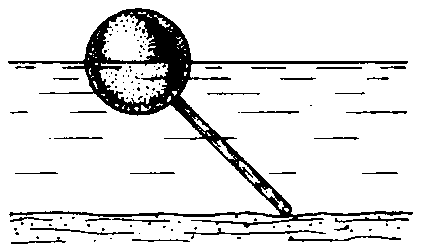
$4.2.11$ With what force a heavy stick presses on the bottom of the reservoir, if a hollow ball of radius $r$, rigidly connected to the stick, is half immersed in the liquid? The density of the liquid is $\rho$, the length of the stick is $l$.
### Solution
Let's consider the following figure

The system is on equilibrium in above position, so total torque is zero ($\sum\vec{\tau} = \vec{0}$). Considering as a pivot point the center of mass of the stick (located at stick's half),
Another way: Let's suppose the pivot point at the contact of stick with the bottom. Applying Newton Second Law for rotation ($\sum\vec{\tau} = \vec{0}$) and considering the massless ball
Let's suppose the pivot point is at the contact of the stick with the bottom. Applying Newton's Second Law for rotation ($\sum\vec{\tau} = 0$) and considering the massless ball ($m_b = 0$):
Applying Newton's Second Law for translation (vertical axis):
+
$$F_A + N = m_s g$$
+
$$\rho g \frac{V}{2} + N = m_s g \quad (2)$$
−
$$
−
m_s = \rho~V\left(1+\frac{r}{l}\right)\tag{1}
−
$$
+
From $(1)$ and $(2)$, and taking $V = \frac{4}{3}\pi r^3$, the above answer is obtained again:
+
$$N = \rho V g \left(1 + \frac{r}{l}\right) - \rho g \frac{V}{2} = \rho g V \left(\frac{1}{2} + \frac{r}{l}\right) = \frac{\rho g V}{2}\left(1 + 2\frac{r}{l}\right)$$
+
$$N = \frac{2}{3}\pi r^3 \rho g \left(1 + 2\frac{r}{l}\right)$$
−
Applying Newton Second Law
+
<i>Note: By Newton's Third Law, the force $F$ with which the stick presses on the bottom is equal in magnitude to the normal reaction force $N$.</i>
−
$$
−
F_A+N = m_s~g
−
$$
−
−
$$
−
\rho g\frac{V}{2} + N = m_s g \tag{2}
−
$$
−
−
From $(1)$, $(2)$ and taking $V=\frac{4\pi r^3}{3}$, the above answer is obtained again...
−
−
−
−
−
−
+
#### Answer
+
$$F =\frac{2}{3}\pi r^3 \rho g \left(1 + \frac{2r}{l}\right)$$
### Statement
### Statement
$4.2.11$ With what force a heavy stick presses on the bottom of the reservoir, if a hollow ball of radius $r$, rigidly connected to the stick, is half immersed in the liquid? The density of the liquid is $\rho$, the length of the stick is $l$.
$4.2.11$ With what force a heavy stick presses on the bottom of the reservoir, if a hollow ball of radius $r$, rigidly connected to the stick, is half immersed in the liquid? The density of the liquid is $\rho$, the length of the stick is $l$.


### Solution
### Solution
Let's consider the following figure
Let's consider the following figure


The system is on equilibrium in above position, so total torque is zero ($\sum\vec{\tau} = \vec{0}$). Considering as a pivot point the center of mass of the stick (located at stick's half),
The system is on equilibrium in above position, so total torque is zero ($\sum\vec{\tau} = \vec{0}$). Considering as a pivot point the center of mass of the stick (located at stick's half),
Another way: Let's suppose the pivot point at the contact of stick with the bottom. Applying Newton Second Law for rotation ($\sum\vec{\tau} = \vec{0}$) and considering the massless ball
Let's suppose the pivot point is at the contact of the stick with the bottom. Applying Newton's Second Law for rotation ($\sum\vec{\tau} = 0$) and considering the massless ball ($m_b = 0$):
Applying Newton's Second Law for translation (vertical axis):
$$F_A + N = m_s g$$
$$\rho g \frac{V}{2} + N = m_s g \quad (2)$$
$$
From $(1)$ and $(2)$, and taking $V = \frac{4}{3}\pi r^3$, the above answer is obtained again:
m_s = \rho~V\left(1+\frac{r}{l}\right)\tag{1}
$$N = \rho V g \left(1 + \frac{r}{l}\right) - \rho g \frac{V}{2} = \rho g V \left(\frac{1}{2} + \frac{r}{l}\right) = \frac{\rho g V}{2}\left(1 + 2\frac{r}{l}\right)$$
$$
$$N = \frac{2}{3}\pi r^3 \rho g \left(1 + 2\frac{r}{l}\right)$$
Applying Newton Second Law
<i>Note: By Newton's Third Law, the force $F$ with which the stick presses on the bottom is equal in magnitude to the normal reaction force $N$.</i>
$$
#### Answer
F_A+N = m_s~g
$$F =\frac{2}{3}\pi r^3 \rho g \left(1 + \frac{2r}{l}\right)$$
$$
$$
\rho g\frac{V}{2} + N = m_s g \tag{2}
$$
From $(1)$, $(2)$ and taking $V=\frac{4\pi r^3}{3}$, the above answer is obtained again...
