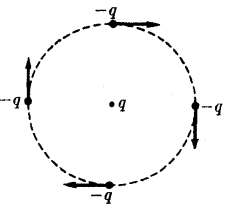
6.1.13. Four identical particles, each of mass $m$ and charge $-q$, revolve in a circular orbit, located at the corners of a square of side $\ell$. A charge $q$ is located at the center of this square. Determine the angular velocity of the particles in orbit.
For problem $6.1.13$
Solution
Let us find the magnitude of the net radial force $F$ acting on one of the $-q$ charges and directed towards the center of the orbit. This force is the superposition of the attractive force from the central charge $q$ and the repulsive forces from the other three $-q$ charges.
The radius of the orbit (distance to the center) is $r = \frac{\ell}{\sqrt{2}}$. Using Coulomb's law, we project all forces onto the radial axis: $$F = F_{\text{center}} - 2F_{\text{adj}} \cdot \cos 45^\circ - F_{\text{opp}} \quad (1)$$
Where:
The 1st term is the interaction with the central charge $q$.
The 2nd term is the interaction with the two adjacent $-q$ charges (at distance $\ell$).
The 3rd term is the interaction with the opposite $-q$ charge (at distance $\ell\sqrt{2}$).
Note: Since $3 > 2\sqrt{2}$, we have $F > 0$. The net force is indeed directed towards the center, which makes circular motion possible.
According to Newton's second law for rotational motion (where $a_{\text{cp}}$ is the centripetal acceleration): $$\omega^2 r = a_{\text{cp}} = \frac{F}{m} \quad (4)$$
From this, we express the angular velocity $\omega$: $$\omega = \sqrt{\frac{F}{mr}} = \sqrt{ \frac{1}{4\pi\varepsilon_0} \frac{q^2}{\ell^2} \left( \frac{3 - 2\sqrt{2}}{2} \right) \cdot \frac{1}{m \ell / \sqrt{2}} } \quad (5)$$
After mathematical simplifications (multiplying by $\sqrt{2}$), we obtain the final expression: $$\omega = \sqrt{ \frac{3\sqrt{2} - 4}{2} \cdot \frac{1}{4\pi\varepsilon_0} \frac{q^2}{m\ell^3} } \quad (6)$$