Правка раздела «Statement»

en/12.1.3.md
+2 −0
| @@ -1,7 +1,9 @@ | |||
| ### Statement | |||
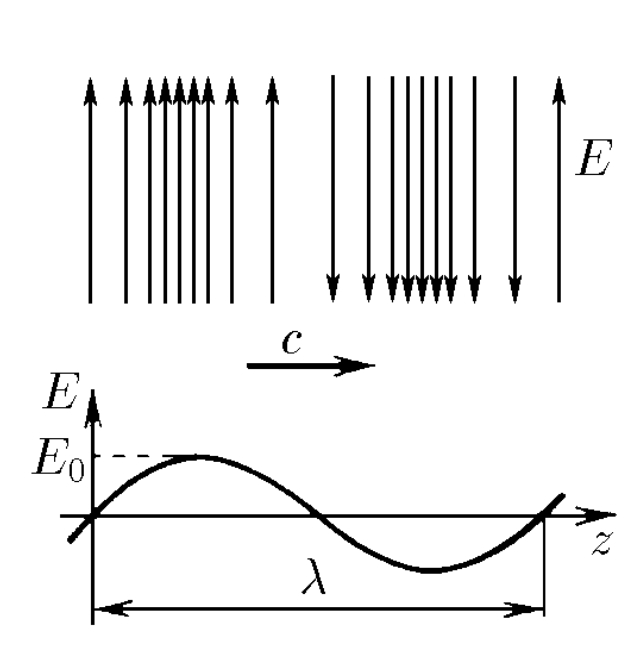
| $12.1.3.$ The figure shows the electric field of a plane sinusoidal wave at the initial moment of time $t=0$. The direction of wave propagation is indicated by an arrow. How does the electric field strength depend on the coordinate $z$ and time $t$? | |||
| + |  | ||
| + | |||
| ### Solution | |||
| For a plane sinusoidal wave, the general equation of the electromagnetic wave is given by: | |||
| $$E(z,t) = E_0 \sin(At + Bz + \varphi_0)$$ | |||
| where $A$, $B$ and $\varphi_0$ are constants. | |||
| From the condition of the problem (based on the wave profile at $t=0$), we know that the initial spatial distribution is: | |||
| $$E(z,0) = E_0 \sin\left(\frac{2\pi}{\lambda} z\right)$$ | |||
| where $\lambda$ is the wavelength. | |||
| By substituting $t=0$ into the general equation, we equate the two expressions: | |||
| $$E_0 \sin(Bz + \varphi_0) = E_0 \sin\left(\frac{2\pi}{\lambda} z\right)$$ | |||
| By comparing the phases, we obtain the spatial constant and the initial phase: | |||
| $$B = \frac{2\pi}{\lambda}, \quad \varphi_0 = 0$$ | |||
| Since the wave travels in the positive $z$-direction with a phase velocity $c$, the phase of the wave $\varphi = At + Bz + \varphi_0$ must remain constant for a fixed point on the wave profile. Taking the time derivative of the phase yields: | |||
| $$\frac{d\varphi}{dt} = A + B \frac{dz}{dt} = 0$$ | |||
| Given that the wave propagation speed is $\frac{dz}{dt} = c$, we get: | |||
| $$A + Bc = 0 \implies A = -Bc = -\frac{2\pi c}{\lambda}$$ | |||
| Finally, plugging the derived constants $A$, $B$, and $\varphi_0$ back into the general equation gives us: | |||
| $$E(z,t) = E_0 \sin\left(-\frac{2\pi c}{\lambda} t + \frac{2\pi}{\lambda} z\right) = E_0 \sin\left[\frac{2\pi}{\lambda}(z - ct)\right]$$ | |||
| #### Answer | |||
| $$E(z,t) = E_0 \sin\left[\frac{2\pi}{\lambda}(z - ct)\right]$$ | |||
| ещё строк без изменений 24 | |||
| @@ -1,7 +1,9 @@ | |||
| ### Statement | ### Statement | ||
| $12.1.3.$ The figure shows the electric field of a plane sinusoidal wave at the initial moment of time $t=0$. The direction of wave propagation is indicated by an arrow. How does the electric field strength depend on the coordinate $z$ and time $t$? | $12.1.3.$ The figure shows the electric field of a plane sinusoidal wave at the initial moment of time $t=0$. The direction of wave propagation is indicated by an arrow. How does the electric field strength depend on the coordinate $z$ and time $t$? | ||
|  | |||
| ### Solution | ### Solution | ||
| For a plane sinusoidal wave, the general equation of the electromagnetic wave is given by: | For a plane sinusoidal wave, the general equation of the electromagnetic wave is given by: | ||
| $$E(z,t) = E_0 \sin(At + Bz + \varphi_0)$$ | $$E(z,t) = E_0 \sin(At + Bz + \varphi_0)$$ | ||
| where $A$, $B$ and $\varphi_0$ are constants. | where $A$, $B$ and $\varphi_0$ are constants. | ||
| From the condition of the problem (based on the wave profile at $t=0$), we know that the initial spatial distribution is: | From the condition of the problem (based on the wave profile at $t=0$), we know that the initial spatial distribution is: | ||
| $$E(z,0) = E_0 \sin\left(\frac{2\pi}{\lambda} z\right)$$ | $$E(z,0) = E_0 \sin\left(\frac{2\pi}{\lambda} z\right)$$ | ||
| where $\lambda$ is the wavelength. | where $\lambda$ is the wavelength. | ||
| By substituting $t=0$ into the general equation, we equate the two expressions: | By substituting $t=0$ into the general equation, we equate the two expressions: | ||
| $$E_0 \sin(Bz + \varphi_0) = E_0 \sin\left(\frac{2\pi}{\lambda} z\right)$$ | $$E_0 \sin(Bz + \varphi_0) = E_0 \sin\left(\frac{2\pi}{\lambda} z\right)$$ | ||
| By comparing the phases, we obtain the spatial constant and the initial phase: | By comparing the phases, we obtain the spatial constant and the initial phase: | ||
| $$B = \frac{2\pi}{\lambda}, \quad \varphi_0 = 0$$ | $$B = \frac{2\pi}{\lambda}, \quad \varphi_0 = 0$$ | ||
| Since the wave travels in the positive $z$-direction with a phase velocity $c$, the phase of the wave $\varphi = At + Bz + \varphi_0$ must remain constant for a fixed point on the wave profile. Taking the time derivative of the phase yields: | Since the wave travels in the positive $z$-direction with a phase velocity $c$, the phase of the wave $\varphi = At + Bz + \varphi_0$ must remain constant for a fixed point on the wave profile. Taking the time derivative of the phase yields: | ||
| $$\frac{d\varphi}{dt} = A + B \frac{dz}{dt} = 0$$ | $$\frac{d\varphi}{dt} = A + B \frac{dz}{dt} = 0$$ | ||
| Given that the wave propagation speed is $\frac{dz}{dt} = c$, we get: | Given that the wave propagation speed is $\frac{dz}{dt} = c$, we get: | ||
| $$A + Bc = 0 \implies A = -Bc = -\frac{2\pi c}{\lambda}$$ | $$A + Bc = 0 \implies A = -Bc = -\frac{2\pi c}{\lambda}$$ | ||
| Finally, plugging the derived constants $A$, $B$, and $\varphi_0$ back into the general equation gives us: | Finally, plugging the derived constants $A$, $B$, and $\varphi_0$ back into the general equation gives us: | ||
| $$E(z,t) = E_0 \sin\left(-\frac{2\pi c}{\lambda} t + \frac{2\pi}{\lambda} z\right) = E_0 \sin\left[\frac{2\pi}{\lambda}(z - ct)\right]$$ | $$E(z,t) = E_0 \sin\left(-\frac{2\pi c}{\lambda} t + \frac{2\pi}{\lambda} z\right) = E_0 \sin\left[\frac{2\pi}{\lambda}(z - ct)\right]$$ | ||
| #### Answer | #### Answer | ||
| $$E(z,t) = E_0 \sin\left[\frac{2\pi}{\lambda}(z - ct)\right]$$ | $$E(z,t) = E_0 \sin\left[\frac{2\pi}{\lambda}(z - ct)\right]$$ | ||
| ещё строк без изменений 24 | |||