Правка раздела «Solution»

en/3.9.16.md
+2 −2
| ### Statement | |||
| $3.9.16.$ Let's bring a vibrating tuning fork to a high cylindrical vessel, in which water is poured little by little. We will hear the sound getting stronger, weaker and stronger again. How to explain this? Why does the tuning fork sound weak without the vessel? | |||
| @@ -4,10 +4,10 @@Statement | |||
| ### Solution | |||
| − | 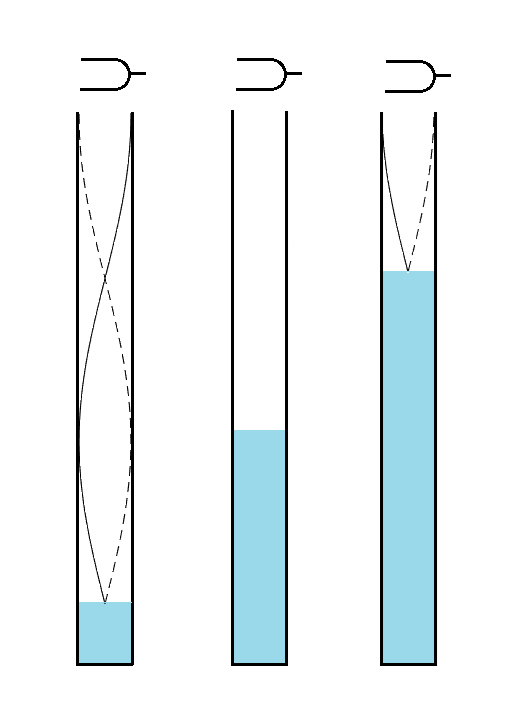 | ||
| − | The sound gets stronger when the air column in the vessel above the water has length $L$ that permits a standing wave, i.e. $L=(2n-1)\lambda/4=(2n-1)c/(4f)$, where $c$ is the speed of sound and $f$ is the frequency of the tuning fork. In between, the sound gets weaker. The figure shows standing waves of displacement waves, which must have antinodes at the opening of the vessel and nodes at water surface. | ||
| + | The sound gets stronger when the air column in the vessel above the water has length $L$ that permits a standing wave, i.e. $L=(2n-1)\lambda/4=(2n-1)c/(4f)$, where $c$ is the speed of sound and $f$ is the frequency of the tuning fork. In between, the sound gets weaker. The figure shows standing waves of displacement waves, which must have antinodes at the opening of the vessel and nodes at water surface. The tuning fork sounds weak without the vessel, because it has small surface area. An amplification can be achieved by putting the stem of the tuning fork on a larger surface. | ||
| #### Answer | |||
| See the solution. | |||
| ### Statement | ### Statement | ||
| $3.9.16.$ Let's bring a vibrating tuning fork to a high cylindrical vessel, in which water is poured little by little. We will hear the sound getting stronger, weaker and stronger again. How to explain this? Why does the tuning fork sound weak without the vessel? | $3.9.16.$ Let's bring a vibrating tuning fork to a high cylindrical vessel, in which water is poured little by little. We will hear the sound getting stronger, weaker and stronger again. How to explain this? Why does the tuning fork sound weak without the vessel? | ||
| @@ -4,10 +4,10 @@Statement | |||
| ### Solution | ### Solution | ||
|  | ||
| The sound gets stronger when the air column in the vessel above the water has length $L$ that permits a standing wave, i.e. $L=(2n-1)\lambda/4=(2n-1)c/(4f)$, where $c$ is the speed of sound and $f$ is the frequency of the tuning fork. In between, the sound gets weaker. The figure shows standing waves of displacement waves, which must have antinodes at the opening of the vessel and nodes at water surface. |
The sound gets stronger when the air column in the vessel above the water has length $L$ that permits a standing wave, i.e. $L=(2n-1)\lambda/4=(2n-1)c/(4f)$, where $c$ is the speed of sound and $f$ is the frequency of the tuning fork. In between, the sound gets weaker. The figure shows standing waves of displacement waves, which must have antinodes at the opening of the vessel and nodes at water surface. The tuning fork sounds weak without the vessel, because it has small surface area. An amplification can be achieved by putting the stem of the tuning fork on a larger surface. | ||
| #### Answer | #### Answer | ||
| See the solution. | See the solution. | ||