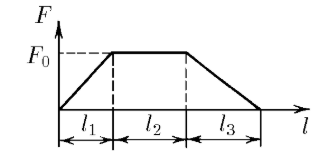
2.3.5. The force acting on a projectile of mass $m$ in a gun barrel increases uniformly from zero to $F_0$ over a barrel length $l_1$, remains constant over a barrel length $l_2$, and finally decreases uniformly to zero over a barrel length $l_3$. What is the velocity of the projectile upon exiting the barrel?
For problem $2.3.5$
Solution
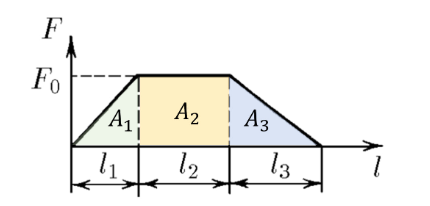
From the law of conservation of mechanical energy, the kinetic energy of the projectile equals the total work done by the force: $$E_{\text{mec}} = A_1 + A_2 + A_3 = \frac{mv^2}{2} \quad \text{(a)}$$
The work parts $A_1, A_2$ and $A_3$ can be found as the respective areas under the force-displacement graph: $$A_1 = \frac{1}{2}F_0 \cdot l_1; \quad A_2 = F_0 \cdot l_2; \quad A_3 = \frac{1}{2}F_0 \cdot l_3$$
Substitute these into equation (a): $$E_{\text{mec}} = \frac{mv^2}{2} = F_0 \cdot \frac{l_1 + 2l_2 + l_3}{2}$$
Express the velocity $v$ of the projectile upon exiting the barrel: $$v = \sqrt{\frac{F_0(l_1 + 2l_2 + l_3)}{m}}$$